Climate change represents a formidable challenge to contemporary society, manifesting its impacts in multifarious ways extending from global food security to intricate economic dynamics and everyday human livelihoods. Characterized as a “threat multiplier,” climate change exacerbates existing geopolitical tensions and social inequities, making collective global action to address its consequences profoundly complex. Despite these daunting obstacles, emerging scientific insights and ecological innovations provide pathways to adapt and mitigate these effects, particularly through transformative approaches in agriculture.
Central to this discourse is the pioneering work presented in “Living Roots: The Promise of Perennial Foods” (Island Press, 2026), edited by environmental scholar Liz Carlisle of the University of California, Santa Barbara, and Aubrey Streit Krug, director of the Perennial Cultures Lab at The Land Institute. Their scholarship posits that integrating perennial crops into modern food systems can significantly enhance agricultural resilience in the face of climate variability, while also reducing carbon footprints and preserving ecosystem integrity.
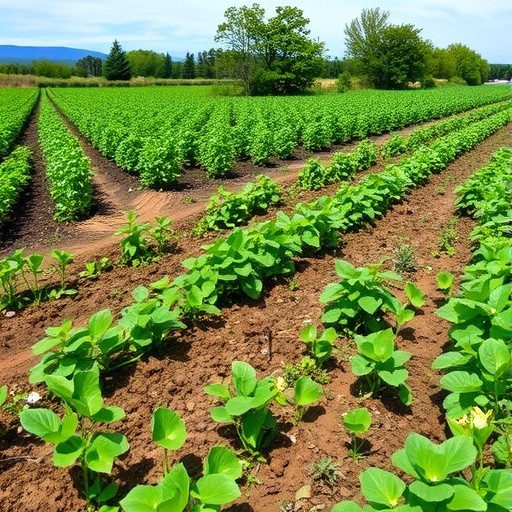
Perennial plants, distinguished from annual crops by their ability to persist and yield harvests over multiple years without the need for annual replanting, offer substantial ecological advantages. Trees and shrubs that produce nuts and fruits epitomize this category, harnessing robust root systems that extend deeply into the soil. These extensive root architectures enable perennial species to access water and nutrients more efficiently, enhancing drought resistance and soil stabilization while reducing erosion. This contrasts sharply with annual crops such as wheat, corn, and soy, which require intensive soil disturbance through tillage and frequent replanting.
From a biogeochemical perspective, perennials contribute to mitigating climate change by sequestering carbon belowground. Their deep-rooted biomass stores substantial quantities of organic carbon within soil horizons—a natural process that curtails atmospheric CO₂ levels. This carbon sequestration, coupled with reduced energy inputs due to diminished soil tilling and fertilizer application, positions perennial agriculture as a vital strategy for lowering the agricultural sector’s substantial greenhouse gas emissions, which presently account for approximately 25-33% of global carbon output.
The recent anthology curated by Carlisle and Streit Krug offers a multifaceted exploration of perennial food systems through more than 30 essays and poems. This compendium weaves narratives from diverse geographical and cultural contexts, encompassing seasoned farmers who cultivate perennial crops, ecologists researching ecosystem dynamics, and Indigenous knowledge holders who have stewarded perennial species for millennia. Collectively, these voices illustrate the capacity of perennial agriculture not only to produce diverse, nutrient-rich foods but also to revitalize cultural connections to land and bolster community resilience.
The geographic scope of the contributions—from the expansive Great Plains and Argentine pampas to Australian grasslands and East African highlands—underscores the global relevance of perennial crops. The editors emphasize inclusivity within this emergent movement, inviting participation from smallholder farmers seeking less resource-intensive cultivation methods to consumers aiming for sustainable dietary choices. This holistic approach aligns ecological benefits with social equity, underscoring the need to confront the unequal distribution of climate change impacts and access to agricultural resources.
Perennial systems also offer functional benefits that extend beyond food production. Their year-round root presence enhances soil structure and hydrological regulation, thereby attenuating flooding risks and improving water quality by limiting nutrient runoff—a persistent problem in conventional agriculture often leading to destructive eutrophication in aquatic ecosystems, such as that observed in the Mississippi River Delta. These ecological services highlight the multifunctional nature of perennial landscapes, integrating food security with environmental stewardship.
The transition toward perennial dominance in agriculture does not imply the elimination of annual crops, which remain integral to global diets. However, current farming paradigms dominated by annual monocultures are recognized as fragile under climatic stressors. The soil degradation and high input requirements inherent in annual systems contrast with the resilience and sustainability potential of perennials. By increasing the share of perennial species in agricultural ecosystems, the food system can become more adaptive, reducing vulnerability to drought, heat stress, and soil erosion.
The practical steps toward adopting perennial agriculture are accessible and scalable. Consumers can support this transition by prioritizing locally sourced tree nuts and fruits cultivated through sustainable and regenerative methodologies. Also significant is the encouragement of meat production systems integrated with perennial pasture landscapes, which can simultaneously support animal welfare, reduce inputs, and contribute to carbon sequestration. These integrative food system approaches help bridge the gap between production practices and environmental outcomes.
Looking forward, research and development efforts must concentrate on diversifying the portfolio of perennial crops adapted to a wide array of climatic and edaphic conditions. This diversification is paramount for ensuring food security under future environmental uncertainties while maintaining or enhancing ecosystem services. The adaptation and domestication of wild perennial species hold promise, necessitating interdisciplinary collaboration across agronomy, ecology, genetics, and Indigenous knowledge systems.
Fundamentally, the movement toward perennial foods signifies a paradigm shift—reimagining agriculture not merely as food production but as a socio-ecological system capable of regenerating itself and sustaining human and environmental health over the long term. The insights compiled in “Living Roots” illuminate pathways for this transformation, underscoring the imperative of collective action informed by scientific innovation and cultural reverence for the land.
Embracing perennial food systems requires a reevaluation of agricultural policies, market incentives, and public awareness to foster widespread adoption. Educational initiatives that highlight the environmental and nutritional benefits of perennial foods can catalyze consumer demand, while investments in perennial crop breeding programs and extension services can support farmers in transitioning to these resilient systems. Such systemic changes offer hope in confronting the intertwined crises of climate change, biodiversity loss, and food insecurity.
As the global community grapples with the urgency of climate adaptation and mitigation, perennial agriculture emerges not only as a viable strategy but as an ethical imperative rooted in stewardship and sustainability. Its promise lies in harmonizing human needs with ecological processes, thereby forging a resilient and equitable food future responsive to the challenges of our changing planet.
Subject of Research: The role of perennial crops in sustainable agriculture and climate change adaptation.
Article Title: Living Roots: Exploring the Resilience of Perennial Foods in a Changing Climate
News Publication Date: 2026 (anticipated)
Web References:
– University of California Santa Barbara, Environmental Studies Program: https://news.ucsb.edu/people/liz-carlisle
– The Land Institute: https://landinstitute.org/
– Island Press, “Living Roots”: https://islandpress.org/books/living-roots
Image Credits: Island Press
Keywords: perennial foods, sustainable agriculture, climate change adaptation, carbon sequestration, soil health, resilient farming, regenerative agriculture, food security, perennial crops, environmental sustainability
Tags: carbon footprint reduction in agricultureecological benefits of perennial plantsinnovative agricultural practices for climate adaptationinterdisciplinary approaches to climate-resilient agricultureperennial agriculture and food securityperennial crops and global food system resilienceperennial crops for climate change mitigationperennial food crops and social equityperennial plants and ecosystem preservationperennial root systems and soil healthsustainable farming with perennial foodstransforming food systems with perennial crops