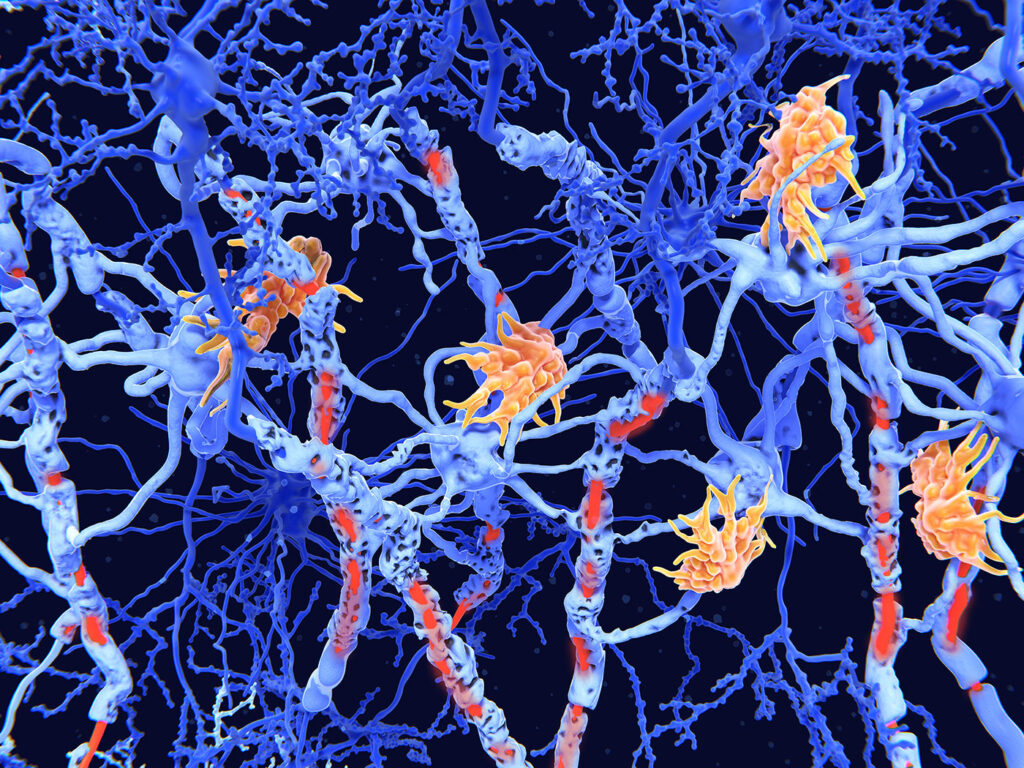

Axons—the long, cable‑like projections that relay electrical signals across the nervous system—depend on tightly wrapped layers of myelin to keep those messages fast and reliable. When this insulation is damaged, as in multiple sclerosis (MS) and other neurodegenerative diseases, signal transmission slows and neurons eventually degenerate. Although oligodendrocytes can repair myelin early on in the process, this capacity declines with age and repeated inflammatory attacks, leaving researchers searching for therapies that can restore myelin more effectively.
A team at University College London (UCL) has now developed a more physiologically realistic way to study how myelin forms—and how potential drugs might influence that process. Their new hydrogel‑based axon model, described in Nature Methods in a paper titled “Tunable hydrogel‑based micropillar arrays for myelination studies,” recreates both the geometry and softness of real axons. The platform is designed to address a longstanding problem in the field: many drug candidates that appear promising in rigid, plastic‑based lab models ultimately fail in human trials.
“To stop MS, we need therapies that repair myelin,” said senior author Emad Moeendarbary, PhD, professor of cell mechanics and mechanobiology at UCL and CEO of BioRecode. “Promising drug candidates in the past have failed when tested in human patients. One factor might be that laboratory models do not replicate the basic physical properties of the human brain.”
The UCL team engineered vertical micropillars—each tens of times thinner than a human hair—using a microfabrication process called photolithography that allowed them to precisely tune diameter, spacing, and stiffness. Unlike earlier artificial axons made from hard polymers, these pillars are composed of polyacrylamide hydrogel, a material whose elasticity can be adjusted to match the ~5 kPa softness of native axons. As the authors noted in the paper, the system “mimics the three‑dimensional architecture and softness of axons,” enabling oligodendrocytes to form “multilayered compact myelin” around the pillars.
The researchers seeded the hydrogel pillars with human and rodent oligodendrocytes and tested several candidate remyelination drugs. When the pillars were tuned to realistic softness, drug performance dropped—suggesting that overly rigid models may have produced misleading hits in the past. “Our work suggests that commonly used rigid models, hundreds of times stiffer than real axons, can generate misleading drug hits,” Moeendarbary said. “We believe that our more life-like model can be used as a more robust early test of drug candidates and as a platform to discover new drugs.”
The study also marks the first demonstration of compact, multilayered myelin grown from human oligodendrocytes in a fully hydrogel‑based system. The platform’s design allows high‑content imaging, transcriptomic profiling, and systematic variation of mechanical cues—capabilities that could help researchers dissect how myelin forms and why it fails in disease.
Building such a soft, microscale structure was not trivial. “Hydrogel is a close mimic of living cells… but to fabricate a soft hydrogel at such a small scale is not an easy task,” Moeendarbary noted, crediting the five years of work led by PhD student Soufian Lasli and Claire Vinel, PhD.
By more faithfully recreating the physical environment of the brain, the UCL team hopes their model will provide a more reliable proving ground for remyelination therapies before they reach clinical trials.