With the question of immunotherapeutics’ efficacy answered in the resounding affirmative, the challenge has shifted to the practical considerations of how to cost-effectively manufacture these highly precise therapeutics. That challenge is exacerbated by small runs and individual therapies as patients become more finely stratified vis-à-vis specific genetic mutations.
“The core problem is how to industrialize production of bespoke and one-time therapeutics,” Samuel Deutsch, PhD, CSO of Nutcracker Therapeutics, tells GEN. “This is very different from what the pharmaceutical industry has done historically.” So, although individual therapeutics can be made, “Scaling up production is still very painful.”
For example, last summer, baby KJ became the first person to be treated with a CRISPR-based gene therapy designed specifically for him. Developing that RNA therapy took a collaboration among two companies and two institutes, in addition to the child’s physicians.1

CSO, Nutcracker Therapeutics
“That took a huge effort, and Danaher and Acuitas spent millions of dollars,” Deutsch says. Nutcracker Therapeutics’ goal is “to make it so that any researcher at any clinical institution can do this themselves.”
For such therapies to become accessible, they must also be affordable. For that to happen, manufacturers must pivot from the large-batch, scale-up approach that met global pandemic needs to small-batch, scale-out strategies designed for small groups of patients, and even individual treatments like the one developed for baby KJ.
To this end, Nutcracker Therapeutics is developing automated, self-contained, single-use, small bioreactor-on-a-chip systems for just such needs.
It recently used its system to pilot the manufacturing of personalized cancer therapeutics from about a dozen archived tumors. Patients’ tumor biopsies were sequenced, which identified the mutations a vaccine should target. “That’s our starting point,” Deutsch says.
That particular project put up to 30 tumor-specific mutations into a single strand of RNA. “It’s a very unnatural-looking protein,” Deutsch says. “The proteins don’t always fold correctly, so we need to determine the best order to make them look as natural as possible,” and also to separate the mutations effectively. “The spacers are somewhat repetitive. During manufacturing, that repetition can cause problems. Consequently, the manufacturing success rate on the first attempt was quite low,” he recalls.
Nutcracker saw that early failure as a learning opportunity, though. “We analyzed those failed samples using nanopore sequencing, which sequences individual DNA molecules through a pore. We fed that nanopore sequencing information to our machine learning models, which converted them into design rules for our Codoncracker™ design software.”
“We’re completing a batch for 10 patients now and had a 100% success rate the first time. Every single design worked,” Deutsch says. “That highlights the importance of the design piece for a robust operation.”
Modeled on Semiconductors
In 2018, when Nutcracker Therapeutics was formed, “Personalized therapies in the form of autologous CAR T cells were facing severe manufacturing challenges,” Deutsch recalls. Nutcracker’s goal was to design very scalable technology to make precise therapeutics accessible and affordable for people throughout the world.

“We had two types of founders–those from the semiconductor industry and those with a biotech background,” Deutsch says. That convergence of thoughts and ideas enabled Nutcracker to apply the strategies used to automate semiconductor manufacturing to the biopharmaceutical environment.
In the semiconductor industry, he explains, “There are giant factories with hundreds and hundreds of individual machines producing chips. Most of them have green lights, meaning they’re all running and working correctly. There’s very low (human) intensity because most of the work is being done by the instrumentation. We wanted to translate that concept to drug manufacturing.
“We thought RNA was a very good candidate for doing this because, unlike proteins and small molecules, RNA manufacturing can be highly standardized,” Deutsch says.
RNA in a Box
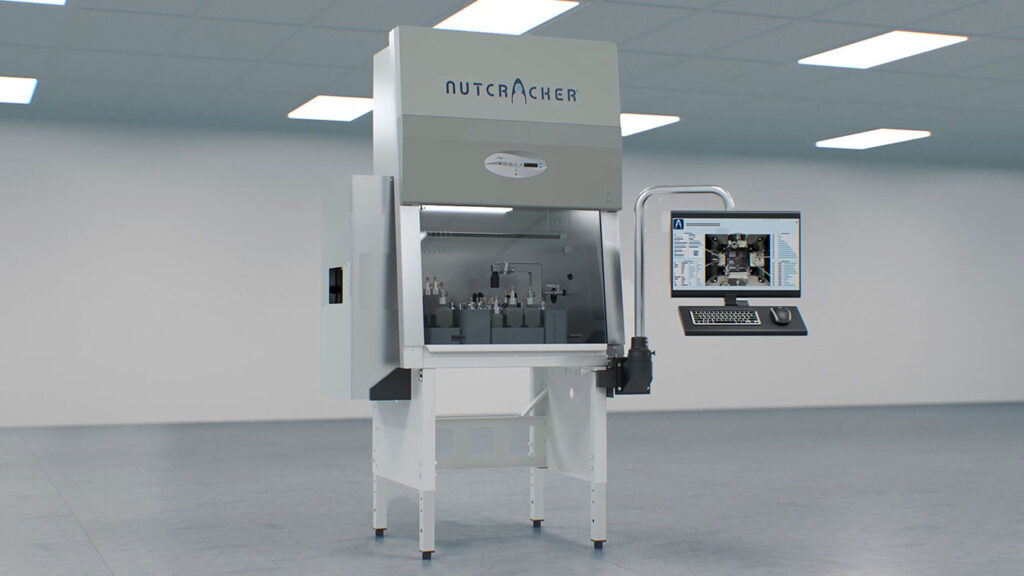
What resulted is start-to-finish, “in-a-box” manufacturing dubbed the Nutcracker® Manufacturing Unit (NMU)-Symphony™ system. “There are three main components: hardware, consumables, and software,” Deutsch says.
The hardware is the interface where one connects the raw materials that go into the process.
“The main consumable—the second component—is a biochip, where the reactions occur,” he says. The biochip encompasses synthesis, purification, and other process reactions, as well as monitoring, to help manage the quality of the materials throughout the run.
The third component is Nutcracker Therapeutics’ cloud-based ProcessVision® software. It helps technicians specify the type of run, which downloads the protocol into the system, and then specify the sequence for a specific patient or group of patients.
“That system guides the technician,” Deutsch continues, through the loading of reagents and consumables, and then calibrates the measurements. It checks approximately 100 connections before beginning the run. At that point, he says, “The technician can pretty much walk away.”
The system is designed to maximize efficiency and minimize the risk of contamination. Therefore, each box is self-contained and isolated from the others, and consumables are single-use. The Nutcracker team also optimized liquid handling within the units. For example, the paths from the reagent vials to the reactors are very short to minimize dead space for reagents that may be needed in microquantities.
The NMU-Symphony platform scales out rather than up. Therefore, “You only have the number of boxes (running) that you need at any time point. When you need additional capacity, you add additional machines.”
Early Challenges
Before the COVID pandemic, “There were a lot of things about RNA medicines that were unknown,” Deutsch recalls.
Making RNA was straightforward using standard molecular biology equipment, but scientists didn’t yet understand the fine points of developing RNA drugs that exhibited consistent levels of activity. Strategies to package and deliver RNA to the right tissues and cells, where it could be converted to protein, were still being identified.
“As an industry, we were all learning,” Deutsch says. It was only once he saw near identical results from 20 production runs–”which you don’t see in typical manufacturing,” he points out–that he knew the technology could succeed as a scale-out manufacturing solution.
Today, he says, “We are all so excited about making these very precise, n-of-1 therapies that target the disease itself. The reality is that the demand for these products is still developing.” Meanwhile, it’s tempting to let that excitement minimize the potential risks of future bottlenecks during scale-out. “So, thinking about logistics, automated batch review, and other bottlenecks required to truly industrialize personalized therapeutics remains important.”
Right now, the technologies are still being validated industry-wide, and demand is still limited, Deutsch admits. “So, yeah, we’re a little bit early.”
References
- Lin F. ASGCT 2025: World’s First Patient Treated with Personalized CRISPR Therapy. GEN – Genetic Engineering and Biotechnology News. Published May 15, 2025.