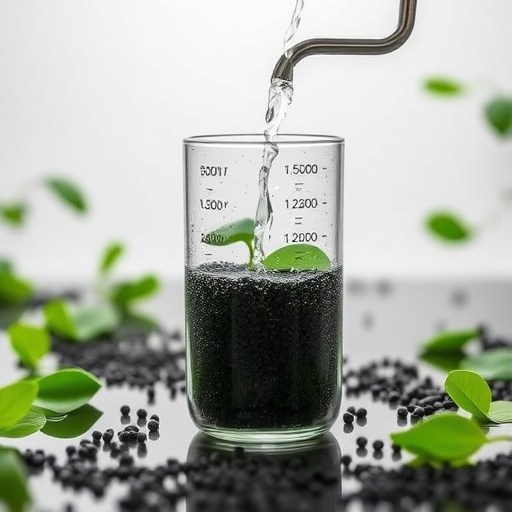
In an era where antibiotic contamination in water sources has escalated into a critical environmental and public health concern, a groundbreaking study unveils a novel technological advance that promises to revolutionize wastewater treatment paradigms. Scientists have engineered an innovative carbon-based composite that dramatically enhances the removal efficiency of persistent antibiotics using a synergistic biochar-enhanced ultrasound cavitation approach. This pioneering work introduces a paradigm shift by coupling a carefully designed composite material with low-frequency ultrasonic energy, achieving remarkable antibiotic degradation while significantly reducing energy consumption.
The prevalence of antibiotics like enrofloxacin and amoxicillin in natural water bodies stems from their extensive utilization in human healthcare and veterinary applications. Because these compounds resist conventional degradation pathways, they accumulate in wastewater streams, posing ecological risks and fostering antibiotic resistance. Traditional treatment methods, including standalone ultrasound applications, often suffer from inefficiencies and high operational energy demands, limiting their practical viability. Recognizing these challenges, researchers focused on optimizing the catalytic environment that can intensify ultrasound-assisted degradation processes under mild and energy-efficient conditions.
At the heart of this technological leap is a composite synergistically integrating biochar, carbon nanotubes, and iron carbide (Fe3C). This complex architecture marries the unique properties of each constituent—biochar’s porous structure and hydrophobicity, the exceptional electrical conductivity and mechanical strength of carbon nanotubes, and the catalytic potential of iron carbide—to promote robust cavitation phenomena under low-frequency ultrasound excitation. The biochar matrix not only provides mechanical stability but also serves as an effective platform facilitating cavitation bubble nucleation and stability, a critical factor in enhancing ultrasound-mediated pollutant breakdown.
Ultrasound-induced cavitation involves the generation, oscillation, and violent collapse of microbubbles in aqueous media, producing localized hot spots characterized by extreme temperatures and pressures. These microenvironments catalyze the formation of reactive oxygen species (ROS) such as hydroxyl radicals and superoxide anions, renowned for their potent oxidizing capability in decomposing organic contaminants. However, conventional ultrasound treatment at low frequencies often suffers from suboptimal bubble dynamics and limited ROS generation. The introduction of the biochar-based composite material addresses these limitations by enhancing bubble formation and persistence at the catalytic surface, thus magnifying cavitation intensity and reaction efficacy.
The carbon nanotubes embedded within the composite play a multifaceted role. Their high surface area and excellent electron transfer properties facilitate the generation and stabilization of reactive species. Simultaneously, the iron carbide nanoparticles act as catalytic active sites, promoting Fenton-like reactions that synergistically increase ROS production. The interplay of these nanoscale phenomena results in a pronounced acceleration of antibiotic degradation pathways, surpassing the removal rates achievable by ultrasound or adsorption alone.
Quantitative assessments demonstrated that this novel system enhanced antibiotic removal rates up to 15-fold relative to conventional biochar or ultrasound treatments. Remarkably, the composite achieved over 90% degradation of enrofloxacin and amoxicillin within a few hours under low-frequency ultrasound, all while operating at a fraction of the energy expenditure required by traditional methods. This substantial energy efficiency stems from the composite’s ability to optimize cavitation dynamics, reducing the need for high ultrasonic power input.
The antibiotic removal mechanism was elucidated as a dual-stage process. Initially, antibiotics are adsorbed onto the composite surface through hydrophobic interactions and molecular binding, leveraging the biochar’s porous and chemically active surface. Subsequently, reactive oxygen species generated during bubble collapse chemically degrade the adsorbed molecules into less harmful substances. This combined adsorption-degradation framework ensures a more comprehensive elimination of antibiotic residues, minimizing the potential for pollutant rebound or incomplete treatment.
Moreover, the researchers observed a sustained synergistic interaction between the composite and ultrasound over prolonged operational cycles. The material improves cavitation bubble nucleation and enhances surface reactivity, while continuous ultrasonic agitation prevents the fouling and passivation of active sites, maintaining catalytic efficiency. This dynamic interaction is crucial for the long-term viability of the technology in real-world wastewater treatment applications, where treatment units are expected to operate under fluctuating environmental conditions.
Robustness tests across variable pH regimes and multiple reuse cycles confirmed the composite’s operational stability and regenerative capacity. When subjected to complex real water matrices containing various ions and organic matter, the system retained high antibiotic removal efficiencies with only marginal performance declines. These attributes underscore the composite’s potential for scalable deployment in diverse environmental settings, including municipal wastewater treatment plants, agricultural runoff remediation, and industrial effluent management.
Importantly, this approach aligns with sustainable environmental engineering principles. By utilizing low-frequency ultrasound and a reusable carbon-based catalyst, the system dramatically reduces operational costs and the carbon footprint associated with conventional high-energy treatment processes. The biochar’s origin from biomass feedstocks also adds an element of circular economy, reinforcing the composite’s eco-friendly credentials.
The implications extend beyond antibiotic remediation. The fundamental insights gained into controlling cavitation processes via engineered carbon nanomaterials open avenues for tackling a broad spectrum of persistent organic pollutants. This platform technology may be adapted to address contaminants such as pesticides, dyes, and pharmaceuticals, potentially transforming wastewater treatment landscapes globally.
This innovative research exemplifies the convergence of nanotechnology, materials science, and environmental engineering to address one of the pressing challenges of our times. By harnessing the synergy of biochar-enhanced cavitation and low-frequency ultrasound, the study provides a scalable, energy-efficient, and sustainable solution for mitigating antibiotic pollution and safeguarding water quality for future generations. The work paves the way for further exploration into tailored nanocomposites engineered for environmental remediation, marking a significant advancement in the quest for cleaner and safer water resources.
Subject of Research: Experimental study on enhanced antibiotic removal from water using biochar-carbon nanotube-Fe3C composite under low-frequency ultrasound.
Article Title: Sustainable removals of antibiotics via biochar-enhanced ultrasound cavitation effect: synergy of carbon nanotube bonded biochar@Fe3C composite and low frequency energy efficiency.
News Publication Date: 9-Feb-2026.
Web References:
– Journal: Biochar (https://link.springer.com/journal/42773)
– Article DOI: http://dx.doi.org/10.1007/s42773-025-00551-2
References:
Wang, A., Zhao, N., He, L. et al. Sustainable removals of antibiotics via biochar-enhanced ultrasound cavitation effect: synergy of carbon nanotube bonded biochar@Fe3C composite and low frequency energy efficiency. Biochar 8, 46 (2026).
Image Credits: Ao Wang, Nan Zhao, Lei He, Ye Xiao, Chuanfang Zhao, Siyuan Guo, Xiang Liu, Weihua Zhang, Kunyuan Liu & Rongliang Qiu.
Keywords
Antibiotics, biochar, carbon nanotubes, iron carbide, ultrasound cavitation, water treatment, antibiotic resistance, environmental remediation, reactive oxygen species, low-frequency ultrasound, nanocomposites, sustainable technology.
Tags: antibiotic degradation technologyantibiotic removal from wastewaterbiochar carbon nanotube compositesbiochar ultrasound water treatmentcarbon-based composite materialsenergy-efficient pollutant degradationenrofloxacin and amoxicillin removalenvironmental antibiotic contaminationiron carbide catalytic applicationslow-energy ultrasound cavitationultrasound-assisted catalytic degradationwastewater treatment innovation