
Sponsored content brought to you by

Introduction
Prions are infectious proteins that cause neurodegenerative diseases in animals including bovine spongiform encephalopathy (cattle), Creutzfeldt-Jakob disease (humans), and chronic wasting disease (deer, elk and other cervids).1 Prion diseases, also known as transmissible spongiform encephalopathies, result from misfolded proteins that accumulate primarily in the cells of the nervous system including the brains of infected animals. More widely, protein misfolding is linked to diverse neurological and non-neurological diseases and further research is needed in many areas due to the central importance of protein folding and aggregation in biology.
Prions propagate after regularly folded prion proteins (PrPC) are converted into misfolded, aggregation-prone PrPSc proteins that build up and yield amyloids. These misfolded proteins and their aggregates damage nerve and other cells and, over time, lead to a decline in brain function and ultimately death. With no cure available for prion diseases, researchers are striving to improve assay sensitivity and exploit the benefits of real-time monitoring to support the development of better diagnostic and treatment approaches.
RT-QuIC assays and microplate readers for prion analysis
Prions typically replicate by a series of sequential, amplifying events. Misfolded PrPSc acts as a point of recruitment of normal PrPC cellular prion proteins. This interaction converts the recruited normal protein into the abnormal conformation setting in place a chain reaction where the protein-protein aggregates grow to produce a larger seed of misfolded proteins. As the aggregates grow, they can fragment to produce new nucleation sites. The seeds are eventually transformed into fibers of amyloid-rich assemblies that comprise significant amounts of beta-sheet conformations of the misfolded proteins.
[BMG LABTECH]
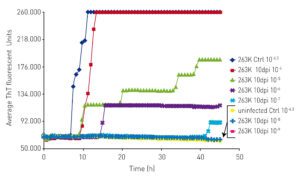
The most widely used assay for detecting misfolded prions in biological samples is the RT-QuIC (Real-time quaking-induced conversion) assay. RT-QuIC assays are highly sensitive, seeding amplification assays that detect disease-associated prion activity. Formation of amyloid proteins is measured in real time using the fluorescent dye thioflavin T (ThT) whose emission increases significantly upon binding to beta-sheet-rich amyloid structures. Other dyes such as Congo Red are available that bind to amyloid but show reduced specificity for fibril proteins. Cyclic shaking accelerates fragmentation of the growing fibrils and produces a rapid amplification of the original prion seed. In practice, RT-QuIC assays generate characteristic amplification curves (figure 1) that comprise a baseline phase, an exponential increase in fluorescence, and a plateau phase. The lag time, maximum fluorescence, and reaction kinetics can provide quantitative or semi-quantitative measurements of prion seeding activity.
In the experiments shown in figure 1, scrapie brain homogenates were harvested 10 days after inoculation, incubated over time with shaking for the specified serial dilutions of Syrian hamster 263K cells, and ThT fluorescence was measured. The assays were quantified by measuring the loss of seeding activity at the end-point dilution.
Microplate readers and detection technologies for the investigation of amyloid
Microplate readers offer a robust platform for performing prion assays and measuring protein misfolding and aggregation. The ability to combine sensitive, high-performance kinetic fluorescence measurements with periodic cycles of rigorous shaking and consistent temperature control makes them the most widely adopted and practicable system for effective RT-QuIC assays.
Originally, the RT-QuIC assay was developed on the FLUOstar® Omega microplate reader from BMG LABTECH which quickly became an international standard for prion analysis. BMG LABTECH readers, which continue to lead the way for prion detection and activity measurements, offer a robust platform for shaking for extended periods of time (over multiple days), while periodically reading the fluorescent signal as ThT is incorporated into amyloid aggregates.
Applications for protein misfolding
As mentioned earlier, protein misfolding has impact beyond prion disease and is a hallmark of impaired function in a wide range of conditions including Alzheimer’s disease, Parkinson’s disease, Huntington’s disease and amyotrophic lateral sclerosis. The way certain proteins misfold and aggregate is closely tied to how proteins become toxic and cause neurodegenerative diseases.
BMG LABTECH´s application note “Monitoring amyloid-beta aggregation in real-time using a FLUOstar Omega microplate reader2” provides one example where the accumulation of misfolded amyloid protein aggregates linked to Alzheimer’s disease is measured using ThT. Figure 2 shows some signal curves for samples and controls where ThT incorporation into newly formed amyloid-beta fibrils is measured.
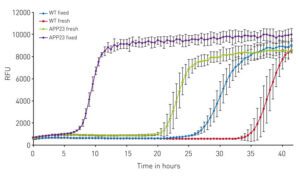
In figure 2, error bars represent the deviation of replicate wells within one plate from the mean. All signal curves show a clear increase in fluorescence with time. This increase illustrates the incorporation of ThT into the newly formed amyloid-beta fibrils. After some time, a plateau is reached that is considered as the endpoint of amyloid formation and ThT incorporation process.
Protein misfolding and aggregation are likely to play a critical role in many processes related to aging. Misfolded proteins are also thought to influence different aspects of metabolic dysfunction and amyloid accumulation although the mechanism for most of these effects remains poorly understood. ThT assays thus offer applications across multiple disease areas and research domains.
Future developments
RT-QuIC assays have significantly accelerated research and analysis into prions compared with earlier more costly and lengthy bioassays where infected animals were studied over months. RT-QuIC assays also offer potential for disease surveillance in populations of prion-infected animals in the wild that could impact public health. Researchers are also looking at ways to use RT-QuIC-based screening assays to ensure the safety of human food chains. In this context, microplate readers and RT-QuIC assays have been used in experimental settings to characterize prion-seeding activity in samples of tissue from wild and farmed deer that may have been exposed to chronic wasting disease.3
Beyond surveillance, new drugs are actively being sought for different targets related to protein folding and amyloid accumulation. In clinical trials, translatable biomarkers are needed that track the progression and severity of the neurodegenerative diseases impacted by protein misfolding and aggregation. Progress in artificial intelligence and modeling techniques will enhance studies of protein folding and misfolding which should bring further advances to the drug discovery space.
Demand for ThT assays is poised to increase due to the lack of interventions for neurological and non-neurological diseases caused by protein misfolding and aggregation events and the potential for other high-impact applications.
ThT-related assays are therefore moving away from being a means for a rapid diagnosis towards offering a quantitative tool for disease surveillance, pathogenesis, and therapeutic development across a wide range of disease and fundamental research areas in the life sciences.
BMG LABTECH offers a portfolio of single- to multimode microplate readers ideally suited for studying protein misfolding and aggregation. While the FLUOstar Omega remains the gold standard for RT-QuIC and seeding assays, the PHERAstar® FSX was specifically conceived for screening campaigns and is the go-to reader for high-performance high-throughput screening. Both the VANTAstar® and CLARIOstar® Plus allow for wavelength flexibility and include Enhanced Dynamic Range technology for superior performance and ease of use. Collectively, these multimode readers combine high performance with miniaturized assays and short measurement times, delivering considerable savings on materials and other resources.
References
- Dong TT, Satoh K. The Latest Research on RT-QuIC Assays-A Literature Review. Pathogens. 2021 Mar 5;10(3):305. doi: 10.3390/pathogens10030305.
- Baumann F. Following Abeta Fibrillization/Aggregation in Real-Time | BMG Labtech. n.d. [Last accessed: 9/14/2026].
- Li M et al. RT-QuIC detection of CWD prion seeding activity in white-tailed deer muscle tissues. Sci. Rep. 2021 Aug 18;11(1):16759. doi: 10.1038/s41598-021-96127-8. PMID: 34408204; PMCID: PMC8373970.l

If you are interested in further details about microplate-based evaluation of prions and protein misfolding, please contact us at [email protected] or scan the QR code on the right-hand side