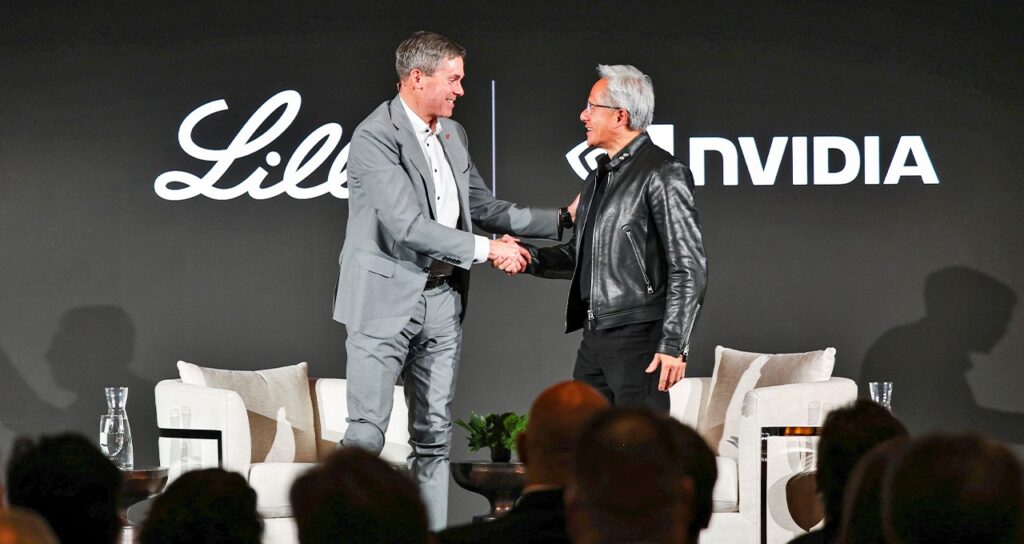
SAN FRANCISCO—They met for the first time in 2018. David A. Ricks, a year into his tenure as Eli Lilly’s Chair and CEO, hosted Jensen Huang at Lilly’s Indianapolis headquarters campus, where the Nvidia founder and CEO gave a talk to the pharma giant’s management team about a new technology called artificial intelligence (AI) and its potential in reshaping drug discovery.
“100% being honest, I could see it in their eyes,” Huang recalled of the Lilly executives’ reaction to his talk:
“Nonsense!”
“Honestly,” Ricks interjected, “it blew my mind.”
The two CEOs recalled their first meeting on Monday, when they entertained a packed ballroom at the Fairmont San Francisco hotel, a hilly half-mile north of where the J.P. Morgan 44th Annual Healthcare Conference is taking place. The occasion was a Huang-hosted “fireside chat” in which he and Ricks discussed the companies’ latest partnership, and extolled the promise and potential of AI to reshape not just drug discovery but the development of new treatments and their uptake by patients.
The Silicon Valley microprocessing giant and pharma powerhouse announced a five-year, $1 billion partnership to create a “Co-Innovation AI Lab” designed to address key challenges in AI drug discovery.
“Moore’s law runs at about 10 times every five years, 100 times every 10 years. In the last 10 years, we’ve accelerated AI a million times,” Huang told the fireside chat audience, referring to the idea that computers’ speed and capability is expected to double every two years.
“A million times, compounded over 20 years, gives us an opportunity to maybe address some of the most incredible, most impactful challenges of humanity,” Huang observed. “We’ve been thinking about accelerated computing and this co-design idea for a very long time.”
Thinking big
Just as attracting the world’s greatest physicists requires a large-scale facility such as a supercollider, Huang reasoned, Nvidia concluded it needed to think big by coming together with a biopharma giant like Lilly on large-scale AI.
“Which led our conversation to that AI is starting to make enough progress, but we might be able to apply it to tackle some of the most incredible challenges,” Huang continued. “And the two of us thought it’d be amazing if we have the largest computer science company in the world, partnered with the world’s largest life science company. It’s as if we created this map where we are essentially one company, combining all of our destinations, all of the things we want to do together which led us to our announcement.”
Lilly will be more than able to pay into the AI partnership, flush with cash on the sales strength of its tirzepatide, marketed for diabetes as Mounjaro® and for obesity as Zepbound®. The drugs serve as agonists for both glucose-dependent insulinotropic polypeptiden (GIP) and glucagon-like peptide 1 (GLP-1). Together Mounjaro and Zepbound have racked up nearly $25 billion in sales in the first three quarters of 2025, rising faster than the sales of its arch rival GLP-1 drug developer Novo Nordisk.
Ricks attributes Lilly’s success during his tenure to speeding up the long-lumbering process of bringing drugs to market.
“Our competitor innovated into obesity,” Ricks said of Novo Nordisk. “We chased and executed quite well to become the market leader last year, so we not only now have an engine that’s faster; we have a tremendous success cycle with this one idea.
“The challenge for us now is, how do we find another success cycle before that one runs out, and hopefully a lot sooner than it runs out?”
Key player
On biopharma’s most visible stage, Nvidia also showed how much of a key player it has become in AI-based biopharma by announcing plans to integrate its AI technology into the lab instruments of Thermo Fisher Scientific, through a collaboration intended to develop intelligent and increasingly autonomous laboratories.
The Co-Innovation AI lab will be designed, the companies said, to bring together Lilly’s expertise in drug research, discovery, development, and manufacturing with Nvidia’s know-how in AI, accelerated computing and AI infrastructure, spearheaded by AI model builders and engineers focused on generating large-scale data and build powerful AI models based on using NVIDIA BioNeMo™ platform.
The up to $1 billion will fund additional talent, infrastructure and computing power for the new lab, which will be located in the San Francisco Bay Area.
“The scale of that lab is going to be sufficient to attract people who really want to do their lives working in research,” Huang said. “I’m super excited about that.”
Numerous partners
Nvidia is one of Lilly’s numerous partners in AI drug discovery. Most recently between January 8-9, four partners of Lilly announced drug- and AI data-focused collaborations with the pharma giant:
- Benchling—The cloud-based platform company said Thursday its customer base of more than 1,300 biopharmas will be able to opt into Lilly TuneLab and access in their own scientific workflows Lilly’s proprietary models trained on decades of the Lilly’s research data, representing over $1 billion in research investment.
- Chai Discovery—Lilly has committed up to $1.3 billion to partner with the AI antibody designer in deploying its frontier AI platform to design biologics for multiple targets. Chai agreed to develop a purpose-built AI model, exclusively for use by Lilly, that will be trained on large-scale proprietary Lilly data and tailored to Lilly’s discovery workflows. Chai completed a $130 million Series B financing last month.
- Revvity—The life-sci tools, tech, and services provider made Lilly TuneLab available through its Revvity Signals platform, in a collaboration building on Revvity’s recently-launched Signals XyntheticaTM offering, creating a scalable, federated framework designed to accelerate AI-enabled drug discovery.
- Schrödinger—The physics-based, AI-enhanced computational drug discoverer and software developer agreed to make available on its LiveDesign enterprise informatics platform Lilly TuneLab as a priority interface. That will allow biopharma companies to access TuneLab workflows.
In November, Lilly joined AI drug developer Insilico Medicine to announce a collaboration they said could generate “over $100 million” for Insilico, which last month became a public company by raising about $293 million through an initial public offering (IPO).
And in 2024, Lilly agreed to apply the generative AI of ChatGPT developer OpenAI to create antimicrobials that treat drug-resistant pathogens. The alliance was intended to support an earlier commitment by Lilly to fight drug-resistant pathogens through its Social Impact Venture Capital Portfolio, which in 2020 set aside $100 million to the AMR Action Fund, with the aim of developing two to four new antibiotics by 2030.
Nvidia in recent years has carried out AI drug discovery-focused collaborations with partners that include:
- AstraZeneca and GlaxoSmithKline (GSK)—Nvidia partnered with the British pharma giants to build the U.K.’s most powerful supercomputer, Cambridge-1, in 2020 through a partnership that also included the kingdom’s National Health Service (NHS).
- Novo Nordisk—Lilly’s arch-rival in obesity and diabetes drug development, especially glucagon-like peptide-1 (GLP-1) receptor agonists, agreed in June to house an Nvidia supercomputer at the Danish Centre for AI Innovation.