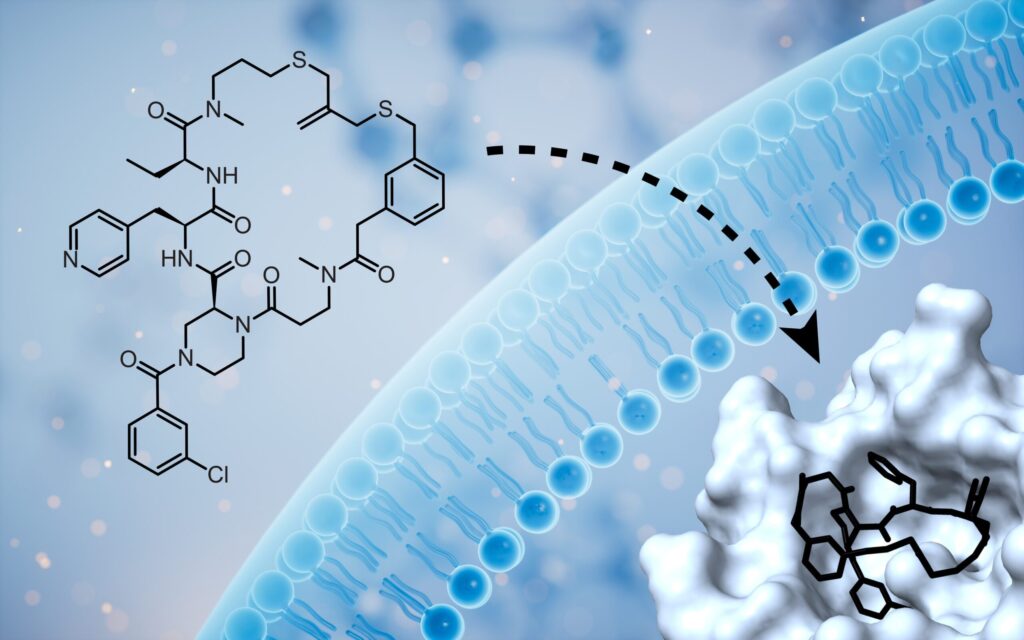
![Membrane-permeable cyclic peptide that inhibits the intracellular Keap1-Nrf2 protein-protein interaction. [Christian Heinis (EPFL)]](https://www.genengnews.com/wp-content/uploads/2026/05/Figure_Cyclic_Peptide_Membrane-2-scaled.jpg "Figure_Cyclic_Peptide_Membrane-2")
Macrocyclic peptides are a promising drug modality that combine the oral convenience of small molecules with the high specificity of large biologics. Yet, they struggle with cell membrane permeability, limiting their ability to target disease interactions within cells.
In a new study published in Nature Chemical Biology titled, “Generation of membrane-permeable cyclic peptides inhibiting protein–protein interaction”, researchers from École Polytechnique Fédérale de Lausanne (EPFL) have developed a new method to generate and screen large libraries of synthetic cyclic peptides to identify compounds that can enter cells for therapeutic effect.
“We focused on small, less than 1000-Dalton, non-polar cyclic peptides that can enter cells by rapidly crossing the hydrophobic inner region of cell membranes,” says Christian Heinis, PhD, associate professor at EPFL. “The challenge was then to develop cyclic peptides with suitable shapes so that they can bind to targets of interest.”
The authors focused on protein interactions linked to inflammation, oxidative stress, and neurodegeneration, and cancer. The study synthesized and screened a library of 15,360 fully random cyclic peptides, all designed to be small, compact, and relatively nonpolar to support membrane permeability. The screen identified several compounds capable of disrupting the disease-associated Keap1–Nrf2 interaction.
The team optimized a cyclic peptide candidate, termed peptide 30, which combined strong target binding with membrane permeability. Peptide 30 inhibited the Keap1–Nrf2 interaction inside living cells in a dose-dependent assay. Compared with the natural Nrf2 sequence, peptide 30 had no electrical charge, fewer hydrogen bond donors, and lower polar surface area to support membrane permeability.
The study demonstrated that membrane-permeable cyclic peptides can be developed without starting from known ligands, natural products, or binding motifs, broadening access to intracellular targets previously considered difficult to drug.
“Our lab is now further advancing the technology to synthesize and screen even larger libraries of small, membrane-permeable cyclic peptides,” says Heinis. “And we are applying the technology to some of the most challenging protein–protein interaction targets, including big cancer targets like KRAS, b-catenin and c-Myc.”
Heinis’s group has patented the method and founded the spin-off company Orbis Medicines, which recently raised more than €90 million in Series A funding to further develop and apply the technology for drug discovery.