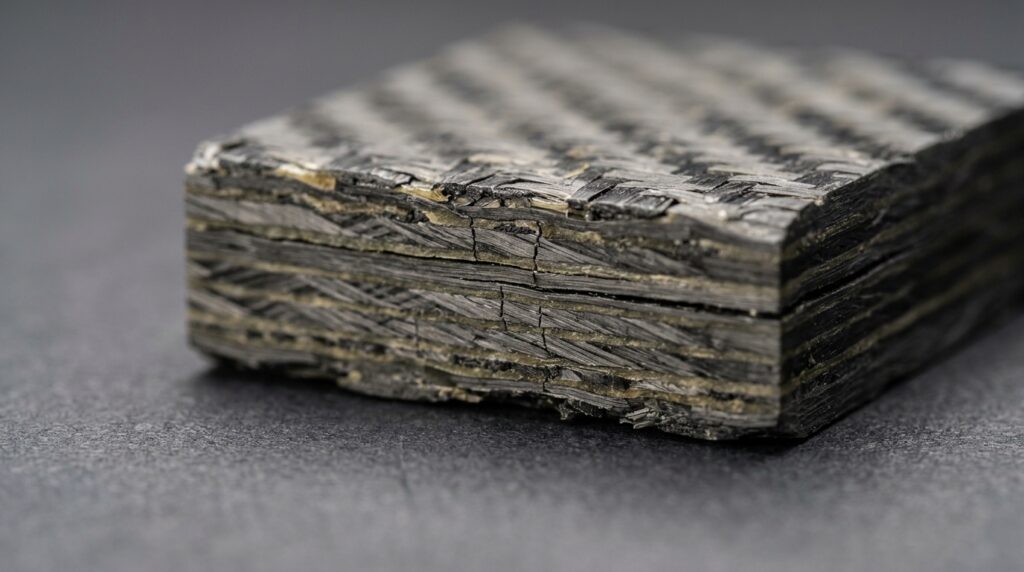
Microscopic damage in the constituent plies of multidirectional fiber-reinforced plastic laminates, as well as along their internal ply interfaces, develops well before the macroscale failure of the overall engineering structure. The initial mode of mechanical degradation typically emerges as intralaminar matrix cracks, also designated as tunneling or transverse cracks, which propagate along the reinforcing fibers with crack planes oriented perpendicular to the laminate middle plane. In conventional tensile specimens, these intralaminar cracks span the full thickness of the affected ply and extend across the entire width of the coupon, predominantly driven by Mode I energy release rate mechanisms. As external mechanical loading continues, the spatial frequency of damage intensifies, characterized by a rising crack density defined as the inverse of the average spacing between adjacent cracks. This progressive evolution subsequently induces secondary damage mechanisms, most notably local interface delaminations that initiate directly at the intralaminar crack tips and propagate along adjacent layer boundaries, accompanied by localized fiber breakage in neighboring plies. Together, intralaminar transverse cracks and their emanating interface delaminations form unified damage entities that perturb internal stress fields and substantially alter macroscopic thermo-elastic properties.
To capture the mechanical degradation caused by these combined damage modes without relying entirely on computationally prohibitive numerical models, researchers Mohamed Sahbi Loukil, Rodrigo T. S. Freire, and Janis Varna formulated an analytical framework known as the GLOB-LOCdel model. Originating from foundational elasticity solutions established within the governing structure of Classical Laminate Theory, the methodology mathematically correlates macroscopic laminate stiffness tensors, compliance matrices, and thermal expansion coefficient vectors directly to localized damage metrics. Rather than attempting to evaluate complicated and highly variable stress perturbations across partially debonded ply boundaries, the framework relies upon two kinematic parameters characterizing the crack faces: the normalized average crack opening displacement, denoted as COD, and the normalized average crack sliding displacement, denoted as CSD. When interfacial delaminations develop at the tips of transverse cracks, relative sliding along the debonded ply interface significantly amplifies both the opening and sliding displacements of the transverse crack faces. This geometric expansion relieves constraint and reduces average in-plane stress carrying capacity within the damaged layer, dictating the ultimate extent of property loss experienced by the laminate.
Within the rigorous mathematical structure of the GLOB-LOCdel formulation, the expressions for the damaged laminate stiffness matrix, compliance matrix, and thermal expansion coefficients are formulated as exact elasticity relationships for symmetric configurations containing arbitrary crack densities across multiple plies. The formulation incorporates individual ply stiffness matrices, coordinate transformation matrices corresponding to ply orientation angles, and a characteristic damage matrix for each damaged layer. This damage matrix incorporates the normalized average opening displacement in the transverse direction and the normalized sliding displacement in the longitudinal fiber direction. Importantly, the relative sliding displacements between the two faces of an interfacial delamination do not enter the in-plane stiffness equations directly; rather, their influence is transferred entirely through the resulting physical increase in the opening and sliding displacements of the linked transverse crack. In contrast, while the in-plane constants are fully governed by these amplified displacements, out-of-plane thermo-elastic constants depend explicitly on the relative sliding of delamination faces and remain outside the analytical scope of the current modeling framework.
Because the exact macroscopic expressions require reliable local displacement values, the research team conducted comprehensive three-dimensional finite element parametric analyses to evaluate the dependence of normalized average crack opening displacements on delamination length and crack density. Using the commercial finite element code ANSYS 19, the investigators executed more than 1,200 individual numerical simulations across representative repeating volume elements bounded by adjacent matrix cracks. The three-dimensional numerical mesh utilized higher-order SOLID186 structural solid elements, incorporating refined discretization near both the intralaminar crack tips and the delamination fronts where steep stress gradients occur. Surface-to-surface contact pairs, comprising CONTA174 and TARGE170 contact formulations, were implemented along the delaminated interface zones between the cracked ninety-degree ply and adjacent constraining plies to prevent unphysical material interpenetration under deformation. Across these models, intralaminar cracks were assumed to be uniformly spaced, and localized delaminations were modeled symmetrically on either side of the transverse crack plane with equal lengths.
The parametric numerical campaign analyzed balanced cross-ply configurations with central or surface ninety-degree layers constrained by orthotropic sublaminates across three distinct composite material systems, including glass fiber-reinforced epoxy and two carbon fiber-reinforced epoxy systems. In these evaluations, the normalized crack density was varied incrementally from 0.1 to 1.0, while the normalized delamination length was varied systematically from zero up to ninety percent of the half-distance between adjacent cracks, encompassing scenarios ranging from intact interfaces to nearly fully delaminated plies. The finite element findings demonstrated that secondary elastic properties, such as the out-of-plane shear modulus and minor in-plane Poisson ratio of the damaged ply, exerted a negligible influence of approximately one percent on the resulting crack opening displacement, producing an even smaller effect on predicted laminate stiffness. Variations in the shear modulus of the constraining sublaminate produced only a minor three percent shift in glass-epoxy laminates and less than half a percent in carbon-epoxy laminates. Consequently, the primary governing variables were isolated to the ply stiffness ratio, the ply thickness ratio between the cracked layer and its constraining sublaminates, crack density, and delamination length.
Guided by these numerical findings, the authors established closed-form algebraic fitting functions for crack opening displacements across distinct damage regimes, simplifying computational implementation while retaining physical accuracy. For internal cracked plies at low crack densities below or equal to 0.4, the formulation differentiates between short delaminations and long delaminations. In the short delamination regime where normalized delamination length is less than or equal to 0.5, crack opening displacement follows a quadratic polynomial characterized by coefficients dependent on the ply thickness ratio and the square root or direct ratio of transverse to constraining longitudinal moduli. When normalized delamination length exceeds 0.5, the opening response transitions to a linear dependency. Conversely, for high crack densities exceeding 0.4, interaction between adjacent cracks dominates, and the opening displacement is described by a simplified relationship inversely proportional to crack density. For surface cracked plies, separate piecewise equations were established for low crack densities below 0.15 and higher crack densities, successfully capturing the inherently greater compliance of unconstrained outer layers.
To evaluate complex multidirectional laminates where damaged off-axis plies are bounded by asymmetric lay-ups, the researchers introduced an equivalent sublaminate homogenization procedure. When an off-axis ply is evaluated, the laminate coordinate system is mathematically rotated so that the analyzed layer temporarily aligns with the transverse ninety-degree orientation. The surrounding plies situated above and below the damaged layer are then categorized into effective constraining sublaminates. Parametric observations revealed that remote plies situated beyond twice the thickness of an internal damaged layer, or beyond four times the thickness for a surface layer, exert negligible constraining influence on crack face opening. Therefore, only plies within this localized constraint zone are homogenized using Classical Laminate Theory to determine effective longitudinal and shear moduli. For internally damaged plies possessing unequal top and bottom constraining lay-ups, opening and sliding displacements are calculated independently under the assumption of identical boundary conditions on both faces, and the final displacement is determined by averaging the two symmetric calculations.
Validation of the combined GLOB-LOCdel framework against direct finite element simulations demonstrated robust agreement across various cross-ply and multidirectional lay-ups. In cross-ply laminates, normalized axial modulus and Poisson ratio degradation curves tracked numerical results closely across the full spectrum of delamination lengths. Reductions in axial stiffness were significantly more pronounced in glass-fiber systems than in carbon-fiber systems due to the greater relative stiffness contrast between the transverse and longitudinal plies. Furthermore, as normalized delamination lengths approached the physical spacing between adjacent cracks, both axial modulus and Poisson ratio converged toward the theoretical limits predicted by classical ply-discount models, which assume complete loss of transverse and shear load capacity within the damaged layer. For multidirectional glass-epoxy configurations, such as laminates containing cracked central ninety-degree plies or damaged forty-five-degree plies, the model accurately predicted the simultaneous degradation of axial modulus, shear modulus, and Poisson ratio without requiring recalibration.
When applied to multidirectional carbon-fiber laminates containing cracked off-axis plies, the GLOB-LOCdel approach demonstrated good agreement with published finite element data for transverse thermal expansion coefficients and non-zero shear thermal expansion components that develop when internal damage breaks laminate balance. However, the model showed a tendency to overestimate axial thermal expansion coefficient changes in severely damaged carbon-fiber systems possessing highly dissimilar upper and lower constraining plies. The investigators attributed this discrepancy to several interacting factors, including the simplifying assumptions of the sublaminate averaging procedure under severe geometric asymmetry, the extremely small absolute magnitude of the baseline thermal expansion coefficients, and minor overpredictions inherent to the algebraic fitting functions when normalized debond lengths approach full delamination. Additionally, differences in numerical modeling techniques in reference literature, such as omitting contact elements and permitting interface penetration, contributed to minor deviations.
The authors emphasized that practical structural modeling must balance analytical complexity against empirical reality. While intralaminar crack density can be measured reliably through optical microscopy or x-ray computed tomography, the physical measurement of internal delamination lengths remains fraught with uncertainty because delamination cracks remain tightly closed under unloaded conditions and edge inspections reflect localized three-dimensional stress states rather than interior behavior. Consequently, simplified predictive tools that capture fundamental mechanical trends offer substantial engineering utility. The GLOB-LOCdel formulation provides an efficient methodology that can be easily programmed into standard numerical tools like MATLAB or spreadsheet software to assess property degradation across complex laminates without executing computationally demanding stress-field calculations. Furthermore, the researchers noted that the framework enables inverse modeling: by experimentally measuring macroscopic stiffness degradation alongside observable crack density, engineers can analytically back-calculate average internal delamination lengths to validate emerging fatigue and delamination growth models.
Subject of Research: In-plane thermo-elastic constants of symmetric composite laminates with intralaminar cracks and local delaminations
Article Title: Thermo-Elastic Constants of Symmetric Laminates with Cracks and Local Delaminations in Off-Axis Ply
Article References: Loukil, M. S., Freire, R. T. S., & Varna, J. (2026). Thermo-Elastic Constants of Symmetric Laminates with Cracks and Local Delaminations in Off-Axis Ply. Applied Composite Materials, 33(2), Article 64. https://doi.org/10.1007/s10443-025-10432-3
Image Credits: AI Generated
DOI: 10.1007/s10443-025-10432-3
Keywords: composite laminates, symmetric laminates, intralaminar cracks, transverse cracking, local delaminations, thermo-elastic constants, crack opening displacement, crack sliding displacement, finite element method, classical laminate theory, GLOB-LOCdel model, fiber reinforced plastics, sublaminate homogenization, axial modulus degradation, cross-ply laminates, off-axis plies