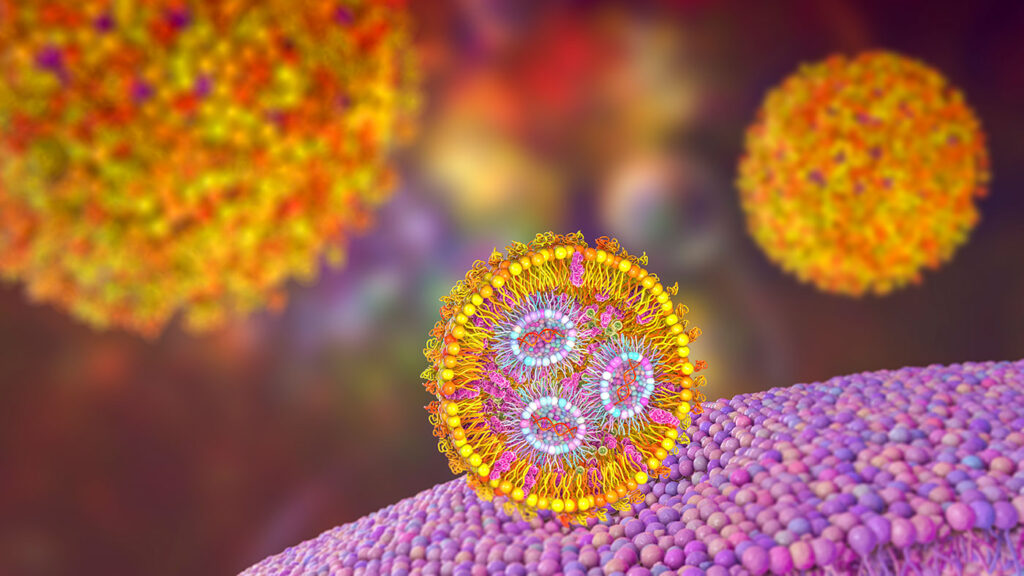

Lipid nanoparticles have become the workhorse of mRNA vaccines, ferrying genetic cargo into cells so the immune system can learn to recognize a threat. But most LNPs don’t travel where vaccine developers would ideally want them to go. Instead of homing to immune tissues, they tend to accumulate in the liver—a biological detour that can limit efficacy and contribute to side effects.
A team at the University of Pennsylvania School of Engineering and Applied Science has now redesigned these particles to shift that balance. By re‑engineering the ionizable lipid at the core of the nanoparticle, the researchers created a new class of “aroLNPs” that largely avoid the liver and instead accumulate in the lymph nodes, the immune system’s central training hubs. The work appears in JACS under the title “Liver‑Detargeted Aromatic Bioreducible mRNA Lipid Nanoparticles Confer Lymph Node Tropism and Robust Antigen-Specific Immunity.”
“The lymph nodes are key to this process,” said first author Hannah Yamagata, a doctoral student in bioengineering, in a press release. “That’s where the mRNA vaccine teaches the immune system what to guard against.”
To build the new particles, the team synthesized a library of aromatic, ionizable lipids. The aromatic rings allowed the researchers to tune the regiochemistry around the benzene scaffold, while disulfide bonds introduced biodegradability. “The library consists of three modular components: amine core structure, lipid tail length, and regiochemistry. These aromatic ionizable lipids employ benzene rings both as a scaffold for regiochemical differences and as a moiety to improve transfection,” the authors wrote. They found that aroLNPs with “tail lengths of six and eight carbons tended to have greater mRNA delivery to organs of interest than their nonaromatic counterparts, while aroLNPs with tail lengths of ten and twelve carbons demonstrated the opposite tendency,” potentially indicating a dependency on lipid hydrophobicity.

These structural tweaks produced LNPs that behaved differently in vivo: in mouse models, the best-performing aroLNPs sent roughly tenfold less mRNA to the liver than LNPs made with Moderna’s ionizable lipid yet still accumulated in the lymph nodes just as effectively.
“The more particles that reach the lymph nodes, the fewer particles each dose needs,” added senior author Michael J. Mitchell, PhD, associate professor of bioengineering.
To track biodistribution, the researchers packaged luciferase mRNA into the nanoparticles and measured light output across tissues. The shift in organ targeting was clear. “We were initially just trying to make better-performing lipids,” Yamagata said. “When we looked at where the LNPs were going, the shift away from the liver was striking.”
Importantly, the redirection didn’t compromise immune activation. In a preclinical vaccine model, aroLNPs generated antigen-specific antibody responses on par with clinically used ionizable lipids. They also triggered minimal increases in systemic inflammatory cytokines, suggesting a potential reduction in vaccine‑associated side effects.
“What’s exciting is that we were able to redirect where the particles go without losing immune potency, and even reducing side effects,” Yamagata said. “That suggests we can design vaccines that are more precise, better tolerated, and more efficient.”
Looking ahead, the team sees opportunities to adapt this delivery strategy for cancer vaccines, autoimmune conditions, and other applications where steering mRNA toward immune tissues—and away from off‑target organs—could offer a therapeutic advantage.