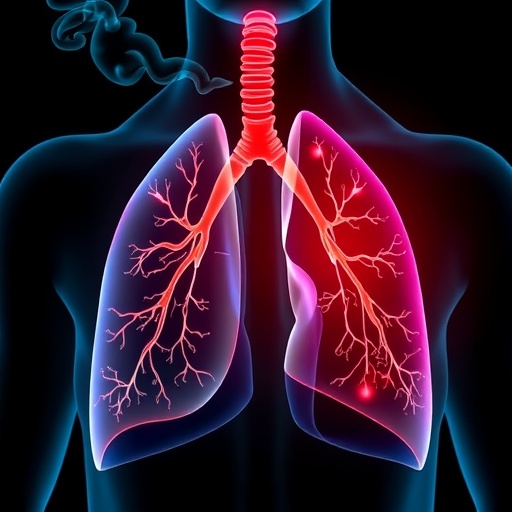
For the first time in scientific research, experts have directly quantified how cigarette smoking fundamentally alters the mechanical properties of human lung tissue. This breakthrough study, recently published in the prestigious Journal of the Royal Society Interface, was led by Mona Eskandari, a mechanical engineer at the University of California, Riverside. Through meticulous experimentation on donor lungs, her team has shed light on the profound biomechanical transformations that smoking induces in the lung parenchyma — the soft, intricate tissue responsible for gas exchange and comprising the bulk of the lung’s architecture.
Lung parenchyma is a highly delicate and spongy matrix composed of alveoli, capillaries, and connective tissue, essential for lung elasticity and efficient respiration. Eskandari’s research focused on assessing the tensile mechanics of this tissue by harvesting small, uniform square samples from human lungs obtained from donors deemed eligible for transplantation or strictly for research use. These samples underwent multi-axial tensile testing, where the tissue was stretched simultaneously across multiple directions to closely simulate natural breathing mechanics. This innovative approach distinguishes her work from previous studies that were limited by unidirectional testing or solely based on animal models.
The differences observed between lung tissues from smokers and nonsmokers were startling. The lung parenchyma of smokers exhibited significantly increased stiffness, resisting expansion more forcefully when stretched. This biomechanical behavior starkly mirrors the pathological stiffening characteristic of pulmonary fibrosis, a debilitating condition marked by scar tissue formation and progressive loss of lung compliance. The study highlights that smoking accelerates fibrotic-like changes in lung tissue, hindering the lungs’ natural ability to expand and contract seamlessly during respiration.
A particularly novel aspect of this research is the demonstration that lung tissue stiffness is not uniform throughout the organ. Surprisingly, tissue samples harvested from the upper regions of the lung were consistently stiffer than those from the lower sections within the same lobe. Eskandari hypothesizes that gravity plays a crucial role in this mechanical gradient, as the upright posture of humans causes differential long-term mechanical stresses acting on various lung zones. Such uneven mechanical properties could elucidate why certain lung injuries and diseases, including ventilator-induced lung damage, do not propagate evenly throughout the organ but instead target vulnerable, mechanically distinct regions.
Moreover, the team quantified the energy dissipation of lung tissue subjected to cyclic stretching, reflecting the tissue’s viscoelastic nature and resilience under dynamic breathing conditions. Human lung tissue was found to dissipate more mechanical energy in each respiration-like cycle than previously reported in murine models. This revelation underscores a critical limitation in animal studies: the mechanical behaviors of rodent lungs may not translate accurately to humans due to interspecies differences in tissue biomechanics. Hence, computational lung models built predominantly on animal data risk overlooking essential mechanical subtleties inherent to human lungs.
This finding carries significant implications as biomedical engineers increasingly develop sophisticated digital twin models—high-fidelity computational representations designed to simulate human lung function, disease progression, and responses to medical interventions. Eskandari stresses that grounding these models in human-derived mechanical data is paramount to ensuring their clinical relevance and predictive accuracy. Without such data integration, models risk misrepresenting lung dynamics, potentially hampering the optimization of ventilation strategies and therapeutic planning.
While the study revealed convincing evidence linking smoking to lung stiffening, preliminary data also hinted at age-related stiffening of lung tissue. However, Eskandari carefully notes that confirming such age effects necessitates larger datasets, a challenge compounded by the rarity of human donor lungs suitable for this precise type of biomechanical analysis. Despite this limitation, the mechanical characterizations gathered represent one of the most detailed and comprehensive datasets on human lung parenchyma to date.
Beyond advancing fundamental lung biomechanics, Eskandari’s research has practical repercussions for clinical tools and treatments. Improved understanding of lung tissue mechanics could refine ventilator configurations, making them safer and more effective, especially for patients with chronic lung diseases or those undergoing surgery. Additionally, augmented computational models can enhance preoperative planning by predicting how compromised lungs might respond to mechanical stress, thereby tailoring interventions to individual patient physiology and lung condition.
Eskandari leads the biomechanics Experimental and Computational Health (bMECH) laboratory at UC Riverside, which focuses on deciphering the complex mechanical behaviors of biological tissues. Her pioneering work bridges engineering principles with human biology, facilitating technological advancements that better mimic real physiological conditions. Notably, her research earned recognition in New York Times bestselling author Mary Roach’s recent book, Replaceable You: Adventures in Human Anatomy, which delves into the evolution of mechanical respiratory support technologies, underscoring the critical synergy between engineering innovation and medical science.
Highlighting the importance of biomaterial understanding, Eskandari emphasized, “We are trying to understand the biological materials we are working with. If we want ventilators and predictive tools that truly reflect how people breathe, these technological advances need to be informed by human-based lung data.” Her remarks encapsulate the core motivation driving this endeavor: bridging gaps between experimental human data and clinical applications to elevate respiratory care and outcomes.
Through meticulous multi-axis mechanical testing, the study elucidates how smoking drives pathological stiffening that mimics fibrotic changes in the lung, how lung tissue properties vary spatially within the organ, and why reliance on animal models limits the translational fidelity of lung mechanics research. By providing rich, experimentally grounded data, Eskandari’s work propels forward the fields of pulmonary biomechanics and biomedical engineering, paving the way for more accurate digital lung twins and better-informed clinical decision-making. Ultimately, these insights could improve treatment protocols for millions of individuals affected by smoking-related and other pulmonary diseases, marking an important stride in respiratory medicine and technology.
Subject of Research: Human lung parenchyma tensile mechanics and the effects of smoking
Article Title: Human lung parenchyma: tensile mechanics and the effects of smoking
News Publication Date: 13-May-2026
Web References: https://royalsocietypublishing.org/rsif/article/23/238/20250721/481637/Human-lung-parenchyma-tensile-mechanics-and-the-effects-of-smoking
Image Credits: Mona Eskandari/UCR
Keywords: Lungs, Airway resistance, Airway, Respiratory system, Anatomy, Organismal biology, Diaphragm, Diseases and disorders, Fibrosis, Respiration, Mechanical energy, Engineering, Medical technology, Biomedical engineering, Medical equipment, Health care, Emergency rooms, Hospitals, Rehabilitation centers, Medical facilities, Clinical medicine, Medical treatments
Tags: biomechanical changes in lung parenchymacigarette smoking and respiratory mechanicshuman lung donor researchimpact of smoking on lung elasticitylung parenchyma biomechanicslung stiffness and smokinglung tissue mechanical alterationsmechanical properties of lung tissuemulti-axial tensile testingsmoking effects on lung tissuesmoking-induced lung damage studiestensile testing of human lungs