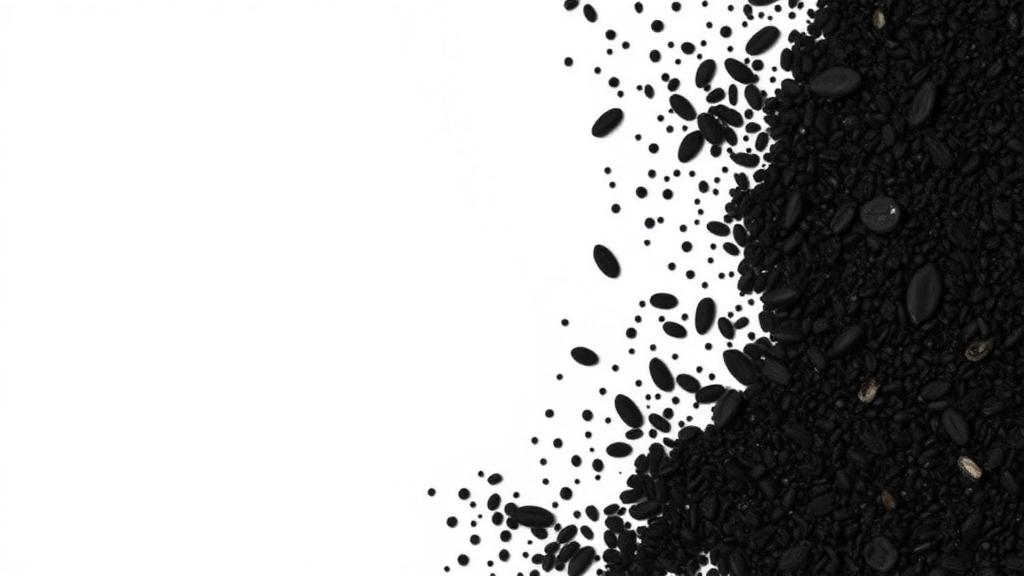
Agricultural waste that would otherwise be burned in fields or left to rot could soon become one of the most effective weapons against water pollution. A comprehensive review published in Results in Chemistry synthesizes more than 100 studies from the past decade on nitrogen-doped biochar, a carbon material made by heating biomass and weaving nitrogen atoms into its structure. The verdict is striking: for selected pollutants, these engineered carbons achieve adsorption capacities between 22.6 and 300 percent higher than commercial activated carbon, while costing an estimated 60 to 77 percent less to produce. With global wastewater treatment still leaving roughly half of the world’s effluent untreated, and with antibiotics, dyes, pesticides, and heavy metals increasingly detected in rivers and groundwater, the timing of this assessment could hardly be more urgent.
The secret to the material’s performance lies in chemistry at the atomic scale. When biomass such as sugarcane bagasse, rice husk, corn stalk, or even shrimp shells is pyrolyzed in the presence of a nitrogen source, nitrogen atoms take up distinct positions within the carbon lattice. X-ray photoelectron spectroscopy distinguishes four species: pyridinic-N at the edges of the carbon framework, pyrrolic-N in five-membered rings, graphitic-N substituting carbon inside the plane, and oxidized-N. Each plays a different role. Pyridinic nitrogen acts as a Lewis base, donating its lone electron pair to coordinate metal cations such as lead and cadmium. Pyrrolic nitrogen drives hydrogen bonding with polar molecules. Graphitic nitrogen sustains cation–π interactions and shuttles electrons across the carbon skeleton. The review shows that total nitrogen content alone is a poor predictor of performance; it is the distribution of these species that determines how much pollutant a given biochar can capture.
The numbers compiled in the review are remarkable. For tetracycline antibiotics, nitrogen-doped biochars derived from industrial lignin reached 1396 milligrams per gram, roughly four to seven times the capacity of commercial activated carbon, which typically manages 200 to 300 milligrams per gram. Garlic-peel-derived biochar achieved 1304.5 milligrams per gram for the same antibiotic. For dyes, capacities spanned from 27.4 up to an extraordinary 3791.2 milligrams per gram for malachite green. In the heavy-metal category, urea-modified biochar made from Medulla tetrapanacis captured 1466.5 milligrams of lead per gram, nearly five to eleven times what commercial activated carbon delivers. Even anionic herbicides such as 2,4-D, which are normally repelled by negatively charged biochar surfaces, were captured at 990.1 milligrams per gram by melamine-doped palm kernel shell biochar, because nitrogen doping creates locally positive surface domains that overcome the electrostatic barrier.
Not all pollutants are captured the same way, and the review draws a crucial mechanistic distinction. Lead, cadmium, and zinc are removed purely by sorption: coordination at pyridinic nitrogen sites, cation–π interactions with graphitic carbon planes, electrostatic attraction, and ion exchange, with the metal’s oxidation state unchanged. Hexavalent chromium follows a different, two-step pathway. First, the anionic chromate species is electrostatically attracted to the positively charged surface under acidic conditions; then electron-donating pyridinic and pyrrolic nitrogen reduce the toxic Cr(VI) to the far less toxic Cr(III), which is immobilized on the surface. X-ray photoelectron spectroscopy confirms this directly: the pyridinic nitrogen fraction of a tofukasu-derived biochar dropped from 28.2 to 26.9 percent after chromium uptake, evidence that the nitrogen sites themselves donated electrons. Copper sits in between, showing partial reduction to metallic and monovalent forms alongside complexation.
The review is refreshingly candid about the weaknesses of the evidence base. Mechanism assignments in much of the literature are presented as conclusions rather than tested hypotheses. Fourier-transform infrared spectra, with their overlapping bands, are often treated as proof of bonding when they are merely suggestive. The near-universal preference for the pseudo-second-order kinetic model is flagged as a methodological artifact, since both pseudo-first-order and pseudo-second-order equations can fit diffusion-limited and reaction-limited data alike, and linear regression biases model selection. Likewise, the Langmuir maximum capacities that headline most papers are fitted parameters whose values shift with temperature, concentration range, and regression method, not intrinsic material constants. The authors propose minimum reporting standards, including formal model-selection criteria, nonlinear regression, and triangulation of XPS, density functional theory calculations, and surface-charge measurements before any mechanism is accepted.
Regeneration, which determines whether an adsorbent is economically viable, emerges as a nuanced story. When the eluent chemistry is matched to the pollutant’s charge, alkaline sodium hydroxide for anionic dyes and many metal-loaded biochars, dilute acids for cationic species, nitrogen-doped biochars retain 75 to 92 percent of their initial capacity over three to ten cycles. Sodium hydroxide regeneration kept tetracycline removal at 84 percent after ten cycles in one study, and on lead-loaded nitrogen-doped biochar it delivered 93 percent removal in the first cycle and 85 percent after five, whereas pristine biochar fell from 78 to 32 percent under identical conditions. Thermal regeneration above 600 degrees Celsius restores 80 to 90 percent of capacity but destroys 40 to 60 percent of the nitrogen, converting the valuable pyridinic and pyrrolic sites into far less useful graphitic and oxidized forms. Perhaps the most surprising finding is ball milling: mechanical regeneration of a norfloxacin-loaded biochar did not merely restore capacity but raised it from 11.5 to 46.3 milligrams per gram by exposing previously blocked pores and creating fresh defects.
The sustainability case is compelling on paper. Biochar production requires about 6.1 megajoules per kilogram against 97 for activated carbon, and its global-warming potential is estimated at minus 0.9 kilograms of carbon dioxide equivalent per kilogram, thanks to the carbon sequestered in the char itself. Converting crop residues that would otherwise be open-burned, emitting fine particulate matter at rates of 7.6 to 11.7 grams per kilogram, into adsorbents closes a circular-economy loop. But the review also documents genuine environmental risks on the synthesis side. Pyrolysis of nitrogen-rich algae feedstocks can release ammonia and hydrogen cyanide amounting to roughly 20 percent of feedstock nitrogen, although co-pyrolysis with biochar addition cuts these emissions by 85 percent. More alarmingly, a widely used activation route combining potassium porogens with urea or melamine generates potassium cyanide as a byproduct, up to 328 milligrams per gram of product at a one-to-one dopant ratio, making mandatory washing and byproduct screening a safety requirement rather than an option.
The commercial reality check is sobering. Despite the laboratory triumphs, the technology sits at technology readiness level 3 to 4. More than 95 percent of published studies use batches below 100 grams, almost all rely on synthetic single-pollutant solutions rather than real wastewater, fewer than 15 percent include any cost analysis, and fewer than 10 percent conduct a life-cycle assessment. No pilot-scale demonstration of nitrogen-doped biochar for water treatment has been reported. Real industrial effluents, with their competing ions, fluctuating pH, and dissolved organic matter, typically reduce adsorption capacities by 15 to 40 percent relative to synthetic solutions. Scaling up also confronts practical hurdles: gaseous ammonia doping requires sealed reactors or continuous purging, batch-to-batch variability runs 15 to 30 percent, and nitrogen retention falls sharply at the higher temperatures industrial reactors favor.
The review closes with a concrete roadmap for the next five to ten years: pilot demonstrations in the 100-kilogram to one-ton-per-day range running on real wastewater, standardized reporting and certification aligned with emerging International Biochar Initiative and European Biochar Certificate standards, systematic mapping of nitrogen speciation against adsorption performance, long-term regeneration durability testing, hybrid systems that combine adsorption with oxidation or membrane processes, and full life-cycle and end-of-life assessment, including safe disposal of spent, metal-laden adsorbents. If those steps are taken, the authors argue, nitrogen-doped biochar could move from laboratory curiosity to credible commercial alternative, simultaneously valorizing billions of tons of agricultural residue, cutting the carbon footprint of water treatment, and capturing the antibiotics, dyes, and heavy metals that conventional plants let slip through. The chemistry, it turns out, was never the hard part; the engineering of scale is.
Subject of Research: Nitrogen-doped biochar as a sustainable adsorbent for wastewater remediation
Article Title: Nitrogen-doped biochar for wastewater remediation: Synthesis strategies, adsorption mechanisms, regeneration performance, and technology readiness
Article References: Kurnia, I., Nursyaidah, T., Prawiranegara, S. P. H., Pratomo, U., Irkham, Karnjanakom, S., Yu, Z., & Hartati, Y. W. (2026). Nitrogen-doped biochar for wastewater remediation: Synthesis strategies, adsorption mechanisms, regeneration performance, and technology readiness. Results in Chemistry, 31, Article 103922. https://doi.org/10.1016/j.rechem.2026.103922
Image Credits: AI Generated
DOI: 10.1016/j.rechem.2026.103922
Keywords: nitrogen-doped biochar, wastewater remediation, adsorption, heavy metals, antibiotics, synthetic dyes, pyrolysis, activated carbon, regeneration, technology readiness, circular economy, water pollution