
From small molecules and protein therapeutics to gene therapies, biotech industry players have placed their bets on a wide range of modalities that push the limits of what was once considered “druggable.”
AI biologics company, Absci, focuses on rational antibody design to bypass labor-intensive experimental screens. The ability to computationally design antibodies from scratch, or de novo, without reference to a known binder, could transform an antibody drug market projected to reach $445 billion within the next five years.
Unveiled in January, the company’s latest protein design model, Origin-1, generated developability-optimized antibodies that achieved nanomolar binding affinity and functional inhibition of IL36RA, a therapeutic target for squamous cell carcinomas. By simulating the delivery of pro-inflammatory cytokine, IL-36, the AI-designed drug candidate boosts intratumor immune response for cancer control.
Origin-1 generates de novo antibodies for “zero-prior” epitopes, or target sites that lack structural data from known protein-protein complexes. Sean McClain, CEO of Absci, emphasizes the approach as a “more expansive” version of de novo design that requires only a monomeric structure as input to generate viable candidates.
Nathaniel Bennett, PhD, co-founder at Xaira Therapeutics, highlights that Absci’s atomic-level experimental validation contributes to the field’s understanding of how AI will play a major role in therapeutic development, particularly for expanding the range of tractable drug targets.
“This is a solid piece of work that shows how AI-driven antibody design continues to mature,” says Bennett, “particularly in settings with limited prior structural information.”
Janani Iyer, PhD, head of AI/ML product at Absci, emphasizes that the targets that most often strike interest from pharma partners are typically less studied and lack epitope structure in the public domain. “We’re focused on building an AI platform technology that unlocks really unmet needs,” she said.
Permanently bound
While highly precise therapeutics, biologics, such as antibodies, are typically constrained to intravenous delivery. A growing number of biotech companies are expanding the capabilities of small molecules, which offer the advantage of convenient oral administration.
Unveiled from stealth last October, Expedition Medicines leverages generative AI to design small-molecule drugs that target shallow pockets using covalent chemistry. The Flagship Pioneering spinout targets a range of traditionally undruggable sensors, regulators, and transcription factors, where disease is driven by interactions across protein surfaces. These small molecules remain inert inside the body until activated by the appropriate protein catalyst.
“Small molecules have historically been more challenging for generative AI, but I think we are at an inflection point, with the right chemistry insights, data, algorithms, and compute finally coming together,” said Molly Gibson, PhD, CEO of Expedition.
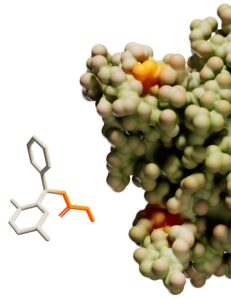
[Expedition Medicines]
She notes that Expedition’s technology contrasts with many of today’s molecular design efforts, which use 3D atomic positions to model reversible interactions in deep pockets.
The company’s tech stack trains AI models on high-throughput mass spectrometry data that measures the potency of each small molecule against 20,000 sites in the proteome. These fit-for-purpose datasets are advantageous over DNA-encoded libraries (DELs), which are burdened by substantial noise that can limit predictive power.
Expedition is focusing on demonstrating clinical proof points. In a partnership with Pfizer, the startup is identifying target molecules correlated with prostate cancer disease progression and treatment resistance. As a long-term goal, the team plans to expand the proteomics platform to additional modalities, such as proximity events that drive protein degradation or stability.
Biologic in a pill
AI drug developer, 1910 Genetics, has recently tackled macrocyclic peptides, a class that aims to combine the oral convenience of small molecules with the high specificity of biologics. Historically, these compounds have struggled to balance cell-membrane permeability with key therapeutic properties such as potency and solubility.
To address this gap, 1910’s AI model, PEGASUS, is trained on a multi-modal dataset that generates billions of cyclic peptides separated by permeability-related characteristics and solvent-dependent computational simulations. PEGASUS was able to demonstrate the first cyclic peptides with more than two polar or ionizable fragments to achieve in vitro cell-membrane permeability.
Jen Asher, PhD, founder and CEO of 1910, describes the model as a “versatile tool” that accelerates the design-make-test cycle by triaging compounds for synthesis, supporting lead optimization, and designing new starting peptides with desired properties.
With a company name that references the year that the first patient was diagnosed with sickle cell disease in the United States, the first condition for which the field identified a molecular basis, 1910 is committed to multi-modality drug discovery. The company’s platform also houses CANDID-CNS, an AI model that predicts small molecule blood-brain barrier (BBB) penetration within Beyond-Rule-of-5 (bRo5) chemical space to advance therapies for neurological disease.
With only about two percent of small-molecule drugs able to cross the BBB, accurate penetration prediction can identify promising candidates that are more likely to succeed in the clinic. The model achieved an 87% success rate for predicting bRo5 small molecule brain penetration and distribution, outperforming a 56% success rate for the industry standard, Pfizer’s CNS Multiparameter Optimization (CNS-MPO) score.
Encrypted message
Jacob Becraft, PhD, CEO at Strand Therapeutics, is placing his bet on programmable mRNA therapeutics for cancers and autoimmune diseases. Strand is among a vibrant genetic medicine ecosystem, where engineered vehicles, such as adeno-associated vectors (AAVs) and lipid nanoparticles (LNPs), deliver therapeutic genetic material into patient cells to produce therapeutic proteins. These medicines must achieve therapeutic potency in the right tissues while avoiding off-target effects. Yet, targeted delivery beyond the liver remains a challenge.

Strand’s technology addresses this gap by enabling selective mRNA expression within cancer cells while sparing healthy tissue. This approach allows mRNA to be delivered broadly while targeting expression to the intended tumor cells.
“It’s like an encrypted message. It doesn’t matter who picks up my message because they can’t read it,” Becraft said. “If the protein doesn’t get created, then it’s not off-target.” The tech stack challenges the “old school mentality” that mRNA biodistribution is the key metric that defines off-target effects.
Strand’s technology leverages a machine learning–driven approach that applies molecular sensors to detect microRNA expression signatures distinguishing tumor cells from healthy cell types. As an example, liver-specific microRNAs bind to target sites in the 3¢ UTR of the delivered mRNA to suppress its expression in healthy hepatocytes and prevent off-target effects.
Last May, Strand announced the Phase I dose-escalation trial for STX001, a programmable, self-replicating mRNA therapy designed to treat advanced solid tumors by producing IL-12 directly in the tumor microenvironment. Notably, STX001 demonstrated an abscopal response, in which localized treatment of a single tumor led to a systemic immune response that reduced distant tumor sites. The company looks to advance the candidate to Phase II trials.
As the therapeutic toolbox continues to expand, the field is working to close the “undruggable” gap.