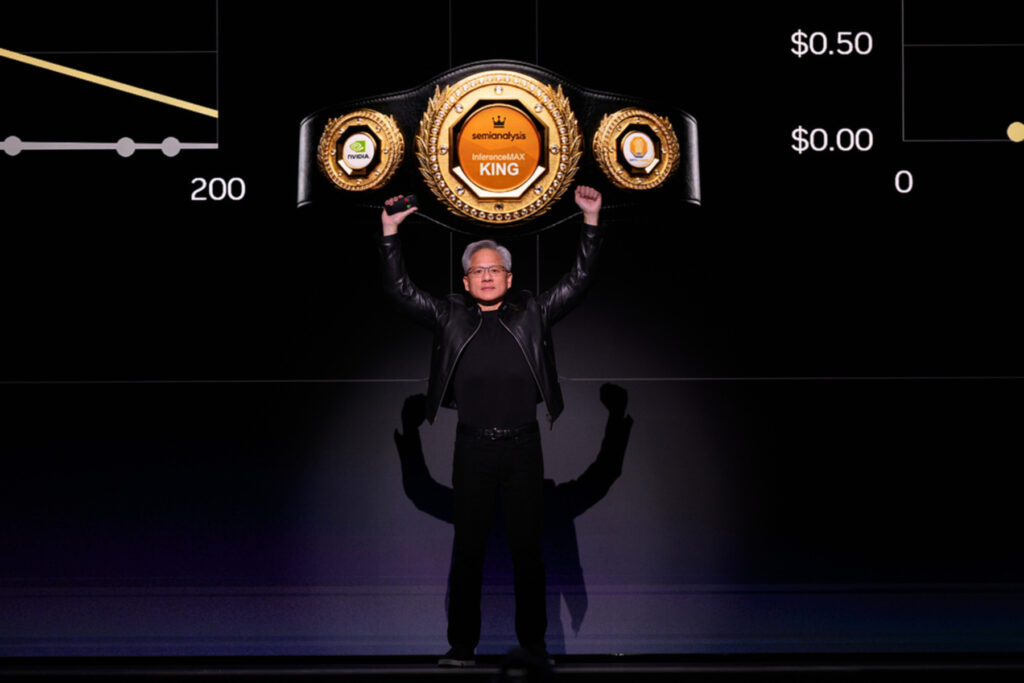
![CEO Jensen Huang delivering the NVIDIA GTC 2026 keynote [Nvidia]](https://www.genengnews.com/wp-content/uploads/2026/03/nvidia-ceo-jensen-huan-gtc26-key-3.jpg "nvidia-ceo-jensen-huan-gtc26-key-3")
SAN JOSE – Nvidia CEO Jensen Huang foresees the computer giant’s revenue to surpass a whopping $1 trillion through 2027. The rise of “AI natives” is one source of this accelerating compute demand. These newly launched companies skyrocketed this last year, reaching a new investment high of approximately $150 billion going into venture startups.
“This is the first time in history that every one of these companies need compute—lots and lots of it,” Huang declared on the stage of his opening GTC keynote.
Huang described the current moment as a major platform shift where agentic AI, systems that can act autonomously to achieve goals, is driving transformation across industries. This new age builds on the momentum created by generative AI tools, like ChatGPT, and advances in reasoning models, such as OpenAI’s o1.
He also spotlighted OpenClaw, the free, open-source autonomous AI agent designed to function as a personal assistant, that rapidly gained traction in Silicon Valley as one of the fastest growing open-source projects.
Among the key announcements at GTC was NemoClaw, an enterprise optimized version of OpenClaw that adds privacy and security controls, enabling organizations to deploy AI agents more safely at scale.
This push toward agentic AI is extending into healthcare. GTC’s life sciences announcements included big pharma’s continuing AI infrastructure moment, biological reasoning for drug discovery, and physical AI aimed to accelerate healthcare robotics.
Pharma adoption
Kimberly Powell, vice president of healthcare at Nvidia, says “the transformer moment is now for biology and drug discovery.”
She explains that the $4.9 trillion healthcare industry is deploying AI at more than twice the rate of the broader economy. The startup ecosystem is driving this shift, capturing over 85% of healthcare AI spending last year. Correspondingly, Nvidia’s Inception program has jumped to over 5,000 healthcare and life sciences startups, with digital health leading at more than 2,000 members.
As AI systems evolve, their growing demands for reasoning, memory, and orchestration require new infrastructure. A wave of recent partnerships between AI native companies and big pharma has signaled this shift.
Aligned with this momentum, Roche has announced the deployment of more than 3,500 NVIDIA Blackwell GPUs across hybrid cloud and on‑premises environments in the U.S. and Europe to accelerate R&D productivity, next-generation diagnostic, and manufacturing efficiencies. These AI factories are described by Nvidia as the “greatest announced” GPU footprint available to a pharmaceutical company.
Roche’s GPU deployment comes after Eli Lilly and Nvidia jointly pledged $1 billion over five years to fund talent, infrastructure and compute to address key bottlenecks in AI-based drug discovery. The AI co-innovation lab was announced during January’s JP Morgan Healthcare Conference and will be staffed by the combined teams from the pharma giant and computational powerhouse.
Rory Kelleher, senior director and global head of business development for healthcare and life sciences, notes that pharmaceutical companies are sitting on mountains of internal data suited for foundation models and multi-agent frameworks to unlock insights for biological discovery. Yet, unlike the fast-moving AI native startups, these companies have traditionally been more cautious about overhauling their systems.
“You’re seeing the leaders in this space, Roche and Lilly, start to invest in ways that pharmaceutical companies haven’t invested in AI infrastructure in the past,” Kelleher told GEN Edge. “Computing is the essential instrument to how R&D gets done.”
Biology reasoning
In drug discovery, AI models have evolved beyond simple structure prediction to simulate complex protein interactions, ushering in a new era of biological reasoning to unlock disease mechanisms.
Announced at GTC, a new collaboration between Nvidia, European Molecular Biology Laboratory (EMBL), Google DeepMind and Seoul National University, has contributed 1.7 million new predicted protein complexes to the AlphaFold Protein Structure Database. 30 million additional predicted structures have been made available for bulk download. The expansion removes a massive computational barrier for researchers, particularly those in limited super computing environments.
Concurrently, Nvidia unveiled a new protein design reasoning model, Proteina-Complexa, which generates binders for structure-based drug discovery. One million designed protein binders were experimentally validated against over 130 targets in an expansive collaboration with Manifold Bio, Novo Nordisk, Viva Biotech, University of Cambridge, LMU Munich, and Duke University. The model combines the partially latent flow matching architecture of its predecessor, La-Proteina, with test-time compute scaling to iteratively optimize designs.
In domain-specialized healthcare agents, IQVIA unveiled a unified agentic platform, called IQVIA.ai, which has already deployed over 150 specialized agents to reduce complex workloads, such as clinical trial site selection. Additional Nvidia partners include Hippocratic AI, which is building patient-facing agents for chronic care and post-discharge follow-ups, and HeidiHealth, a multilingual clinical documentation platform to power ambient listening for over 2.4 million weekly consultations across 190 countries.
In healthcare robotics, Nvidia has launched the following physical AI platform:
- Open-H, a healthcare robotics dataset, composed of over 700 hours of video, to represent the diversity and complexity of surgical procedures.
- Cosmos-H, an open model family that enables domain-specific, physics-based synthetic data generation at scale. Developers can augment datasets with lifelike simulations and evaluate robotic policies by predicting the future state of surgical environments.
- GR00T-H, a vision language action (VLA) model, trained on Open-H, that processes text commands for clinical tasks and performs complex physical actions in healthcare environments.
- Rheo, a blueprint that enables developers to build a hospital digital twin that simulates clinical workflows, medical device interactions, human movement and hospital logistics
As GTC 2026 comes to a close, autonomous agents are hard at work, running toward a potential $1 trillion compute revolution.