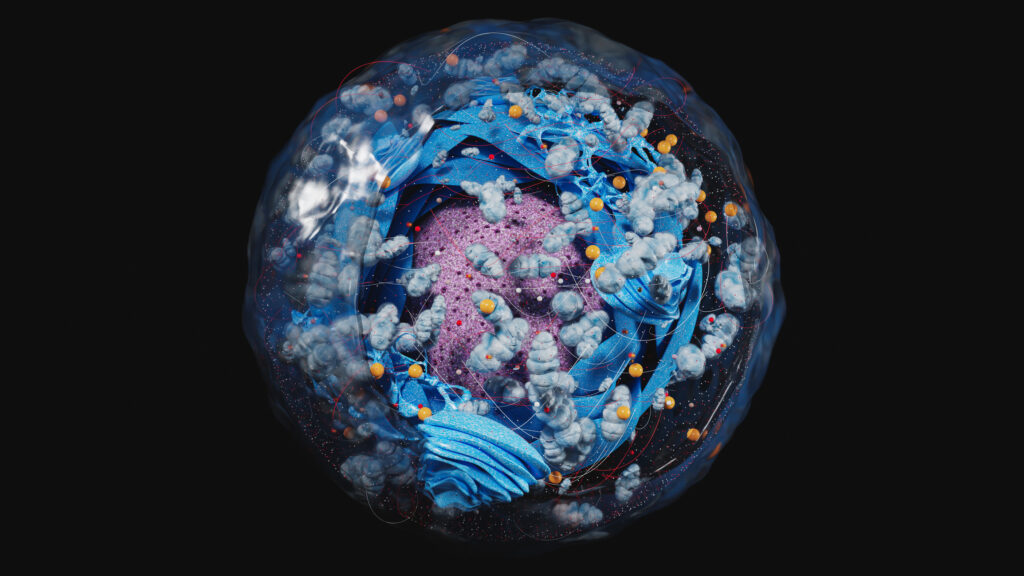

All cells in animals, plants, fungi, and protists share a fundamental characteristic, in that they are eukaryotic cells. These are essentially complex cells with specialized internal compartments. The cells that make up our bodies are no exception.
How this type of cell emerged is one of the great questions in biology. For decades, the dominant explanation has placed acquisition of the mitochondrion as the ultimate turning point. It’s thought that an archaeon established a symbiotic relationship with a bacterium, which eventually became the mitochondrion, and this alliance opened the door to cellular complexity.
A study led by Toni Gabaldón, PhD, an ICREA researcher at IRB Barcelona and the Barcelona Supercomputing Center-Centro Nacional de Supercomputación (BSC-CNS) now rethinks this view. While the research does not deny the central role of the mitochondrion, it suggests that the origin of complex cells was a longer, more gradual and more collaborative process than had previously been thought. Challenging the idea that cellular complexity emerged from a single evolutionary encounter, the study results point instead to a gradual process of interactions among different microorganisms that lasted for millions of years. The findings identify contributions from several bacteria, in addition to the one that gave rise to the mitochondria, and suggest that giant viruses may have acted as vehicles for genetic transfer.
“For a long time, we have explained the origin of complex cells as a story with two main protagonists: an archaeon and the bacterium that gave rise to the mitochondrion,” said Gabaldón. “Our study suggests that this narrative is incomplete and that there were more actors on stage, including other bacterial groups and giant viruses that may have facilitated gene exchange.” The team published their findings in Nature, in a paper titled “Gene ancestries reveal diverse microbial associations during eukaryogenesis.”
“The origin of eukaryotes remains a central enigma in biology,” the authors wrote. Unlike studies with dinosaurs, the origin of eukaryotes cannot be reconstructed from visible bones or fossils. It likely occurred about two billion years ago in microscopic organisms, of which barely any direct traces remain. “The current consensus on eukaryogenesis revolves around scenarios that always involve an endosymbiotic relationship with extensive gene transfer between an alphaproteobacterial endosymbiont and a host with an Asgard archaeal ancestry,” the team noted. However, the footprints of this evolution are still present in today’s genomes.
To trace them, the team approached the problem as a form of computational molecular archaeology, using the computing power of the MareNostrum series of supercomputers to analyze public genomic data spanning biodiversity as a whole.
The researchers first reconstructed the repertoire of gene and protein families of the last common ancestor of all eukaryotes, known as LECA (last eukaryotic common ancestor). “Our analysis provided a revised reconstruction of the last eukaryotic common ancestor (LECA) proteome, in which we traced the phylogenetic origin of each protein family,” they wrote. The investigators then analyzed its evolutionary origin by comparing these families against databases containing tens of thousands of bacterial, archaeal, and viral genomes.
“We are trying to reconstruct a story that took place billions of years ago and for which we have no direct fossils. That is why we have been very conservative: we only kept the most robust evolutionary signals—those with a strength comparable to the signals already accepted for the ancestral archaeon and for the bacterium that gave rise to the mitochondrion,” explain study co-authors Moisès Bernabeu, PhD, Saioa Manzano-Morales, PhD, and Marina Marcet-Houben, PhD, who are researchers in the Comparative Genomics group led by Gabaldón at IRB Barcelona and the BSC.
After more than five years of work using complex mathematical models and processing large volumes of genomic sequences, the team was able to detect signals that would otherwise have remained invisible.
Beyond the mitochondrion, the study identifies two particularly relevant bacterial signals: Myxococcota and Planctomycetota. The former are related to metabolic functions, including processes linked to lipids and membranes. The latter are bacteria known for their structural complexity, featuring internal compartments that are unusual for bacterial organisms. “Transfers from these donors have been identified in earlier studies, including small-scale detailed ones such as the acquisition of some steroid biosynthesis enzymes from Myxococcota,” the team stated.
Their analyses indicate that these contributions did not happen all at once. Planctomycetota appear as an older signal, whereas Myxococcota and the bacterium that gave rise to the mitochondrion show signals that are closer in time. “We found compelling evidence for multiple waves of horizontal gene transfer from diverse bacterial donors, with some likely to have preceded mitochondrial endosymbiosis,” the scientists suggested.
One of the most unexpected findings of the study is that some genes integrated during the early evolution of eukaryotes appear to come from giant viruses, specifically Nucleocytoviricota. These viruses have genomes that are much larger than those of most known viruses, and they infect single-celled eukaryotic organisms.
The authors propose that these viruses could have acted as vehicles for genetic transfer between microorganisms coexisting in the same ecosystem, facilitating exchanges that helped shape the ancestral genome of eukaryotic cells. “Our results confirm and expand earlier results supporting sizeable gene flow from diverse prokaryotic ancestors preceding the LECA4, and uncover a role for viruses as potential mediators of such transfers,” the scientists stated.
This vision fits with the idea that the ancestors of eukaryotic cells lived in environments rich in microbial communities, such as microbial mats, where different microorganisms coexist in layers under varying chemical conditions. In this context, genetic exchanges would have allowed them to acquire new biological capabilities over time. “Microorganisms are known to form complex communities such as microbial mats or complex biofilms, of which viruses also form active part, and it is reasonable to consider that the ancestors of the LECA lived in such complex environments,” they stated.
The study addresses one of the major questions in biology: how the complexity of the cells that form our bodies came to be. By reconstructing the genetic traces of that process, the work provides a new perspective on a key episode in the history of life: the origin of the cellular lineage to which animals, plants, fungi, and protists belong. “Taken together, our results suggest that ancient eukaryotes may have originated within complex microbial ecosystems through a succession of diverse associations that left a footprint of horizontally transferred genes.”
The paper expands on a line of research initiated by Gabaldón in 2016, when he published a study in Nature that already suggested the mitochondrion might have been acquired relatively late in the process of eukaryotic origins. Now, with much more genomic data available and more powerful computational tools, the team has been able to analyze in greater detail which other organisms left their mark on that common ancestor.
“All genomes preserve traces of their history. In the case of eukaryotes, those traces tell us of ancient alliances between microorganisms. Understanding them helps us answer a very profound question: what we are and where we come from,” commented Gabaldón.