Antibody-drug conjugates (ADCs) constitute a rapidly evolving class of targeted oncology therapeutics that couple tumor-selective antibodies with highly potent cytotoxins. At the 16th Annual World ADC Conference, leaders across discovery, development, and manufacturing highlighted the accelerating momentum of this clinically maturing field.
Presentations focused, for example, on expanding payload diversity, advancing site-specific conjugation, and engineering hydrophilic linkers to improve stability. Others addressed implementing scalable, stage-agnostic Chemistry, Manufacturing, and Controls (CMC) strategies and integrating manufacturing models for increasingly complex bioconjugates. In this landscape, contract research organizations (CROs) and contract development and manufacturing organizations (CDMOs) play an increasingly central role in advancing ADC candidates from concept to clinic.
Payload optimization

VP, Oncology Drug Discovery
Sygnature Discovery
Improving the next generation of ADC will require solving issues such as how to expand the therapeutic window while managing systemic toxicity, heterogeneous tumor delivery, and payload limitations. Sygnature Discovery, a global drug discovery CRO, is approaching these challenges by optimizing small-molecule payloads alongside linker chemistries and conjugation strategies to move beyond traditional antibody‑first design. Allan Jordan, PhD, vice president of oncology drug discovery, provides a perspective. “For decades, the industry has spent time thinking about the antibody and how it can target a cancer cell, with the linker and cytotoxic payload being largely an afterthought with little or no variety or optimization. That has led to significant limitations, with systemic payload release giving rise to side-effects and reducing the dose that actually gets to the tumor.”
Jordan also blames limited payload choices. “Most ADCs arise from just two or three families of cytotoxic agents, increasing the chances of resistance, and saturating the space with agents which are barely differentiated from each other. By contrast, expanding the payload property space can materially improve therapeutic selectivity.”
Sygnature is applying a more precision medicine-focused approach by repurposing cytotoxic agents. Jordan explains, “The properties of an ADC allow us to potentially rescue ‘fallen angel’ small-molecule therapies, such as those which failed due to on-target systemic toxicity or inadequate pharmacokinetics (PK) parameters. Oftentimes, the properties that lead to failure in the oral small molecule space can be ideal for an ADC payload, and this offers a real opportunity to redeploy a failed asset into a meaningful therapeutic, generating value for an asset that may previously have been destined for the scrap heap.”
The company’s NewPath ADC platform applies small-molecule drug development rigor to ADC design and integrates this within a single discovery workflow. Jordan summarizes, “This includes 1) developing payloads using design-make-test cycles optimized for, and aligned with, the right property space for ADCs; 2) developing modular linker sets to build custom linkers with the right cleavage kinetics and characteristics; 3) optimizing not only the individual components, but also the holistic properties of the final ADC itself; and 4) understanding the fundamental linkage back to disease, with mechanistic understanding of how the ADC is internalized, processed, and the payload released.”
Looking ahead, Jordan predicts, “We can now think credibly about ADCs beyond oncology, such as for immunology and inflammation sectors, and ultimately CNS disorders.”
Site-specific conjugation platform
In the quest to produce the optimally engineered ADC, a key complication is that conventional conjugation chemistries attach the cytotoxic payloads randomly on an antibody, producing a mixture of functionally variable heterogeneous ADC molecules.

VP, ADCs and Bioconjugates Abzena
Nicolas Camper, PhD, vice president of ADCs and bioconjugates for CRO/CDMO Abzena, says the company offers a new platform to help solve such challenges. “Inadequate choices of bioconjugation and linker technologies can derail an ADC program. Using a bioconjugation and linker platform such as Abzena’s ThioBridge™ site-specific conjugation technology ensures that the ADC generated has favorable pharmacokinetics, biodistribution, and manufacturability properties, independent of the selected antibody and payload, giving the ADC the best chances of success in the clinic.”
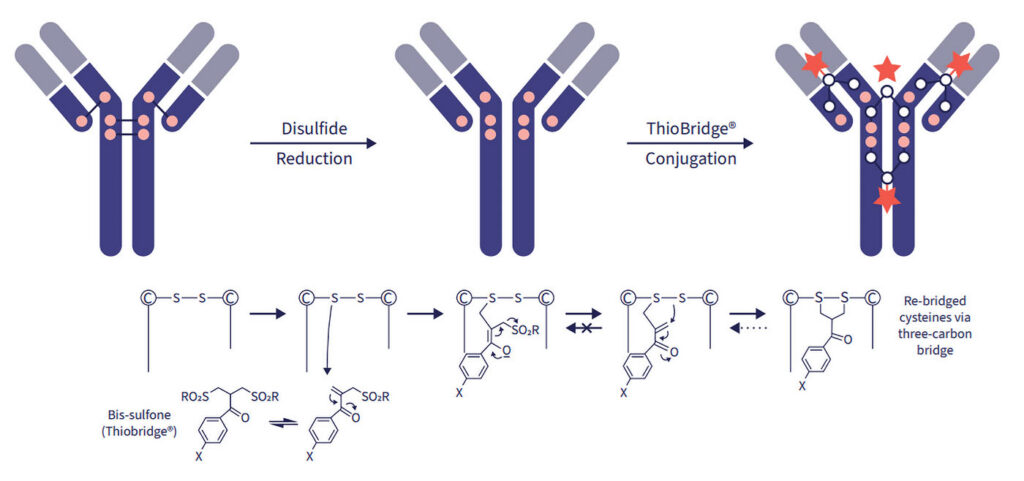
The process involves selectively reducing antibody interchain disulfide bonds and then treating them with bis-sulfone reagents that covalently rebridge the reduced disulfides. Camper explains, “This allows for the site-specific conjugation of linker-payloads at antibody interchain disulfides to generate ADCs with precise, homogenous drug loading. ThioBridge ADCs are very stable with no deconjugation of the linker-payload observed during storage or in systemic circulation.”
The linkers also incorporate a hydrophilic polymer in their structure. Camper notes, “This enhances the biophysical stability of the ADCs and decreases their propensity to aggregate. Importantly, this also reduces ADC hydrophobicity and imparts favorable pharmacokinetics to the conjugates.”
As to the ease of manufacturing of these ADCs, Camper says an advantage of the platform is that it can prepare ADCs from native antibodies. “These are much more straightforward and far less costly to produce than engineered antibodies that, for instance, may incorporate engineered cysteines or non-natural amino acids. Overall, ThioBridge is a conjugation technology well-suited to the low-cost manufacturing of ADCs and is well validated. We now have three customers evaluating ThioBridge ADCs in clinical trials, and we continue to develop linker formats to accommodate the increasing diversity of payloads.”
Hydrophilic linker approach

CTO, LOTTE Biologics
Many cytotoxic ADC payloads are intrinsically hydrophobic, promoting aggregation, poor solubility, rapid clearance, and a restricted therapeutic window. To address this challenge, LOTTE Biologics has developed its SoluFlex Link™ platform. Kern Chang, PhD, CTO, explains, “This technology works by utilizing solubility-enhanced hydrophilic linkers to increase the overall hydrophilicity of the conjugate. By improving these chemical properties, the platform significantly increases ADC stability in both liquid formulations and serum. These superior physicochemical properties are essential for enabling high-concentration formulations, which pave the way for subcutaneous administration. This capability offers a significant advantage for patient convenience by providing an alternative to traditional, time-consuming IV deliveries.”
Chang says that research in tumor models demonstrated that ADCs utilizing these solubilizing linkers achieved better potency and superior anticancer effects compared to industry standards.
In its capacity as a CDMO, Chang says the company’s U.S.-based ADC manufacturing facilities provide biotech companies the option for domestic production, “providing much-needed manufacturing stability and a way to avoid global supply chain disruptions. This challenge becomes significantly worse for programs requiring high-potent payload handling facilities and commercial-scale production. Many sites lack the infrastructure to handle these complex needs.”
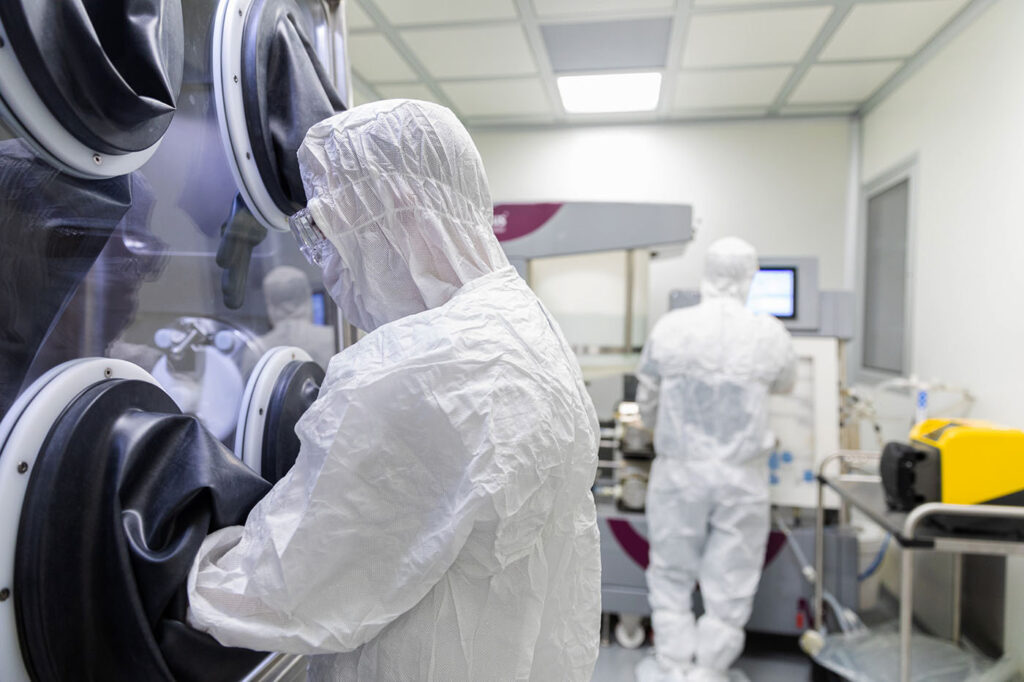
To reduce the risks typically associated with traditional manufacturing, the company implements a complete single-use infrastructure across every stage of ADC production. “By employing a single-use system for all aspects—from buffer preparation and antibody processing to conjugation—we can achieve seamless product changeovers. This integration allows us to expedite the process and shorten the cadence required to move a candidate from development into manufacturing GMP-compliant materials. This single-use strategy extends to purification as well, including tangential flow filtration and chromatography, which minimizes contamination risks and ensures high purity at commercial scales.”
Early versus late-stage strategies
ADCs (among other types of cancer therapeutics) are becoming increasingly diverse and structurally complex molecules presenting a host of new technical and manufacturing hurdles. “One of the central challenges in the ADC field is enabling scalable, cost-efficient, and stage agnostic process development and manufacturing,” points out Engin Ayturk, PhD, senior director, CMC bioconjugation, process development and manufacturing at Exelixis. He continues, “As linkers, toxins, and conjugation formats expand, developers must balance process flexibility with strict control of quality, impurities, and manufacturability. Early‑stage programs prioritize speed, exploratory learning, and adaptable processes, while late‑stage efforts require deep characterization, risk management, and industrial robustness to meet commercial expectations and regulatory demands.”

Senior Director, CMC Bioconjugation, Process Development & Manufacturing, Exelixis
According to Ayturk, Exelixis is addressing these needs via its modular, platform-ready ADC development that supports both rapid exploration and disciplined scale-up. He elaborates, “Our ‘goldilocks leveraging’ model refers to developing processes that are not over‑engineered for early phases nor under‑developed for late phases. Instead, we design them to be just right—balancing flexibility with manufacturability. This enables seamless scaling, efficient technology transfer, reduces redevelopment burden, and accelerates readiness for pivotal studies.”
“We achieve this by integrating predictive modeling, manufacturability/facility-fit assessments, high-throughput screening, and structured Design-of-Experiments (DoE)‑driven process development and characterization. These tools allow us to identify optimal operating spaces earlier and reduce surprises during scale‑up.”

Ayturk says the company has already achieved therapeutic successes with their strategies and will continue to evolve their product portfolio to target “an expanding range of tumor types and indications with our clinically differentiated pipeline of small molecules and biotherapeutics, including ADCs, while also collaborating with industry partners to leverage external innovation to build first- and best-in-class molecules.”
Looking ahead, Ayturk predicts, “Improved manufacturing efficiency, reliability, and optimized cost‑of‑goods will increasingly shape clinical progress, competitive differentiation, regulatory momentum, and patient access. Organizations able to industrialize ADCs with precision and speed will be best positioned to deliver meaningful and sustainable impact.”
Streamlining supply chain
ADC production demands orchestrating many critical processes including biologics manufacturing, highly potent small-molecule synthesis, conjugation chemistry, analytical characterization, and sterile fill-finish. “The rise of novel bioconjugate products such as protein degraders, radioimmunoconjugates, or novel protein scaffold formats also adds an extra layer of complexity in terms of required CMC expertise,” explains Vitor Sousa, PhD, director of business development at Proveo, a division of Cerbios-Pharma SA.

Director, Business Development
Proveo a division of Cerbios-Pharma
Sousa says that developing or manufacturing ADCs often involves a complex supply chain in which some of the components are handled via external specialized contractors. “This situation increases operational complexity, such as handling multiple contracts, multi-party project management, and demands logistics on top of the core manufacturing and containment requirements.”
Proveo is helping to mitigate these vulnerabilities through an integrated ADC supply chain. Sousa elaborates, “Proveo, a partnership between three established industry leaders (Cerbios-Pharma, AGC biologics, and medac CDMO), was created to exactly address the complexity of the supply chain in ADC manufacturing. This partnership brings together, within a single framework, the complementary know-how and expertise required to support ADC programs end-to-end, from development to commercial manufacturing, covering linker-payload and mAb production through to ADC Drug Substance and Drug Product.”
Sousa says this approach also streamlines documentation, centralizes project management, and integrates logistics. “The objective is to provide innovators with a single coordinated structure for consolidating the full supply chain and minimizing operational burden and interfaces.”
By tightening control across the full-value chain, this model aims to enhance timeline predictability and technical robustness for next-generation ADC programs. Sousa advises companies evaluating their options: “For ADC programs specifically, end-to-end supply chain integration, specialized know-how, and reliable capacity up to commercial manufacturing are among the key criteria when selecting a CDMO.”