People come to Orlando, Florida to escape. With Disney World, SeaWorld and Universal Studios all in the area, there are endless opportunities to leave behind the challenges of the real world for a bit of magic and relaxation.
But if hematologists walking into the American Society of Hematology (ASH) annual meeting—which is being held at the Orange County Convention Center in Orlando from Dec. 6 to 9—were hoping to forget about the struggles facing science in the U.S. for just a few days, they likely were disappointed. Imagery around the conference, especially in the main entry, repeatedly referenced the dire situation that U.S. science faces amid the second Trump administration.
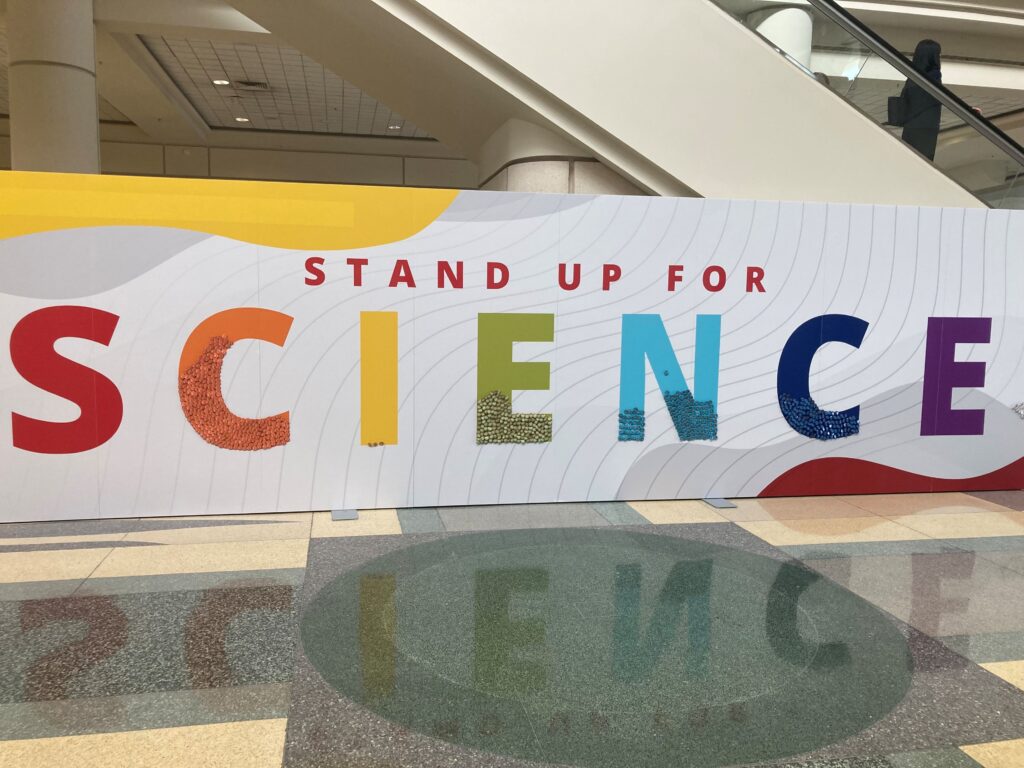
A large mural reading “Stand Up for Science” was adorned with buttons free for the attendees’ taking. The pins featured pro-science messages like: “What do we want? Evidence-based science; When do we want it? After peer review.”

On the reverse side, a rainbow mural celebrating diversity in hematology stood out—a stark contrast to the anti-DEI policies that have become a staple of the Trump administration’s leadership.
Columns were decked out with a message from outgoing ASH President Belinda Avalos, M.D., encouraging attendees to “fight for science, fight for research, fight for hematology, and fight for our patients.” The slogan “Fight 4 Hematology” served as decoration on the conference floor and tables, and guidance on how hematologists can advocate for their field was plastered next to Avalos’ message and on a large flight of stairs.
But step a little further into ASH Central and the fun-filled Orlando atmosphere takes over. Take your pick: Play a game of pickleball? Take a snooze in a futuristic nap pod? Pet some adorable puppies? It was here that the true nature of 2025’s ASH meeting revealed itself.
“You’re seeing an enduring activism,” Jake Van Naarden, president of Lilly Oncology for Eli Lilly, told Fierce Biotech at the conference. “The academic funding situation and the challenges they’re in is real,” he said.
Given the long-standing nature of the activism, the topic isn’t dominating conversations at the conference, Van Naarden added. Instead, the focus has been on new data, advances in care and catching up with old friends.
Related
Van Naarden’s sentiments were echoed by multiple other attendees that Fierce spoke with, and match the mood at the American Society of Clinical Oncology meeting this past spring.
“This is exactly what my experience is here, too,” Anne Kerber, M.D., head of hematology, oncology and cell therapy at Bristol Myers Squibb, told Fierce at ASH.
“The overall field has been making such tremendous progress for patients,” she said, adding that the focus on that progress “unites this whole ASH community.”
That community came out in full-force to Florida. A record-breaking number of abstracts were submitted to the conference, with more than 8,200 accepted, Avalos said during a Dec. 1 media preview.
“You could go across this conference and you would see so many potential breakthroughs for patients with hematological disease,” P.K. Morrow, M.D., Takeda’s head of oncology, told Fierce. “I feel like ASH is meeting the moment in terms of staying scientifically grounded.”
Morrow called the conference “really exceptional,” a description that became clear during the late-breaking abstract presentations on Dec. 9. That’s when Phoebe Ho, Ph.D., of the University of Sydney, presented data on the first four patients treated with Kelonia Therapeutics’ in vivo CAR-T therapy for relapsed and refractory multiple myeloma.
No cancer was detected in any of the patients one month after treatment, as measured by flow cytometry and genetic sequencing.
After Ho’s talk, attendees lined up to ask questions, starting their queries by first describing the data as “beautiful” and “fantastic.” Robert Negrin, M.D., a hematologist at Stanford University and the incoming president of ASH, told Ho the study’s result “takes your breath away.”

In vivo CAR-T, where gene therapy is used to tweak T cells so that they target cancer, has surged in popularity this year.
The method is designed to improve upon ex vivo CAR-T, where the cells are removed from patients and gene edited in the lab before being reinfused, a field that kicked off with the 2012 treatment of pediatric leukemia patient Emily Whitehead and subsequent approval of Novartis’ Kymriah (tisagenlecleucel).
“We’re excited about in vivo,” Cindy Perettie, executive vice president and global head of Gilead’s cell therapy unit Kite Pharma, told Fierce at ASH before Ho’s presentation. Kite presented data for its buzzy next-gen ex vivo CAR-T anito-cel at the conference, and has also made recent buys into in vivo.
“I’m really excited by the meeting. We’re seeing a lot of really interesting data,” she added. “There’s a lot of options for patients now.”
Cautious optimism
Developing new treatments requires strong science, but it also demands extensive capital to fund clinical trials and a stable regulatory environment that enables advance planning. On these fronts, 2025 has been a year of concern.
There were no biotech IPOs from February to September, a prolonged dry period, until LB Pharmaceuticals broke the spell. Profound layoffs and leadership turnover at the FDA has prompted fears of disrupted drug reviews and the loss of American biotech leadership. And Trump policies around “most favored nation” (MFN) drug pricing and pharmaceutical tariffs have caused consternation throughout the year.
Now, the industry may have found its footing in the more turbulent world.
Related
“People are at a point where there’s cautious optimism,” Adam Rosenthal, Ph.D., co-founder and CEO of Star Therapeutics, told Fierce at ASH. “I think on a lot of uncertainties that were there earlier this year, like around tariffs and MFN, that seems to be at a steadier spot.”
“On the FDA, that just continues to be a new surprise every month,” he continued. “We’ll see if and when that settles out.”
The ASH meeting launched mere days after longtime FDA oncology leader Richard Pazdur, M.D., announced plans to retire just weeks after ascending to head up the agency’s Center for Drug Evaluation and Research.
Multiple executives from Big Pharma companies told Fierce at ASH that despite the chaos gripping the FDA, their interactions with the agency haven’t changed.
“Merck continues to work closely with the FDA on our development programs and we appreciate the patient-centered focus that the FDA has,” Gregory Lubiniecki, M.D., vice president of global development at Merck Research Laboratories, told Fierce.

Kite’s interactions with the agency “have been going really well,” Kite’s Perettie said. “And we continue open dialog with them on our next-generation products.”
Van Naarden, Morrow and Kerber also said they haven’t seen changes in their relations with the agency at Lilly, Takeda and BMS, respectively.
“We’re actually not seeing any differences, to be honest,” Hesham Abdullah, M.D., GSK’s global head of oncology, told Fierce at the conference. “From our end, things are continuing to run as planned.”
“We don’t get special treatment,” Lilly cancer leader Van Naarden said. “If we haven’t been seeing it, I assume no one’s seeing that as yet.”
But that’s not necessarily the case. While ASH was ongoing, on Dec. 7, the FDA missed an approval decision deadline for a new indication of Agios Pharmaceuticals’ Pyrukynd (mitapivat) in thalassemia.
Along with Agios, numerous other smaller pharmas and biotechs have faced delays or surprising decisions from the FDA since Trump took office in January. Denali Therapeutics, Regenxbio, Neurizon, Coya Therapeutics, KalVista, Stealth Biotherapeutics and Omeros have all been dealt delays or missed deadlines by the agency, despite FDA Commissioner Marty Makary, M.D., pledging in June that the agency was “on track” to meet its deadlines.
Others, like Capricor Therapeutics and Replimune, have been handed high-profile drug rejections for reasons that reportedly contradict past guidance they’ve received from the FDA.
When Fierce mentioned that the agency has missed some PDUFA deadlines, Van Naarden highlighted the FDA’s recent on-time approvals of Lilly’s breast cancer med Inluriyo (imlunestrant) and expanded label for BTK inhibitor Jaypirca (pirtobrutinib).
“This is what it normally looks like,” he said of the recent approvals. “I don’t know if that changes in the future.”
The discrepancy between the words of Big Pharma leaders and the experiences of smaller companies raises questions about possible FDA favoritism for certain companies, a concern also raised by lawmakers currently probing the agency’s newly launched “national priority” voucher program.
“FDA does not give preferential treatment to any company, and any suggestion that reviews are influenced by a company’s size or name is simply wrong,” Andrew Nixon, the head of communications for the Department of Health and Human Services, which oversees the FDA, told Fierce Biotech.
The fight goes on
Though the data has been strong and the mood buoyant at this year’s ASH meeting, that doesn’t mean the fight for hematology care has been won.
“This has been a really unprecedented time for us in terms of funding by our U.S. federal government, and we have been very concerned about the ability to continue to be able to do research,” outgoing ASH leader Avalos told Fierce.
Related
Hematologists have largely answered the call, she said, advocating for their field at the local or national level, donating to the ASH foundation and sharing stories about the importance of their work for patients.
When the Trump administration began cutting federal science funding from the National Institutes of Health and elsewhere, ASH responded by pledging more than $12 million to cover for lost grants. The group has now increased the number of awards available to $20 million this year, Avalos said.
“Obviously we can’t sustain that, but we’re hoping that there will be interventions that occur over the next year at least,” she explained.
And as suggested by the rainbow mural featured at the conference, ASH has not shied away from the importance of diversity in hematology. In December of last year, the organization conducted a pair of surveys to identify roadblocks to improving diversity in hematology trials and elucidate the strategies ASH members use to advance DEI in their own research.
Part of ASH’s commitment to diversity, which also includes a series of funding opportunities across career levels, stems from hematology’s own history with sickle cell disease. The condition predominantly affects people of African origin, and the disease has long suffered from neglect from the medical community.
“Sickle cell disease has been one of the diseases that has been long ignored,” Avalos said. “We’ve known the cause of sickle cell disease for many, many decades, yet very few treatments have been available.”
ASH now runs the Center for Sickle Cell Disease Initiatives, which launched in 2015, and the disease was the topic of several special interest sessions at this year’s meeting.
Like many of the other attendees, Avalos was thrilled by the quality of data presented at ASH and thinks the optimistic vibe is a good sign for hematology’s future.
“Optimism is important,” she said. “Because that’s what keeps driving us.”