
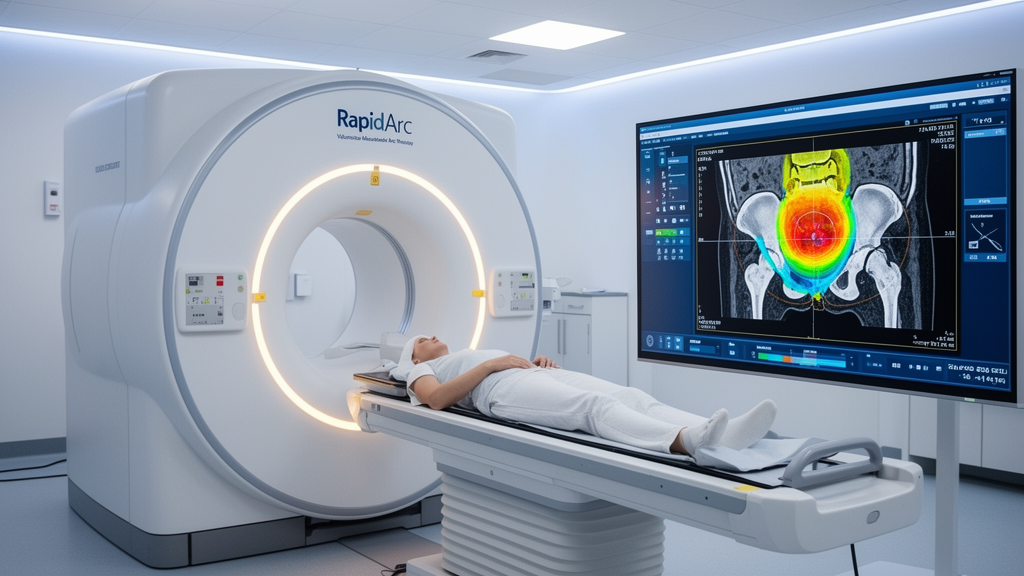
In a retrospective comparative planning study of thirty patients with high-intermediate risk endometrial cancer, researchers evaluated RapidArc Dynamic radiotherapy, which combines continuous arc delivery with strategic gantry pauses and dynamic collimator rotation. Simultaneous integrated boost radiotherapy delivers escalated doses to high-risk nodal areas alongside pelvic treatment, but larger boost volumes and elevated radiation doses increase the risk of acute Grade 3 or greater toxicities in healthy tissues. The comparative investigation at Shandong Cancer Hospital demonstrated that RapidArc Dynamic achieved superior organ-at-risk protection, sharper dose fall-off gradients, and robust target coverage compared to conventional nine-field intensity-modulated radiation therapy and two-arc volumetric modulated arc therapy.
Volumetric modulated arc therapy evolved from intensity-modulated radiation therapy by simultaneously modulating gantry speed, multi-leaf collimator leaf shapes, and dose rates during gantry rotation, thereby reducing delivery duration and monitor units. RapidArc Dynamic advances this approach by integrating continuous arc trajectories with static angle-modulated ports, termed STAMPs, which temporarily halt gantry movement at designated angles while allowing the multi-leaf collimator to continue modulating the beam. Earlier multi-site investigations evaluating RapidArc Dynamic in breast and prostate cancers indicated reductions in mean cardiac dose and enhanced sparing of the bladder and rectum, while cervical cancer evaluations observed improved dose fall-off gradients. Prior to the present investigation, however, the dosimetric feasibility and performance of this dynamic paused-arc approach had not been systematically evaluated for endometrial cancer cases receiving simultaneous integrated boost regimens.
The retrospective single-center study analyzed computed tomography datasets from thirty patients with high-intermediate risk endometrial cancer who underwent external beam radiotherapy with simultaneous integrated boosts between January 1, 2024, and January 1, 2025. Target contouring followed international eviQ protocols and National Comprehensive Cancer Network guidelines. The gross tumor volume captured primary endometrial malignancy, while involved lymph nodes were delineated as the nodal gross tumor volume. The clinical target volume united gross disease with regions of potential microscopic spread, including the uterus, cervix, fallopian tubes, ovaries, upper half of the vagina, paravaginal soft tissues, and parametrium, with explicit cropping of the duodenum and small bowel. A five-millimeter isotropic expansion defined the nodal clinical target volume, while an eight-millimeter isotropic margin was added to generate the planning target volume to account for setup uncertainties and internal anatomical motion.
Delineation of organs at risk encompassed the bladder, rectum, small intestine, duodenum, spinal cord, femoral heads, kidneys, and pelvic bone marrow. Contours were generated using AccuContour version 3.2, a deep learning auto-segmentation tool from Manteia Technologies, and manually refined by an experienced medical physicist and a radiology specialist. To protect surrounding normal tissues against intra-fraction and inter-fraction organ motion, planners delineated two triangular avoidance regions designated Hot_Ant and Hot_Pos approximately 3.5 centimeters away from the planning target volume. Maximum dose suppression criteria were assigned to these triangular avoidance regions during inverse optimization, serving as a supplementary spatial shield that curbed peripheral dose leakage without compromising primary planning target coverage or the simultaneous integrated nodal boost prescription.
For each patient, three treatment plans were generated in the Eclipse planning system using the Photon Optimizer version 18.1 algorithm. Plans prescribed 50.4 Gray in 28 fractions to the planning target volume alongside a simultaneous integrated boost of 61.6 Gray to the nodal clinical target volume, mandating that at least 95 percent of both volumes receive 100 percent of prescribed doses. Modeling corresponded to a Varian TrueBeam linear accelerator with a Millennium 120-leaf multi-leaf collimator featuring forty central leaf pairs of 0.5-centimeter width and twenty peripheral pairs of 1.0-centimeter width. Dose distributions were computed with the Accuros XB algorithm on a 2.5 by 2.5 by 3.0 millimeter grid. RapidArc Dynamic utilized 6-megavolt flattening filter-free beams operating at 1400 monitor units per minute, whereas intensity-modulated and volumetric arc plans used standard 6-megavolt flattened beams at 600 monitor units per minute.
To ensure unbiased comparisons, optimization avoided knowledge-based models and enforced identical initial objective constraints across all techniques, with normal tissue objectives set to automatic. Planners deployed artificial ring structures—four concentric rings surrounding the planning target volume and two rings enclosing the nodal volume—to sharpen external dose gradients and regulate intermediate dose spillage. Conventional intensity-modulated plans adopted a coplanar nine-field sliding window geometry with beam angles spaced at approximately 40-degree increments. Standard volumetric modulated arc plans incorporated two full 360-degree coplanar arcs: the first rotated clockwise from 181 to 179 degrees with collimator angle fixed at 15 degrees, while the second rotated counterclockwise from 179 to 181 degrees with a complementary collimator angle of 345 degrees to limit interleaf radiation leakage.
The RapidArc Dynamic technique integrated two full rotational arcs with static angle-modulated ports positioned at opposing gantry angles of 0 and 181 degrees. The Eclipse platform provides five static weighting modes: arc dominant at minus two with 2 control points, arc at minus one with 14 control points, balanced at zero with 26 control points, static at plus one with 39 control points, and static dominant at plus two with 51 control points per pause. Planners selected the static weighting of plus one, assigning 39 control points to each paused angle to enhance static port modulation while maintaining rotational efficiency, with optimization capped at 4000 iterations. Opposing angles allowed multi-leaf collimator leaves to shield the centrally located bladder and rectum while delivering modulated fluence laterally to parametrial tissues and lymph nodes, with dynamic collimator rotation automatically optimized by Eclipse throughout the arcs.
Plan quality and geometric conformity were quantified through standardized dosimetric indices and dose-volume histograms after normalizing all ninety plans so that 95 percent of the planning target volume received the 50.4 Gray prescription. The Paddick conformity index evaluated dose conformity, where the square of the target volume covered by the reference isodose was divided by the product of total prescription isodose volume and target volume, with values closer to one indicating ideal conformation. Intermediate-dose spillage was evaluated through the 50 percent dose spillage ratio, defined as the ratio of total normal tissue volume receiving at least half the prescription dose to target volume, where lower values denote steeper dose fall-off. Delivery complexity was appraised via the modulation complexity score and leaf travel modulation complexity score, which integrate leaf sequence variability, aperture area variability, and leaf motion, where values closer to zero indicate greater complexity. Statistical comparisons utilized two-tailed Mann-Whitney U tests with Benjamini-Hochberg corrections at a 0.05 significance threshold.
Across all ninety plans, RapidArc Dynamic achieved robust target coverage while significantly reducing radiation exposure to critical pelvic organs. The average dose delivered to 95 percent of the nodal clinical target volume reached 62.41 plus or minus 2.35 Gray for RapidArc Dynamic and 63.03 plus or minus 1.44 Gray for intensity-modulated plans, whereas volumetric modulated arc plans achieved a significantly lower mean of 61.62 plus or minus 1.94 Gray, with several plans nearing the minimum 61.6 Gray prescription threshold. RapidArc Dynamic resulted in the fewest and mildest dose constraint violations for the small intestine, with only 13 plans exceeding the 52 Gray limit across two cubic centimeters, compared to 23 intensity-modulated and 29 volumetric arc plans. Bladder constraint evaluations demonstrated that RapidArc Dynamic matched volumetric arc plans with only 2 instances exceeding 50 percent volume at 45 Gray, while significantly outperforming both modalities by limiting two-cubic-centimeter bladder doses over 53.5 Gray to just 3 plans, compared to 9 intensity-modulated and 13 volumetric arc plans.
Dosimetric evaluation revealed that RapidArc Dynamic attained an average planning target volume conformity index of 0.833, comparable to the 0.835 observed in nine-field intensity-modulated plans and significantly superior to the 0.813 achieved by two-arc volumetric modulated therapy. For the nodal clinical target volume, the conformity index averaged 0.482 with RapidArc Dynamic, outperforming the 0.372 achieved by volumetric arc therapy, though trailing the 0.545 measured in intensity-modulated plans. RapidArc Dynamic produced the lowest 50 percent dose spillage ratio at an average of 3.45, demonstrating significantly sharper dose fall-off than the 3.86 recorded for intensity-modulated plans and the 3.67 observed for volumetric arc plans. Dose-volume histogram analyses confirmed that RapidArc Dynamic delivered significantly lower doses across evaluated metrics including rectum maximum dose, rectum volume receiving 40 Gray, two-cubic-centimeter rectal dose, small bowel maximum dose, and bone marrow volume receiving 40 Gray, though all ninety plans breached the stringent baseline bone marrow constraint of less than 90 percent volume receiving 10 Gy due to large pelvic boost margins.
Analysis of machine delivery characteristics highlighted substantial differences in monitor units and leaf motion among the three delivery techniques. Volumetric modulated arc therapy required the lowest average monitor units at 527.8, while RapidArc Dynamic averaged 1314.7 monitor units, requiring significantly fewer monitor units than the 3334.0 demanded by nine-field intensity-modulated radiotherapy. The modulation complexity score and leaf travel complexity score averaged 0.16 for RapidArc Dynamic, reflecting significantly less mechanical aperture complexity and reduced leaf travel compared to the 0.03 score observed in intensity-modulated plans, though representing higher modulation than the 0.26 score of volumetric arc therapy. The investigators noted several methodological limitations, including that physical delivery times were not empirically measured on linear accelerators and that higher dose rates of 1400 monitor units per minute in flattening filter-free beams may have contributed to theoretical delivery efficiency gains over standard 600 monitor unit per minute configurations. Furthermore, the retrospective planning study utilized relatively generous margins of eight millimeters for the primary planning target and five millimeters for nodal targets, and did not evaluate non-opposing oblique static pause configurations.
Subject of Research: Dosimetric comparison of RapidArc Dynamic, IMRT, and VMAT for endometrial cancer simultaneous integrated boost radiotherapy
Article Title: RapidArc dynamic versus IMRT and VMAT for endometrial cancer SIB radiotherapy
Article References: Zhao, Y., Zhang, X., Wang, X., Jiang, Z., Ma, X., Liu, J., Xiao, H., Gong, G., & Yin, Y. (2026). RapidArc dynamic versus IMRT and VMAT for endometrial cancer SIB radiotherapy. Radiation Oncology, 21(1), Article 161. https://doi.org/10.1186/s13014-026-02933-7
Image Credits: AI Generated
DOI: 10.1186/s13014-026-02933-7
Keywords: RapidArc Dynamic, intensity-modulated radiation therapy, volumetric modulated arc therapy, simultaneous integrated boost, endometrial cancer, organ-at-risk sparing, conformity index, dose spillage ratio, modulation complexity score, monitor units, gantry pauses, dynamic collimator rotation, external beam radiotherapy, AccuContour, Accuros XB, Shandong Cancer Hospital, dose fall-off gradient

