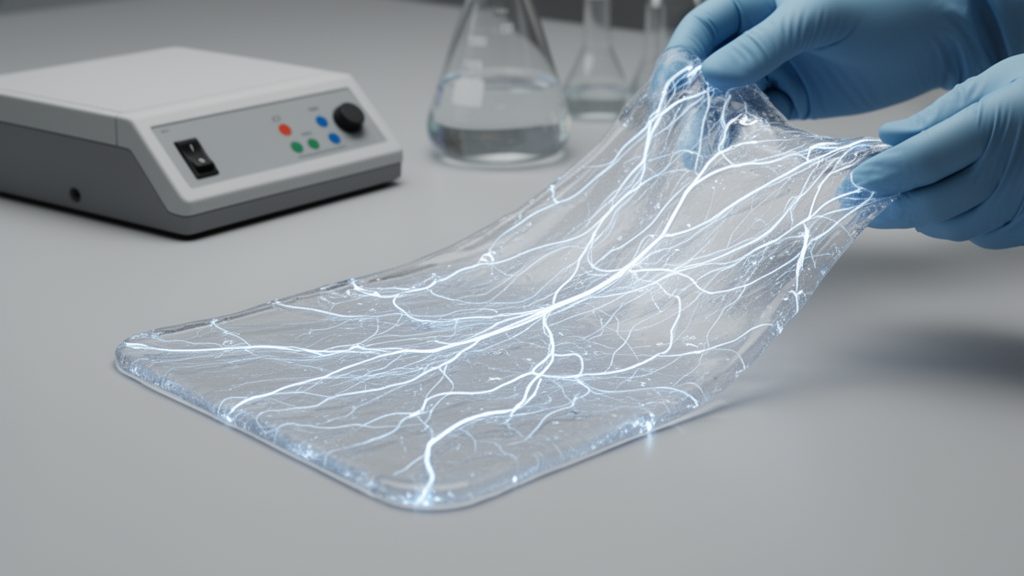
A review in the Journal of Materials Science examines advances in conductive hydrogels, focusing on conductive-network construction, multidimensional performance optimization and functional design. The review covers key electron-conductive material systems, biomass-based composite systems and advanced manufacturing strategies. It also considers how structural design, interfacial regulation and environmental adaptability influence material performance and device functionality.
This is a review of research rather than a report of a new experiment. Conductive hydrogels are presented as important materials for flexible electronics because they combine a soft, wet structure with tunable mechanical properties and coupled electron–ion transport. The review’s central framework links these properties to the construction of conductive networks within the hydrogel.
Rather than treating conductivity alone as the design goal, the authors emphasize optimization across multiple dimensions, including mechanical performance, interfaces and adaptation to operating conditions. The review also examines biomass-based composite systems and advanced manufacturing methods as parts of the field’s development. These topics extend the analysis beyond the choice of an individual conductive component: network construction, material combinations and fabrication strategies are considered together when assessing the performance of conductive hydrogels.
The review summarizes applications in flexible bioelectronics, energy conversion and emerging interdisciplinary fields, where the combination of mechanical adjustability and electron–ion transport supports the use of these materials in soft electronic systems. Several bottlenecks remain. The authors identify a trade-off between high conductivity and high mechanical strength, along with unresolved challenges in long-term operational stability, scalable manufacturing and system-level integration.
The review does not establish that any particular formulation solves these problems or that conductive hydrogels are ready for broad deployment. Instead, it presents coordinated design across network structure, interfaces, mechanical properties, environmental adaptability and manufacturing as the basis for future progress.
Subject of Research: Review of conductive-network engineering and performance optimization in conductive hydrogels
Article Title: Review: advances in conductive network engineering, multidimensional performance optimization, and functional design of conductive hydrogels
Article References: Tai, S., Cao, S., Zhang, X., & Liu, X. (2026). Review: advances in conductive network engineering, multidimensional performance optimization, and functional design of conductive hydrogels. Journal of Materials Science, 61(41), 31552-31570. https://doi.org/10.1007/s10853-026-13655-2
Image Credits: AI Generated
DOI: 10.1007/s10853-026-13655-2
Keywords: conductive hydrogels, conductive networks, flexible electronics, bioelectronics, energy conversion, biomass composites, interfacial regulation, advanced manufacturing, electron–ion transport, Review, advances, conductive