
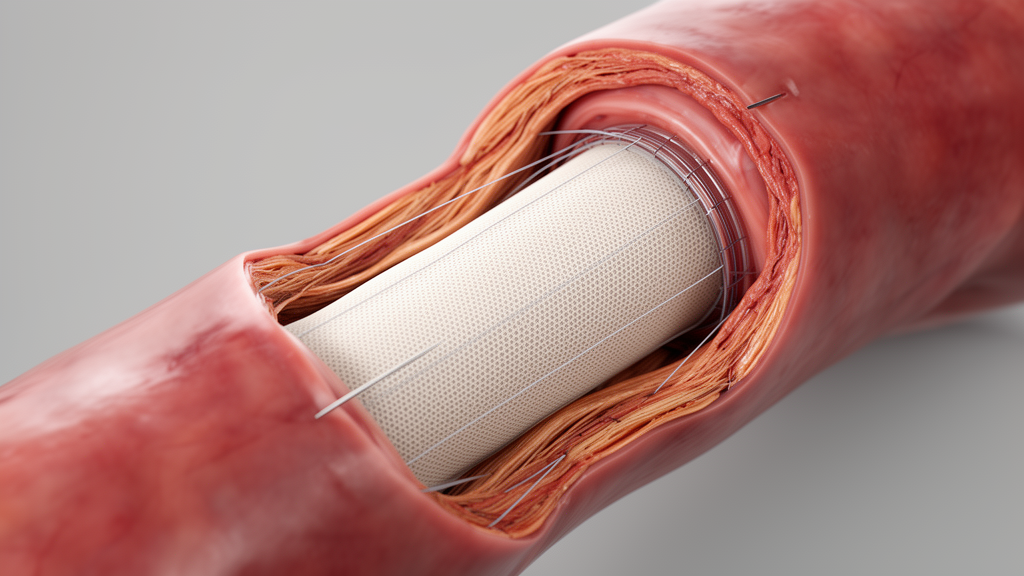
In a single-center retrospective cohort analysis evaluating in-situ reconstruction for aortic vascular graft and endograft infections, researchers observed four treatment failures among patients receiving rifampicin-soaked Dacron prostheses and zero failures among those receiving bovine pericardial grafts, though survival and treatment failure rates showed no statistically significant differences between the cohorts. A retrospective single-center study at a tertiary referral center examined clinical outcomes across 62 patients who underwent infected graft explantation and in-situ reconstruction between January 2018 and December 2025.
Aortic vascular graft and endograft infection represents a rare but life-threatening complication following open and endovascular interventions, with published incidences of 0.6 to 3 percent following open repair and under 1 percent following endovascular repair. In contemporary surgical cohorts, reported in-hospital mortality ranges from 19 to 48 percent, with septic shock and secondary aorto-enteric fistulas acting as adverse prognostic determinants. While autologous veins and cryopreserved allografts yield low reinfection rates, their practical deployment remains constrained by procurement delays and technical limitations, making synthetic rifampicin-soaked Dacron and biological bovine pericardial tissues two primary alternatives for emergency and urgent reconstruction.
The study protocol incorporated adult patients presenting with confirmed central infrarenal aortic or aortoiliac prosthetic graft infections following previous open abdominal aortic repair or endovascular aneurysm repair. Diagnostic confirmation required intraoperative findings, positive microbiological cultures, or adherence to the Management of Aortic Graft Infection Collaboration criteria, which demand at least one major criterion combined with an additional criterion across clinical, imaging, or laboratory domains. Preoperative work-ups routinely incorporated positron emission tomography combined with computed tomography, while esophagogastroduodenoscopy was performed in individuals with suspected secondary aorto-enteric fistulas. Patients undergoing explantation for isolated iliac infections, mechanical dislocation, thrombosis, or endoleak without confirmed infection were excluded.
Among the 62 patients included in the investigation, 21 individuals received hand-sewn bovine pericardial reconstructions and 41 received rifampicin-soaked Dacron prostheses. Demographically, the cohorts presented comparable mean ages of 72.57 years in the bovine cohort and 73.58 years in the rifampicin cohort, alongside male proportions of 85.71 percent and 73.17 percent, respectively. Prior interventions comprised open aortic repair in 53.2 percent of the overall cohort and endovascular aneurysm repair in 46.8 percent, with suprarenal barb or hook fixation frequently noted in endovascular explantations. Urgent surgical intervention within 24 hours accounted for 53.2 percent of cases, while immediate emergency surgery was required in 46.8 percent.
Baseline assessments revealed significant physiological differences between the two recipient groups before surgery. Patients selected for bovine pericardial conduits presented with a significantly higher body mass index of 25.84 kilograms per square meter compared with 21.31 kilograms per square meter in the synthetic prosthesis group. In addition, baseline hemodialysis dependency was significantly more prevalent among bovine graft recipients, documented at 23.8 percent versus 4.9 percent in the rifampicin group. Rates of underlying hypertension, chronic obstructive pulmonary disease, and peripheral arterial disease did not exhibit statistically significant imbalances.
Surgical interventions were performed under general anesthesia via open transabdominal exposure, involving radical debridement and graft explantation. Synthetic prostheses underwent immersion for 10 minutes in a solution of 300 milligrams of rifampicin dissolved in 50 milliliters of physiological saline immediately prior to vascular anastomosis, whereas bovine conduits were hand-fabricated intraoperatively from pericardial patches. This intraoperative fabrication contributed to a significantly longer mean aortic cross-clamp duration in the bovine cohort at 79.24 minutes compared with 39.17 minutes in the rifampicin-soaked Dacron cohort. Omentoplasty coverage was applied when anatomically feasible.
Secondary aorto-enteric fistulas were verified in 27 patients across the study population, representing 47.62 percent of the bovine group and 41.46 percent of the rifampicin group. All fistula cases underwent simultaneous gastrointestinal repair, consisting of segmental intestinal resection in 16 patients or primary enterorrhaphy in the remainder. Pathogen recovery occurred with significantly higher frequency in the presence of secondary aorto-enteric fistulas, yielding positive isolates in 96.3 percent of affected patients compared to 54.28 percent in those without enteric erosion.
Microbiological processing of preoperative blood cultures and intraoperative tissue specimens identified Candida species as the most frequent infectious organism, accounting for 27.78 percent of all positive isolates. Candida was significantly associated with secondary aorto-enteric fistulas, appearing in 12 fistula cases. Additional commonly recovered microorganisms included Escherichia coli at 18.52 percent and Enterococcus faecalis at 14.81 percent, alongside Staphylococcus aureus, Klebsiella species, Enterococcus faecium, Enterobacter cloacae, and Pseudomonas aeruginosa. Negative cultures were documented in 12.90 percent of patients. Postoperative antimicrobial regimens involved intravenous targeted agents followed by oral suppressive therapy for approximately 8 to 12 weeks guided by antimicrobial stewardship specialists.
Overall in-hospital mortality reached 17.74 percent across the series, occurring in 14.28 percent of bovine graft recipients and 19.51 percent of synthetic graft recipients, without a statistically significant difference. Early mortalities stemmed primarily from progressive multiorgan dysfunction and septic shock. Postoperative morbidity encompassed dialysis requirement in 14.52 percent, graft occlusion in 14.52 percent, wound complications in 6.45 percent, and lower limb amputation in 1.61 percent. Tracheostomy was necessary in three patients, all managed with rifampicin-soaked Dacron. Kaplan–Meier analyses revealed no significant divergence in overall cumulative survival between the two conduit groups.
The study’s primary endpoint of treatment failure occurred exclusively in the rifampicin-soaked Dacron cohort, affecting 4 of 41 patients over a mean follow-up of 14.60 months, while no reinfections occurred among the 21 bovine graft recipients followed for a mean of 5.57 months. These treatment failures presented between 17 and 84 months after index reconstruction. Kaplan–Meier estimates showed no statistically significant difference in freedom from treatment failure. The authors noted that retrospective non-randomized allocation, confounding by operative era, small cohort size, and disparate follow-up durations prevent causal conclusions regarding biological graft superiority, underscoring the need for larger prospective multicenter evaluations.
Aortic cross-clamping strategies and perioperative resource utilization provided additional insight into procedural complexity across both treatment arms. Suprarenal aortic clamping was applied in 29.03 percent of all patients, involving 28.57 percent of the bovine group and 29.27 percent of the rifampicin cohort, while supravisceral clamping was required in 45.16 percent of procedures, comprising 38.09 percent of bovine and 48.78 percent of synthetic reconstructions. These clamp placements reflected evolving procedural planning and anatomical considerations rather than disparities in baseline disease severity. Furthermore, requirements for transfused blood products, including red blood cell units, platelet concentrates, and fresh frozen plasma, did not significantly differ between the cohorts. Following surgery, patients spent an average of 10.6 days in intensive care, with stays averaging 8.09 days for bovine recipients and 10.26 days for rifampicin recipients. Overall postoperative hospitalization averaged 25.51 days, spanning 29.70 days in the bovine cohort and 21.78 days in the synthetic cohort.
Detailed microbiological evaluations demonstrated notable pathogen patterns when stratified by whether patients initially underwent open surgical repair or endovascular intervention. Candida species appeared in 32.26 percent of patients with prior open aortic repair compared with 21.74 percent of those who had previously received endovascular aneurysm repair. Conversely, Staphylococcus aureus was isolated slightly more often in patients with prior endovascular stent grafts at 17.39 percent, compared with 9.68 percent among open repair cases. Certain opportunistic Gram-negative organisms were restricted entirely to the open surgical history cohort, where Pseudomonas aeruginosa was identified in 12.90 percent of cultures and Enterobacter cloacae in 6.45 percent. Neither cohort yielded Mycobacterium species. Enterococcus faecalis, Enterococcus faecium, and enteric Gram-negative rods such as Klebsiella species were isolated across both surgical backgrounds without marked disparities, yielding no statistically significant differences in overall pathogen distribution.
Routine follow-up relied on serial clinical evaluations, laboratory blood testing, and duplex ultrasonography, whereas computed tomography was reserved specifically for patients displaying clinical deterioration or suspicious perigraft fluid collections. Formal assessments were recommended one week following the cessation of antimicrobial therapy, followed by evaluations at three months, six months, and annually thereafter for stable individuals. Discussing the theoretical mechanisms underlying graft performance, the authors highlighted that biological tissues such as bovine pericardium exhibit enhanced biocompatibility and lower bacterial adherence compared to synthetic fabrics. Synthetic Dacron soaked in rifampicin relies on temporary local antibiotic elution, which may eventually be compromised by biofilm formation, drug wash-out, and the emergence of rifampicin-resistant bacteria. However, hand-crafting bovine conduits demands substantial operative time and carries risks of mechanical kinking or anastomotic stenosis, necessitating precise conduit sizing.
The investigation underscored the role of centralized multidisciplinary care in managing this high-acuity surgical population. Clinical protocols integrated vascular surgeons, infectious diseases specialists, anesthesiologists, radiologists, and intensive care physicians to guide surgical debridement, operative timing, and targeted pathogen-directed pharmacotherapy. Nonetheless, several methodological constraints bounded the findings. Conduit selection was not randomized and shifted over time, introducing treatment era bias as institutional experience with bovine pericardium matured later in the study period. Retrospective data collection prevented standardized KDIGO staging for postoperative acute kidney injury, restricting renal evaluation to documented dialysis status. Additionally, granular details regarding specific antimicrobial regimens, intravenous-to-oral transition timings, and exact treatment durations could not be systematically compared. The researchers also noted that reliance on conventional culture techniques may have failed to identify fastidious pathogens in culture-negative presentations, reinforcing that these observational outcomes remain exploratory and hypothesis-generating.
Subject of Research: Comparative outcomes of bovine pericardial and rifampicin-soaked prostheses in aortic vascular graft infection reconstruction
Article Title: Rifampicin-soaked versus bovine prostheses in the management of aortic graft infections: a retrospective single-center cohort study
Article References: Strzoda, V. W., Yordanov, M. D., Oberhuber, A., & Ibrahim, A. (2026). Rifampicin-soaked versus bovine prostheses in the management of aortic graft infections: a retrospective single-center cohort study. Langenbeck’s Archives of Surgery, 411(1), Article 289. https://doi.org/10.1007/s00423-026-04349-z
Image Credits: AI Generated
DOI: 10.1007/s00423-026-04349-z
Keywords: aortic vascular graft infection, bovine pericardial graft, rifampicin-soaked Dacron, in-situ reconstruction, graft explantation, MAGIC criteria, secondary aorto-enteric fistula, Candida species, in-hospital mortality, treatment failure, aortic cross-clamp time, endovascular aneurysm repair, vascular surgery, postoperative dialysis, antimicrobial stewardship, Kaplan-Meier analysis, retroperitoneal debridement

