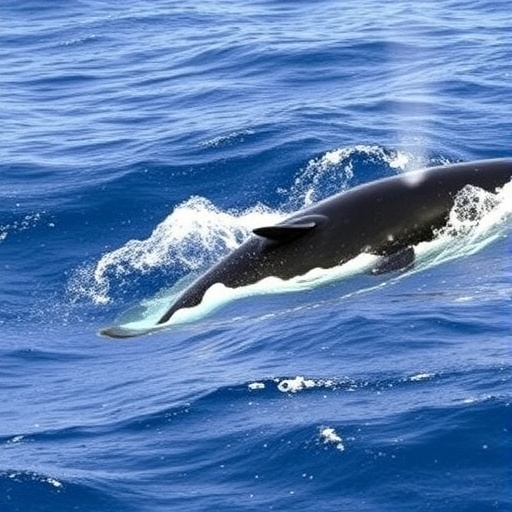
More than four decades after the cessation of industrial-scale whaling, groundbreaking research has unveiled a significant resurgence in the presence of the world’s two largest whale species—Antarctic blue whales (Balaenoptera musculus intermedia) and fin whales (Balaenoptera physalus quoyi)—in the southeastern Atlantic Ocean. This study, recently published in the esteemed African Journal of Marine Science, aggregates over 60 years of verified sighting and stranding data from the Namibian and South African coastlines, revealing a marked increase in these majestic marine giants’ appearances over the past decade.
The comprehensive research compiled observational data stretching from 1964 to March 2025, concentrating on the Benguela upwelling ecosystem—a biologically rich marine region off Namibia and South Africa’s west coast. While absolute numbers of whale sightings remain modest, the study found that an overwhelming 95% of confirmed observations occurred from 2012 onwards, underscoring a potentially significant paradigm shift in population dynamics and habitat utilization in this critical segment of the southeastern Atlantic.
At the core of this research is the examination of two species devastated by early 20th-century industrial whaling campaigns. Historical whaling records estimate a staggering 350,000 Antarctic blue whales and 725,000 fin whales were hunted between 1913 and 1978, resulting in near-collapse of their global populations. These figures cast a long shadow over conservation efforts, and even today, Antarctic blue whales are cataloged as “Critically Endangered” by the International Union for Conservation of Nature (IUCN), with current population estimates lingering at approximately 3% of their pre-whaling numbers. The blue whale population growth rate hovers between 5 to 8 percent annually, indicative of a painstakingly slow recovery process.
Fin whales, while still designated as “Vulnerable,” have experienced a somewhat more robust rebound, currently estimated at exceeding 30% of their historical numbers. Researchers note their populations are expanding at an approximate annual rate of 4 to 5 percent. This recovery is indicative of the species’ resilience and adaptive capacity amidst modern anthropogenic challenges. However, both species’ elusive and migratory nature, coupled with their extensive movements through remote Antarctic waters, have historically posed significant logistical obstacles to monitoring and evaluating their populations accurately.
The study sheds light on the critical knowledge gap regarding recent presence and migration patterns within the Benguela upwelling ecosystem. The region’s significance is rooted in historical data suggesting it served as a vital nursery ground for both blue and fin whales, a function potentially disrupted by intensive whaling activities. Until this investigation, contemporary data on these species in this area had been fragmented and sparse, complicating efforts to assess their full ecological status and threats.
Analyses within the study highlight marked seasonality in sightings; blue whales were primarily observed from late spring through autumn, aligning with known feeding migrations, while fin whales exhibited year-round presence, potentially reflecting different ecological and breeding behaviors. The gathered data encompass 12 blue whale sightings, a single stranding, and five additional records documented in scientific literature. In contrast, fin whales were reported in 76 sightings and six stranding incidents, demonstrating the species’ relatively higher visibility and possibly greater abundance in the area.
Researchers attribute part of the uptick in sightings to increased observational efforts, especially from marine wildlife observers on seismic survey vessels engaged in oil and gas exploration. While this heightened survey activity may partly explain the recent surge in recorded whale appearances, the temporal concentration of these records strongly supports the hypothesis of genuine population recovery and expanded habitat utilization. This nuanced understanding emerges from integrating both ecological data and anthropogenic observation efforts.
Despite these encouraging signs, the researchers caution against complacency. Large baleen whales continue to face significant threats, including but not limited to, ship strikes, entanglement in fishing gear, pervasive underwater noise pollution, chemical contamination, and profound shifts in oceanographic conditions driven by climate change. These ongoing environmental pressures may impede further recovery unless mitigated by effective conservation strategies.
The research team strongly advocates for the expansion of passive acoustic monitoring techniques to enhance detection capabilities across vast oceanic expanses where visual observations alone remain insufficient. Additionally, they emphasize increasing the coverage of trained observers on commercial vessels to improve data resolution and reliability. Incorporating whale distribution data into marine spatial planning initiatives is seen as pivotal to reconciling industrial activity with the ecological needs of these imperiled species.
Ultimately, the study’s findings highlight a story of cautious optimism. They underline the extraordinary resilience of these cetaceans while acknowledging that true recovery remains an ambitious and distant goal. Over 50 years since the moratorium on commercial whaling, the occurrence of only a dozen blue whale observations in this expansive region serves as a sobering reminder of the long-lasting impacts of human exploitation on marine megafauna.
Co-author Dr. Simon Elwen, Director of Sea Search and Research Associate at the University of Stellenbosch, articulates the delicate balance between progress and persistent vulnerability. While whale populations appear to be reoccupying portions of their historical range, capturing this trend is contingent on continued, rigorous monitoring, increased scientific scrutiny, and proactive marine resource management. The research reflects not only ecological insights but also serves as a powerful call to action for sustained conservation commitment.
In conclusion, this pivotal research enriches our understanding of the evolving status of blue and fin whales in the southeastern Atlantic, offering hard-won hope that these giants may one day reclaim their former prominence in ocean ecosystems. The study exemplifies how interdisciplinary, long-term research combined with modern monitoring methodologies can illuminate pathways toward restoring the balance between human enterprise and marine biodiversity.
Subject of Research: Animals
Article Title: Recent increased presence of blue (Balaenoptera musculus) and fin whales (Balaenoptera physalus) in the Southeast Atlantic: Evidence for recovery?
News Publication Date: 23-May-2026
Web References: https://www.tandfonline.com/doi/full/10.2989/1814232X.2026.2626591
Image Credits: Photo by Sara Golaski for the Namibian Dolphin Project
Keywords: Extinction, Endangered species, Fishing, Overfishing, Hunting, Whaling, Wildlife management
Tags: Antarctic blue whale resurgenceBenguela upwelling marine ecosystemblue and fin whale stranding recordsfin whale sightings South East Atlanticindustrial whaling impact on whaleslong-term whale sighting datamarine mammal conservation AfricaNamibian whale habitatSouth African marine biodiversitysoutheastern Atlantic marine researchwhale population recovery post-whalingwhale sighting trends 2012-2025