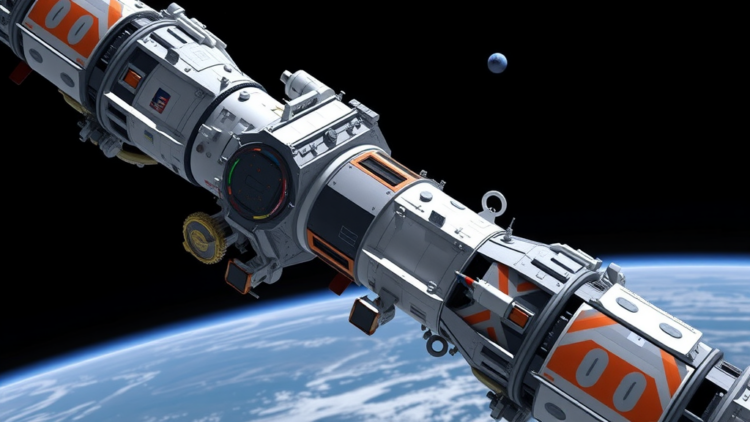
Aboard a spacecraft, the air astronauts breathe is a closed loop, recycled endlessly through ducts, filters, and scrubbers with no open window to dilute whatever accumulates inside. A new computational study published in Discover Chemistry offers one of the most detailed simulation-based frameworks yet for predicting how volatile organic compounds, hydrazine vapors, and heavy metal particulates build up in that closed atmosphere, and how those contaminants might quietly erode crew health on missions to the Moon and Mars. Led by Sampath Emani of Lavira Technologies and an international team of toxicologists and engineers, the research fuses high-fidelity fluid dynamics, molecular docking, and Monte Carlo risk statistics into a single decision-support platform designed to forecast chemical hazards before they strike.
The problem the team set out to address is rooted in physics. On Earth, buoyancy-driven convection constantly stirs the air: warm, contaminated parcels rise, cool air sinks, and pollutants disperse. In microgravity that natural mixing engine disappears entirely. Contaminant transport inside a pressurized cabin becomes governed almost exclusively by forced ventilation, recirculating airflow, and turbulence, with molecular diffusion mattering only in low-velocity pockets where ventilation fades. The consequence is the emergence of stagnation zones, typically behind storage racks and in ventilation-sheltered corners, where contaminants linger far longer than any terrestrial intuition would suggest. Crew movements add a further layer of unpredictability, acting as unintentional mixing promoters whose stochastic trajectories undermine reliable hazard prediction.
To capture this alien fluid dynamics, the researchers constructed a detailed computational fluid dynamics model of a standardized crewed spacecraft cabin, drawing geometric features such as equipment racks, ventilation arrays, and life-support subsystems from publicly available International Space Station schematics and NASA benchmark datasets. They ran simulations on both COMSOL Multiphysics and ANSYS Fluent to cross-validate results, and systematically compared three turbulence closures: k-epsilon, k-omega SST, and large eddy simulation. LES proved superior at resolving the fine-scale vortical structures and recirculation pockets where contaminants accumulate, producing a higher resolved peak VOC concentration of 2.31 ppm in the baseline case compared with 2.03 ppm for k-epsilon and 2.15 ppm for k-omega SST under identical conditions. A three-level mesh-independence check confirmed that the adopted resolution was stable, with differences between medium and fine meshes below three percent.
The simulated results paint a striking picture of invisible danger. Model-predicted peak cabin VOC concentrations reached 1.8 to 2.3 ppm in confined zones, while particulate matter maxima climbed to 0.12 to 0.16 milligrams per cubic meter. In stagnation wells adjacent to equipment racks, contaminant mass fractions exceeded the cabin average by as much as 35 percent, and in some regions surpassed spacecraft maximum permissible exposures by up to 45 percent. Hydrazine vapor, denser than cabin air even without gravity, stratified into layered clouds that settled within ventilation duct bends and junctions. Perhaps most concerning, up to 32 percent of fine metal particulates smaller than five micrometers remained airborne twelve hours after release, circulating endlessly through recirculation loops and multiplying the risk of repeated inhalation.
History shows these are not hypothetical worries. A 1997 incident aboard the Mir space station exposed the crew to ethylene glycol, causing acute eye and respiratory irritation, while Space Shuttle operations documented cabin-air contamination requiring operational response. Acute hydrazine exposure events on the ground demand evacuation, decontamination, and urgent medical care; in orbit there is no evacuation option. Recent ISS records indicate that volatile organic contaminant fluctuations coincide with maintenance operations, hardware changes, and new payload activities, yet without dedicated instrumentation these excursions frequently go undetected until after the fact.
To connect environmental concentrations with biological consequences, the team layered molecular docking simulations on top of the fluid dynamics. Using AutoDock Vina, with PyMOL and ChimeraX for structural visualization, they probed how VOC-derived compounds interact with DNA and key human receptors, including cytochrome P450 isoforms and components of the mitochondrial respiratory chain. Formaldehyde and several benzene derivatives showed favorable interaction tendencies with DNA, with free energies of interaction consistently below minus 7.5 kilocalories per mole, and VOC-derived DNA adducts exhibited binding-energy shifts of 14 to 18 percent relative to reference models. The authors are careful to frame these docking outputs as supportive mechanistic indicators of possible chemical-biomolecular interaction patterns rather than standalone measures of toxicological potency, and they treated heavy metals only qualitatively because conventional docking cannot fully capture metal-centered coordination chemistry.
The probabilistic heart of the framework is a Monte Carlo engine that propagates uncertainty in emissions, ventilation performance, sensor precision, and interaction-weighted toxicological relevance through repeated sampling. For each contaminant, local concentrations predicted by CFD are normalized against toxicological reference limits and combined with sensor correction factors, exposure duration, and docking-informed weighting terms to yield composite risk scores, from which exceedance probabilities are computed. The results are sobering: model-derived acute exposure probabilities reach 0.12 for 30-day missions but escalate to 0.43 to 0.51 for missions beyond 180 days, with probability surfaces for deployments exceeding 250 days revealing risk domains that surpass 70 percent in scenarios of overlapping contaminant releases. Sensitivity analyses indicated that crew members with elevated basal metabolic rates registered risk scores 19 percent above baseline for identical exposures.
The framework culminates in a prototype Python-based monitoring dashboard that overlays time-evolving concentration fields onto simulated sensor streams, delivering exposure forecasts with a mean latency of just 2.4 seconds and 97.8 percent temporal synchrony against archived records. Built with visualization frameworks such as Plotly and Dash, the interface incorporates user-configurable thresholds, automatic alerts, and contextual correlation with crew mobility logs, allowing both flight surgeons on the ground and medical officers in flight to monitor contaminant inventories and extrapolate forthcoming exposure probabilities. The authors emphasize this remains a simulation-driven prototype rather than a flight-validated operational system, and that all quantitative outputs should be read within the assumptions of the models rather than as experimentally validated flight data.
Crucially, the simulations also point to practical countermeasures. Refined cabin ventilation strategies designed to counteract stagnation zones lowered modeled VOC maxima by 38 percent and particulate concentrations by 41 percent. Crew rotation protocols that limited cumulative time in peak-concentration compartments by 40 percent moderated predicted molecular cross-link probabilities to below 0.05, bringing them within established safety margins. The team further proposes catalytic filter cartridges tailored to degrade volatile organic compounds and hydrazine byproducts, and personal exposure badges with microfluidic biodetection assays for astronaut-specific contaminant profiling, all coordinated through onboard decision-support systems that could adaptively revise duty rosters and maintenance schedules.
As agencies prepare for lunar outposts and multi-year Mars transits, the study argues that reactive air-quality management must give way to predictive, statistically grounded forecasting. Current Spacecraft Maximum Allowable Concentration values derive predominantly from terrestrial toxicology and may overlook immune dysregulation, altered respiratory deposition, and synergistic effects with space radiation. By coupling mesoscale environmental prediction with microscale toxicodynamic inference, the framework offers mission architects a way to pre-empt chemical hazards, adaptively deploy countermeasures, and calibrate risk to both mission duration and individual crew vulnerability, before the first long-duration voyage ever leaves the pad.
Subject of Research: Simulation-based chemical risk assessment of airborne contaminants in spacecraft cabins for crew health protection
Article Title: Chemical risk assessment in spaceflight environments and their impacts on crew health
Article References: Emani, S., Velidi, G., Gupalo, S., Saghir, F. S. A., Win, K. Z., Udayah, M. W., Moftah, A. G., & Nazmul, M. H. M. (2026). Chemical risk assessment in spaceflight environments and their impacts on crew health. Discover Chemistry, 3(1), Article 534. https://doi.org/10.1007/s44371-026-00986-x
Image Credits: AI Generated
DOI: 10.1007/s44371-026-00986-x
Keywords: spaceflight toxicology, volatile organic compounds, hydrazine, computational fluid dynamics, molecular docking, Monte Carlo simulation, microgravity, crew health, air quality monitoring, spacecraft cabin, particulate matter, risk assessment
Cite Scienmag News
APA MLA Chicago
Copy citation Download RIS
Tags: air quality monitoringclosed-loop spacecraft atmosphere simulationcomputational fluid dynamicscomputational modeling of space cabin hazardscrew healthfluid dynamics in spacecraft environmentsheavy metal particulate contamination in spacehydrazinehydrazine vapor risk assessmentmicrogravitymicrogravity effects on contaminant dispersionmolecular dockingmolecular docking for space toxicologyMonte Carlo risk analysis for astronautsMonte Carlo simulationparticulate matterrisk assessmentspace mission health hazard forecastingSpacecraft air qualityspacecraft cabinspaceflight toxicologytoxic chemical risk prediction in spacevolatile organic compoundsvolatile organic compounds in microgravity