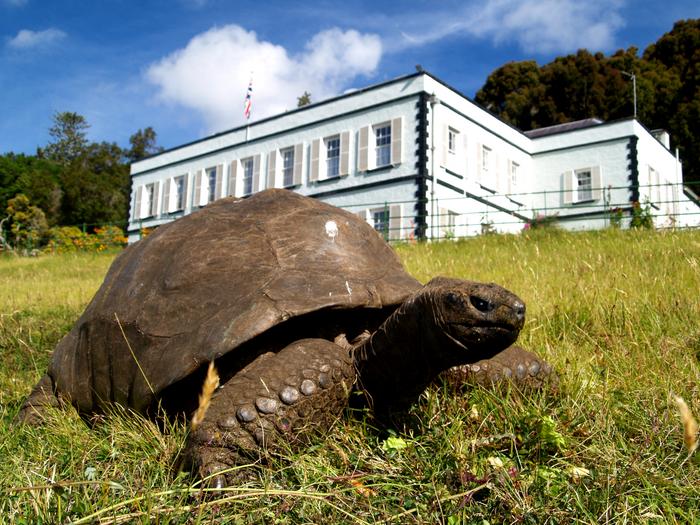
Jonathan has lived most of his life on the island of St. Helena, a British Overseas Territory in the South Atlantic Ocean, in grounds of Plantation House—the residence of the governor of St. Helena. He arrived from the Seychelles 144 years ago, already fully grown, as a gift to the governor. [Joe Holland]
Researchers studying a giant tortoise named Jonathan—who at an estimated 194 years of age is the oldest known living land animal in the world today—say it’s not just good genes, but lack of genetic wear and tear that have kept him going for nearly two centuries.
Headed by Stephen Clark MD, PhD, founder of the Kallel Foundation, the team sequenced Jonathan’s genome and identified 287 unique gene variants in this remarkably old Aldabra giant tortoise (Aldabrachelys gigantea) that may reduce the usual effects of aging.
When comparing Jonathan’s epigenome—the “on/off” switches on his genes—with that of younger giant tortoises of the same species, the team found that switches controlling Jonathan’s DNA repair and metabolism genes were very similar to those in his younger relatives. Usually, the epigenome changes over time, contributing to the aging process. This is a key reason why things start to go wrong in older bodies.
“We found that the gene regulators involved in energy production and DNA repair have remained incredibly stable in Jonathan over almost two centuries,” said Justin Gerlach, PhD, at Peterhouse at the University of Cambridge, who was involved in the study.
The study marks the first time the epigenome of a giant tortoise has been investigated. It was led by researchers at the longevity research non-profit Kallel in the U.S., who say that cracking the genetic code of a multi-century life offers unprecedented insights into extreme lifespan.
Clark is senior and corresponding author of the researchers’ published paper in Science Advances, titled “Epigenetic insights into extreme longevity in the world’s oldest terrestrial animal, Jonathan,” in which they concluded “Our findings support a model for aging wherein the maintenance of low methylation entropy in gene promoters is coupled to efficient mitochondrial energy production, efficient RNA processing, and efficient genomic repair.”
The giant tortoises of the Galapagos and Seychelles islands are the extraordinary last survivors of animals that used to dominate the ecology of many of the world’s islands. Aldabra giant tortoises are exceptionally long-lived, but Jonathan is about 100 years older than most of his species. He’s thought to have hatched in 1832—making him a contemporary of Charles Darwin and Queen Victoria.
![Jonathan arrived in St. Helena as a gift to Sir William Grey-Wilson in 1882, who later became governor of the island. This image was taken around that time - Jonathan is on the left. [A.L. Innes]](https://www.genengnews.com/wp-content/uploads/2026/10/low-res-2-300x230.jpeg)
Jonathan has lived most of his life on the island of St. Helena—a British Overseas Territory in the South Atlantic Ocean—in the grounds of the residence of the governor of St. Helena. Jonathan arrived from the Seychelles 144 years ago, already fully grown, as a gift to the governor.
Gerlach has studied the ecology and conservation of giant tortoises for several decades, but this is the first time he has studied their exceptionally long lives. Gerlach said, “There are few creatures that could tell us more about aging than the giant tortoises of the Galapagos and Seychelles islands. Working with a really old giant tortoise is such a privilege: you get a sense of the tortoise being your collaborator, not your study subject.”
For their study the team extracted Jonathan’s genetic material from cheek scrapings rather than a blood draw (they teased the tortoise with a promise of food until he opened his jaws wide), so that they could compare his genome and methylome with those of four other Aldabras, ranging in age from juveniles to older adults. “Because of concerns for Jonathan’s health and his iconic status on St. Helena, a blood draw for DNA sequencing was not permitted,” the authors explained. “Instead, we collected buccal scrapes and saliva samples for genomic DNA (gDNA) isolation.”
The team’s analyses identified genetic variants associated with several known aging pathways, including DNA repair, telomere maintenance, insulin regulation, mitochondrial function, and cancer. The investigators also analyzed Jonathan’s genome’s methylome—or the total picture of his genome’s methylation, which refers to the addition to DNA of tiny methyl chemical tags that impact gene expression. Methylation entropy, a sign of aging, occurs as random changes in methylation patterns accumulate over time. This analysis showed low entropy within specific gene promoters for mitochondrial function, RNA processing, and genome repair. The regions of low methylation entropy observed in Jonathan “suggest that high-fidelity transcription of genes in these pathways may be crucial for long-lived species,” the researchers noted.
“Nature has already solved the puzzle of aging in remarkable ways, and Jonathan’s genome provides a blueprint for cellular resilience,” said Clark. “Our goal is to take these evolutionary insights and immediately translate them into practical, affordable treatments for everyday people. Aging is the greatest risk factor for nearly every chronic disease we face, and through the generosity of philanthropic partners, we can democratize access to longevity medicine.”
In their paper the authors wrote in summary, “… while we identified many genetic variants in Jonathan associated with known aging pathways, our most notable finding is the low entropy maintained within specific gene promoters. This stability is exceptionally pronounced in promoters of genes involved in mitochondrial function and RNA processing. We hypothesize that maintaining this low-entropy state ensures high-fidelity expression in these critical pathways, partially protecting him from age-related decline.”