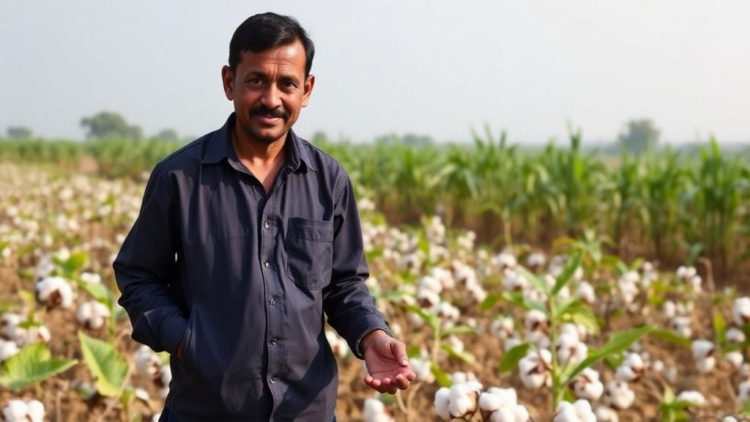
A sweeping 26-year analysis of India’s two most important commercial crops has revealed a striking divergence in what actually drives farm incomes, with seed technology emerging as the single most powerful lever for cotton growers while hired labour dominates sugarcane economics. The study, published in Discover Agriculture by economist Amit Mandal of Mankar College, The University of Burdwan, examined state-level cost of cultivation data from 1996–97 to 2021–22, covering the period in which Indian agriculture was transformed by economic liberalization, the diffusion of Bt cotton, the 2008 debt waiver scheme, and the 2016 Doubling Farmers’ Income initiative. The findings arrive at a moment of intense national debate over agrarian distress, input costs, and the sustainability of commercial farming.
The stakes are considerable. Agriculture still employs nearly 47 percent of India’s workforce and contributes roughly 18 percent of gross domestic product. Cotton and sugarcane sit at the heart of the country’s industrial economy: cotton feeds a textile sector that accounts for about 2.3 percent of GDP, 13 percent of industrial production, and nearly 12 percent of export earnings, while supporting more than 45 million jobs. Sugarcane underpins the second-largest agro-based industry after textiles and has become central to India’s ethanol blending program, which reached approximately 15 percent in 2024–25, reducing petroleum imports and conserving foreign exchange. Any instability in the economics of these crops therefore ripples far beyond the farm gate.
The study draws on the Comprehensive Scheme on Cost of Cultivation maintained by the Directorate of Economics and Statistics under the Ministry of Agriculture. For cotton, the analysis covers Andhra Pradesh, Gujarat, Karnataka, Maharashtra, and Punjab, which together accounted for roughly 66 percent of cultivated area and 65 percent of national production in 2021–22. For sugarcane, it covers Uttar Pradesh, Maharashtra, Karnataka, and Tamil Nadu, which together represent more than 80 percent of area and output. The dataset spans 130 cotton observations and 104 sugarcane observations across five-year intervals, allowing the researcher to isolate phase-wise transformations tied to major policy regimes.
Methodologically, the study combines descriptive statistics, compound annual growth rates, and coefficients of variation with a Cobb–Douglas production function estimated through a fixed-effects panel regression. The fixed-effects specification assigns each state its own intercept, stripping out time-invariant characteristics such as soil, climate, and agrarian structure that would otherwise bias the estimates. Cluster-robust standard errors at the state level were used for cotton, and robust standard errors for sugarcane, to guard against heteroskedasticity and serial correlation within states. The dependent variable is the value of output per hectare, encompassing both main products and by-products, while the explanatory variables capture distinct cost components including seed, labour, machinery, irrigation, and fertilizers.
The descriptive results paint a picture of relentless cost escalation. Cultivation costs rose persistently for both crops across all states, with cotton exhibiting higher growth and greater instability in paid-out costs and total cultivation costs than sugarcane. Maharashtra recorded the steepest cost growth for both crops, but also the highest volatility, a pattern the study links to recurrent droughts and volatile cotton prices. Punjab, by contrast, achieved the highest growth in cotton value of output with moderate instability, reflecting better irrigation infrastructure, market integration, and institutional support. For sugarcane, Karnataka and Tamil Nadu showed more moderate growth and lower variability, while Uttar Pradesh experienced rapid cost expansion accompanied by even greater instability.
Profitability improved over time, but the picture changes dramatically depending on which cost concept is used. When profits are measured against Cost A2, the actual paid-out expenses, farmers generally remained in the black throughout the study period. When the imputed value of family labour is added, the margins narrow. But against Cost C2, the comprehensive measure that includes the rental value of owned land, interest on fixed capital, and family labour, the results turn sobering: Andhra Pradesh, Maharashtra, and Punjab registered negative long-term growth rates in cotton profitability, while for sugarcane, Maharashtra and Tamil Nadu showed weak performance despite strong growth under simpler measures. This divergence is the classic cost-price squeeze, in which rising land values, wages, and capital charges outpace gains in gross output.
The structural decomposition of costs reveals a deeper transformation. Operational costs have grown faster than fixed costs across both crops, meaning that escalation is driven by recurring expenditures on labour, fertilizers, irrigation, and machinery services rather than capital deepening. In Maharashtra and Gujarat, operational costs exceed 70 percent of total cotton cultivation costs, leaving farmers acutely exposed to input price inflation. Human labour remains the largest cost share everywhere, but the declining share of animal labour and rising machine labour in Punjab and Gujarat signal a gradual mechanization transition. The moderation of insecticide expenditure after 2011–12 in cotton regions likely reflects the widespread adoption of Bt technology and improved pest management.
The econometric results deliver the study’s most consequential findings. For cotton, seed expenditure emerges as the dominant determinant of value of output, with an elasticity of 0.42, meaning a 1 percent increase in seed investment raises output value by 0.42 percent. Machine and animal labour follow with an elasticity of 0.30, family labour contributes 0.28, and irrigation shows a small but positive elasticity of 0.04, suggesting that water investments pay off only when complemented by better seeds, nutrients, and management. For sugarcane, casual labour cost is the most influential determinant, underscoring the crop’s labour-intensive nature across planting, weeding, harvesting, and transport. Fertilizer and manure expenditure exerts a positive influence, but irrigation spending shows a negative association with output value, a result the author attributes to inefficient water use, excessive irrigation, groundwater depletion, and poor resource allocation in water-stressed regions.
That negative irrigation coefficient challenges the conventional view of water as an unambiguously productivity-enhancing input and carries significant policy weight in a country where sugarcane is among the most water-intensive crops. The study also finds that mechanization has not yet generated substantial gains for sugarcane, with machine and animal labour coefficients statistically insignificant, possibly due to fragmented landholdings and underutilized machinery. Roughly 77 percent of the variation in sugarcane output value is attributable to state-specific factors, and the model explains about 90 percent of within-state variation over time, indicating strong explanatory power for the selected inputs.
The policy implications are clear. Improving input-use efficiency, strengthening seed systems, promoting appropriate mechanization, and enhancing irrigation management emerge as priorities for sustaining the value of output in commercial crop cultivation. For cotton, continued investment in quality seeds and hybrid technologies offers the highest return; for sugarcane, raising labour productivity through mechanization and skill development could relieve the structural constraint imposed by rising rural wages and labour scarcity. Because cost structures differ so sharply across states, the study argues that policy design must be sensitive to regional production conditions rather than uniform. The author acknowledges limitations, noting that the Cobb–Douglas specification imposes constant elasticities and may not capture non-linear or dynamic relationships, and calls for future research using more flexible production functions. Yet even with those caveats, the analysis offers a rare long-term, comparative accounting of why India’s commercial farmers keep producing more while earning precariously, and where the next rupee of investment is most likely to pay off.
Subject of Research: Structural change in input use, cost instability, and farm profitability in Indian cotton and sugarcane cultivation from 1996–97 to 2021–22
Article Title: Structural change in input use instability and farm profitability in cotton and sugarcane in India
Article References: Mandal, A. (2026). Structural change in input use instability and farm profitability in cotton and sugarcane in India. Discover Agriculture, 4(1), Article 304. https://doi.org/10.1007/s44279-026-00747-5
Image Credits: AI Generated
DOI: 10.1007/s44279-026-00747-5
Keywords: cotton, sugarcane, India, cost of cultivation, farm profitability, input use, Cobb-Douglas production function, fixed-effects panel regression, Bt cotton, irrigation efficiency, agricultural economics, value of output
Cite Scienmag News
APA MLA Chicago
Copy citation Download RIS
Tags: 26-year Indian agricultural cost of cultivation studyagricultural economicsBt cottonCobb-Douglas production functioncontribution of cotton and sugarccost of cultivationcottondoubling farmers’ income initiative and farm profitabilityeconomic liberalization effects on Indian crop farmingeffects of India’s 2008 debt waiver on agriculturefarm profitabilityfixed-effects panel regressionimpact of seed technology on Indian cotton farmingIndiaIndia cotton and sugarcane farm income analysisinfluence of Bt cotton adoption on farm profitsinput useirrigation efficiencyrole of hired labor in Indian sugarcane economicsstate-level agricultural productivity trends in Indiasugarcanesustainability challenges in Indian commercial agriculturevalue of output