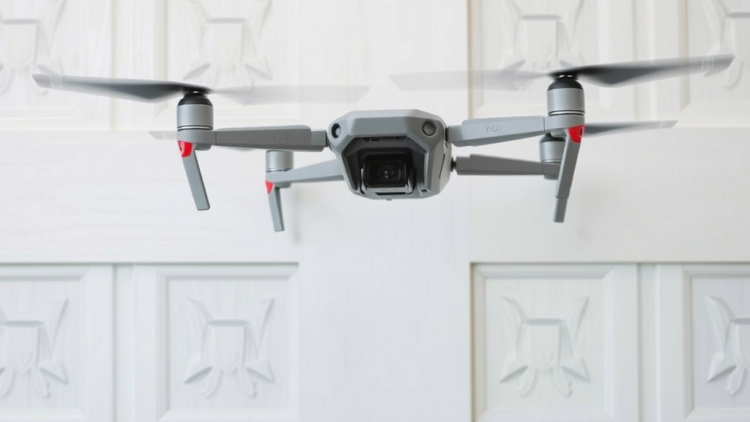
Drones have long been celebrated for what they can do in the air, but some of the most valuable jobs they could perform require them to touch things: pressing a sensor against a bridge cable, sliding a probe across a storage tank, or nudging a heavy object that no human can safely reach. A new study published in the journal Aerospace Systems tackles one of the hardest versions of that challenge, presenting a control and estimation framework that allows an omnidirectional aerial manipulator to push against vertical surfaces and slide along them while keeping the contact force steady, all without the delicate force sensors that such missions traditionally demand.
The work, carried out by Hameed Ullah of King Fahd University of Petroleum and Minerals, Julien Mellet and Vincenzo Lippiello of the University of Naples Federico II, and Santos Miguel Orozco Soto of the Autonomous University of Mexico City, addresses a task roboticists call push-and-slide interaction. In this scenario, the robot must press its end-effector against a wall with a sustained, controlled normal force while simultaneously tracking a trajectory along the surface, such as a rectangle or a circle. The difficulty is that every Newton of force the robot exerts on the wall pushes back on the drone itself, threatening to destabilize a vehicle that must balance thrust, attitude, and position hundreds of times per second.
Conventional solutions to this problem lean heavily on force and torque sensors mounted at the wrist of the manipulator. These devices measure the interaction forces directly and feed them to the controller, but they come with punishing drawbacks for aerial platforms. They are fragile, adding risk in any operation involving unplanned contact. They are also relatively heavy, and on a flying robot every gram of payload translates directly into reduced flight time and reduced capacity for mission equipment. The research team set out to eliminate the external force sensor entirely, replacing its measurements with software estimation built on the physics of the vehicle itself.
The platform at the heart of the study is an actively tilting co-axial octarotor, a drone with eight rotors arranged in four coaxial pairs whose rotors can tilt in flight. This architecture is what gives the vehicle its omnidirectional capability: rather than relying solely on body tilt to direct thrust, as a conventional quadrotor must, the tilting rotors can generate forces and torques in arbitrary directions while the airframe stays level. For contact tasks this is a decisive advantage, because pushing sideways on a wall does not require the drone to bank, which would couple the contact force into the attitude dynamics and make the control problem far harder.
The second hardware innovation is at the tip of the manipulator. The team designed a specialized omni-wheel end-effector, a small roller-wheeled contact tool reminiscent of the wheels used on omni-directional ground robots. Its job is to decouple the two directions of interaction at the contact point. The normal direction carries the pressing force, which the wheels’ rollers allow to pass through with rolling contact in the tangential direction, meaning the lateral sliding motion along the surface encounters dramatically less friction. By stripping away most of the sliding friction that would otherwise fight the controller, the end-effector significantly reduces the disturbances injected into the drone during a slide, allowing a cleaner separation between the force control problem and the trajectory tracking problem.
With the sensor removed, the system still needs to know how hard it is pressing. The researchers’ answer is a momentum-based external wrench estimator, a well-established technique in robot control that has now been adapted for this tilting aerial platform. The estimator uses a dynamic model of the complete vehicle and manipulator, continuously comparing the momentum change predicted by the model with the momentum actually observed through the onboard state estimate. Any discrepancy that cannot be explained by the model’s own dynamics is attributed to generalized external forces and torques, which in this case are precisely the contact interaction wrenches. Because the method exploits the generalized momentum rather than raw accelerations, it is robust to the noise and unmodeled effects that plague aerial platforms, and it provides the controller with a smooth, real-time estimate of the force at the contact.
That force estimate then feeds a model-free hyperbolic position-based force controller. The controller is described as model-free because it does not require an explicit model of the contact environment, such as the wall’s stiffness, which is often unknown and can change from mission to mission. Instead, the error between the desired force setpoint and the estimated external force is mapped through a hyperbolic function into a position correction for the end-effector. The hyperbolic formulation, which the group had previously developed for robust flight control of tilting rotors, provides globally attractive convergence properties, meaning the force error is driven toward zero from a wide range of initial conditions rather than only when the system starts close to equilibrium. Combined with a position loop that handles the tangential direction, the result is a hybrid force and position scheme: force is regulated along the surface normal while position is controlled along the sliding direction, the classical decomposition that ground and arm robots have used for decades, finally executed stably by a free-flying vehicle.
The team validated the framework through an extensive simulation campaign in the widely used ROS and Gazebo robotics environment, chosen specifically for its high-fidelity physics. The experiments tasked the aerial manipulator with maintaining sustained contact force on vertical surfaces while tracking both rectangular and circular trajectories. Across these trials the system successfully followed the commanded paths while holding a stable force setpoint, demonstrating that the estimated wrenches were accurate enough to close the force loop reliably and that the tilting octarotor’s actuators had the authority to absorb the interaction loads without losing control. The authors report that the integration proved accurate, reliable, and fully sensorless for multi-dimensional aerial manipulation.
Beyond the specific results, the study claims to fill a recognized gap in the field: coordinated omnidirectional interaction, in which the full omnidirectional capability of an actively tilting coaxial platform is exploited to execute complex, nonlinear trajectories on vertical surfaces under stable force control. Push-and-slide inspection is a real industrial need, with prior projects in the literature targeting contact-based inspection of industrial plants, oil and gas infrastructure, and power lines, where a robot must both press and move. By showing that this can be done without a wrist force sensor, the framework lowers the weight, cost, and fragility barriers that have kept aerial physical interaction confined largely to laboratories.
The work also reflects a broader trend in aerial robotics: the migration of capabilities from traditional manipulators onto fully actuated flying vehicles. Momentum-based estimation, hybrid force and position control, and impedance-style interaction control were all pioneered on industrial arms, and adapting them to the fast, underdamped, aerodynamics-dominated world of multirotors has been an ongoing research program. This study contributes a piece of that program, demonstrating that a model-based observer paired with a mathematically grounded, environment-agnostic force controller can stand in for hardware sensing. The researchers caution that the validation to date is in simulation, and physical flight experiments with real contact uncertainty remain the next step, but the framework as presented offers a complete recipe, from omni-wheel tool design through wrench estimation to closed-loop force control, for any team building the next generation of touching, pushing, sliding drones.
Subject of Research: Hybrid force/position control of an omnidirectional aerial manipulator for sensorless two-dimensional push-and-slide interaction on vertical surfaces
Article Title: Hybrid force/position control for an omnidirectional aerial manipulator performing two-dimensional push-and-slide tasks
Article References: Ullah, H., Mellet, J., Orozco Soto, S. M., & Lippiello, V. (2026). Hybrid force/position control for an omnidirectional aerial manipulator performing two-dimensional push-and-slide tasks. Aerospace Systems. https://doi.org/10.1007/s42401-026-00543-5
Image Credits: AI Generated
DOI: 10.1007/s42401-026-00543-5
Keywords: aerial manipulation, hybrid force/position control, aerial physical interaction, omnidirectional drone, tilting co-axial octarotor, momentum-based estimator, push-and-slide, force estimation, ROS/Gazebo simulation, omni-wheel end-effector, sensorless control, vertical surface tracking
Cite Scienmag News
APA MLA Chicago
Copy citation Download RIS
Tags: aerial manipulationaerial manipulation without delicate sensorsaerial physical interactionaerial surface navigationautonomous drone surface slidingcontact force estimation in dronesdrone wall interactionforce estimationforce regulation in UAVshybrid force/position controlmomentum-based estimatoromni-wheel end-effectoromnidirectional droneomnidirectional drone manipulationpush-and-slidepush-and-slide robotic tasksrobotic control without force sensorsROS/Gazebo simulationsensorless controlsensorless force control for aerial robotstilting co-axial octarotorvertical surface interaction with dronesvertical surface trackingwall contact control in drones