Sponsored content brought to you by

Few areas of modern biotechnology have generated as much excitement as CAR T cell therapy—an approach that reprograms immune cells to recognize and destroy cancer. Traditionally, CAR T therapies are manufactured ex vivo, with a patient’s T cells engineered outside the body and reinfused. Increasingly, researchers are exploring in vivo CAR T, where genetic instructions are delivered directly into the body to convert T cells into cancer fighters. Although this shift could simplify manufacturing and expand patient access, it also introduces new layers of biological complexity—forcing researchers to rethink how early preclinical experiments are designed and interpreted. For Bio X Cell, which provides high-purity, low-endotoxin antibodies optimized for in vivo studies, the challenge centers on maintaining biological interpretability in dynamic immune environments.
Preclinical CAR T studies carry enormous weight because they determine which constructs advance into costly development pathways. According to Bio X Cell CEO Christopher Conway, the importance of early mechanistic data is often underestimated. “Those early preclinical results carry so much weight,” Conway says. “They influence which constructs move forward, how dosing strategies are set, and how programs are positioned with regulators way down the line.”
The problem is not always flawed experiments, but flawed interpretation. “It’s rarely one bad experiment,” Conway explains. “More often, the signal is misunderstood, and that quietly becomes the entire foundation of your house. Once that happens, it’s tough to unwind.”
Early biological signals can therefore shape the trajectory of entire development programs. If those signals are distorted by experimental artifacts or poorly characterized reagents, researchers may pursue misleading conclusions.
Inside complexity
Moving CAR T engineering directly into the body dramatically increases experimental complexity. In vivo approaches shift those processes into a living immune system where countless signals interact.
“The biggest challenge is separating real biological effects from noise,” Conway says. “Everything’s happening inside a living, dynamic immune system, and all the signals get jumbled, but you need confidence that what you’re measuring is true biology and not some artifact of the tool you’re using.”
Well-characterized reagents cannot eliminate biological complexity, but they can reduce experimental uncertainty. “You’re putting reagents into something uncontrollable—the immune system—but at least you know exactly what you’re putting in,” Conway says.
The importance of antibodies
In in vivo CAR T studies, antibodies are not neutral observers; they directly influence how immune signals are detected and delivered. According to Kaitlyn Bushey, Director of Strategic Alliances at Bio X Cell, antibodies are used to track immune activity throughout the in vivo CAR T workflow.
“In vivo CAR T is incredibly complicated,” Bushey says. “You have to deliver genetic material to a cell, it has to be taken up, and then that cell has to replicate so there are more CAR T cells in the body.”
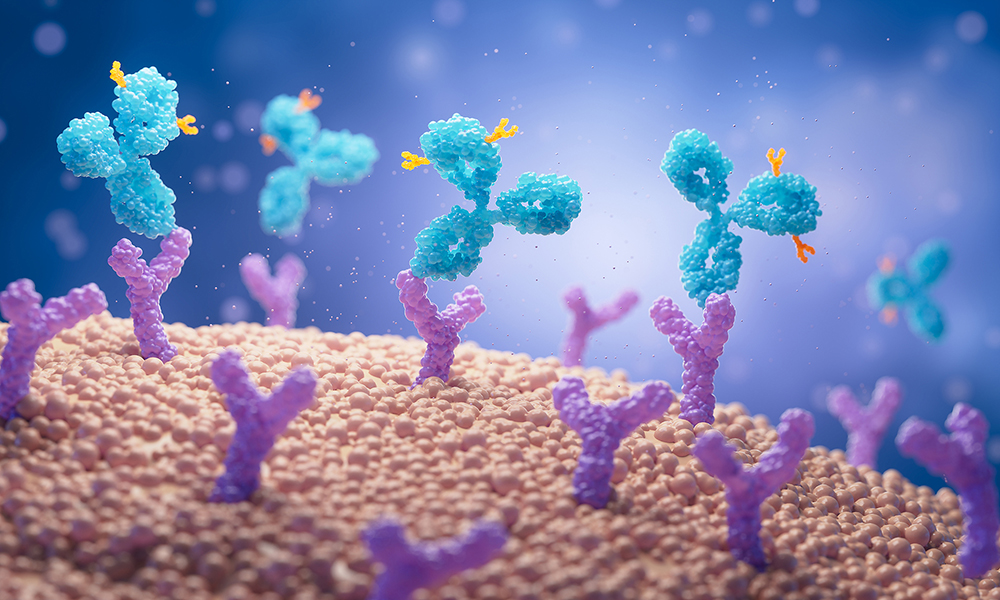
Antibodies help researchers monitor those steps and more. Scientists are “conjugating genetic material to antibodies and using those antibodies to bind directly to T cells and deliver that material,” Bushey explains.
But antibodies used in living systems must be carefully designed. Their design and quality—including isotype, Fc effector function, aggregation state, and endotoxin levels—can influence immune responses. “If you don’t fully understand how an antibody is built or what its function looks like, it can completely change the biology,” Bushey says.
In some experiments, researchers remove Fc‑mediated activity with Fc‑silenced antibodies or Fab fragments to isolate receptor‑mediated signaling from immune effector pathways. In one example, antibody‑mediated immune clearance interfered with lipid-nanoparticle delivery to T cells. “The antibody was actually depleting the T cells instead of delivering the payload,” Bushey explains. Modifying the Fc region resolved the issue and restored the intended targeting strategy.
Continuity is crucial
As in vivo CAR T programs evolve, “the biggest gap in preclinical infrastructure is continuity,” Conway says. “These programs don’t stand still—the constructs evolve, the delivery strategies change—but the tools used to measure the immune system need to remain consistent.” Otherwise, lot-to-lot variability or reagent substitutions can introduce subtle changes that complicate interpretation. “Consistency becomes the backbone of the whole narrative of your translational system,” Conway says.
As in vivo CAR T research accelerates, protecting the integrity of early biological signals might ultimately determine which therapies succeed—and which promising ideas are lost in the noise.

Protect the biological signal behind your data. Explore defined, low endotoxin antibodies for cleaner in vivo studies bioxcell.com.