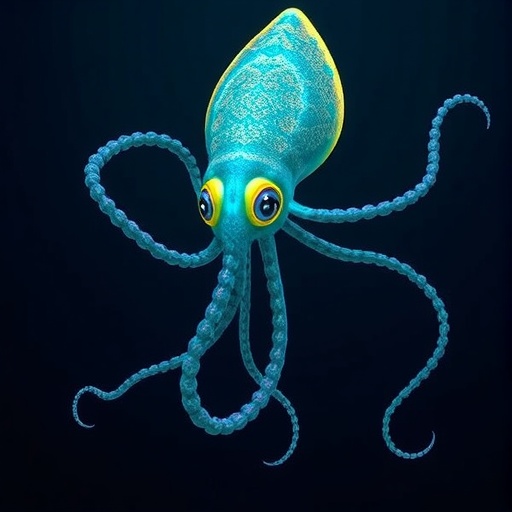
Squid and cuttlefish have long captured the imagination of scientists and marine enthusiasts alike with their stunning abilities—from rapid skin color changes to dynamic jet propulsion. Despite decades of research, unraveling their evolutionary history has remained an intricate puzzle. The scarce fossil evidence and incomplete genomic data left many questions unanswered about when and how the astonishing diversity of these cephalopods arose. A groundbreaking study now emerges from the Okinawa Institute of Science and Technology (OIST), shattering previous uncertainties by combining new genome sequences with extensive databases to trace the evolutionary trajectory of these enigmatic creatures with unprecedented clarity.
The team’s research focuses on decapodiform cephalopods, the ten-limbed group encompassing both squids and cuttlefish, whose evolutionary pathways have long been debated. The study leverages three newly sequenced squid genomes and integrates these with existing genomic repositories, marking the first time a near-complete genomic picture of decapodiform lineages has been assembled. This work, recently published in Nature Ecology & Evolution, reveals a complex and fascinating “long fuse” evolutionary model, characterized by a protracted period of evolutionary stasis followed by rapid diversification coinciding with the mid-Cretaceous period.
Central to this investigation is the examination of the internal shell structures that diverse squid and cuttlefish species exhibit. These range from the broad, buoyant cuttlebones unique to cuttlefish to the sleek, gladius-shaped shells seen in many oceanic squids, and the distinctive spiral shell of the elusive ram’s horn squid (Spirula spirula). Intriguingly, some shallow-water squid species have even lost their internal shells altogether. Past phylogenetic attempts, often constrained by limited morphological data and partial genetic sequences, yielded conflicting conclusions about these evolutionary relationships. However, whole genome sequencing now enables researchers to detect subtle genetic markers and evolutionary signals that paint a more consistent picture of lineage divergences.
The sheer size of cephalopod genomes presents a formidable technical challenge. With genome sizes up to twice that of humans, sequencing and analyzing these complex genomes require state-of-the-art techniques and immense computational resources. Additionally, accumulating fresh, high-quality DNA samples necessitates collecting specimens from a range of habitats, including deep-sea environments and tropical reefs where some species are both highly diverse and harder to access. Researchers at OIST were fortunate to access key species locally in Okinawa and collaborated internationally to secure samples from more remote conditions, allowing a comprehensive dataset to be created.
The monumental effort culminated in the construction of the first evolutionary tree for decapodiformes rooted in genomic data spanning nearly all major lineages. This achievement was enabled by the global Aquatic Symbiosis Genomics Project, funded by the Wellcome Sanger Institute. Within this international research framework, the Japanese team spearheaded the sequencing of previously underrepresented cephalopod genomes, effectively filling in critical gaps that hindered past evolutionary reconstructions. This database now forms a cornerstone resource for cephalopod evolutionary biology.
Among the most compelling insights is the genomic study of the ram’s horn squid, a rare species that biologists have long misclassified due to its unique shell form. For years, its shell’s similarity to cuttlebone structures led scientists to erroneously place Spirula spirula close to cuttlefish. The new genomic evidence upends this view, clarifying its true phylogenetic position and sharpening evolutionary narratives about cephalopods. The fresh data shine light on the diverse evolutionary paths that have produced the remarkable forms and adaptations vital to modern squid and cuttlefish.
Interlacing fossil discoveries with genomic timelines, the study proposes that modern decapodiform cephalopods originated around 100 million years ago during the mid-Cretaceous epoch—a period marked by rapid lineage divergence. Yet, a profound evolutionary bottleneck occurred approximately 66 million years ago during the catastrophic Cretaceous-Paleogene (K-Pg) extinction event, which famously led to dinosaur extinction and massive ecosystem upheavals. Cephalopods managed to endure, likely due to refuge in oxygen-rich microhabitats in the deep ocean where harsh surface conditions and ocean acidification were less severe.
The K-Pg event imposed a severe bottleneck that was followed by a prolonged period of minimal evolutionary change, consistent with a “long fuse” model of diversification. During this interval, deep-sea cephalopod lineages persisted, retaining features like internal shells adapted for their environments. Only after the gradual recovery of coastal ecosystems and the re-establishment of coral reefs did these animals explode in diversity and undergo extensive ecological radiation into shallower niches. This pattern—an initial rapid divergence, a prolonged stasis, then an explosive diversification—reflects a complex interplay between environmental pressures and evolutionary innovation.
Beyond reconstructing evolutionary history, this research lays the groundwork for probing the molecular underpinnings of cephalopod innovation. Squid and cuttlefish possess a suite of biological novelties that distinguish them from all other animal groups: elaborate camouflage systems, novel organogenesis, and extraordinary neural architectures underpinning their sophisticated behavior. With the advent of comprehensive genomes linked to a resolved phylogeny, scientists can now explore the genomic changes and regulatory networks driving these highly specialized traits. Such studies promise to revolutionize our understanding of cephalopod biology and evolution.
Professor Daniel Rokhsar, leading the Molecular Genetics Unit at OIST, underscores the transformative potential of these genomic resources. They enable comparative analyses that connect evolutionary events to genetic mechanisms, from the emergence of dynamic skin chromatophores controlling color and pattern to the development of advanced nervous systems managing complex behaviors. This research not only demystifies cephalopod origins but also provides a rich model for evolutionary developmental biology and genomics.
The implications extend beyond academic interest into biotechnology and evolutionary medicine, where the molecular strategies cephalopods use for adaptation might inspire new materials and neurological research. Given their evolutionary success and ecological importance, understanding how squid and cuttlefish adapted to changing oceans over millions of years also informs studies on resilience to current and future environmental changes, including ocean acidification and habitat degradation.
This landmark study exemplifies the power of international scientific collaboration, cutting-edge genomic technology, and integrative evolutionary biology. By resolving one of marine biology’s most enduring mysteries, it opens new frontiers for inquiry into the deep history and remarkable diversity of cephalopods. Unraveling the evolutionary “long fuse” that preceded the spectacular radiation of squid and cuttlefish enriches our appreciation not only of these enigmatic animals but also of the dynamic processes sculpting marine biodiversity.
As squid and cuttlefish continue to captivate with their luminous displays and rapid movements, scientists now stand equipped with the genetic blueprints to decode their remarkable adaptations. This confluence of paleontology, genomics, and marine biology heralds a new era of understanding, revealing how life in the ocean’s depths has shaped some of the most fascinating creatures on Earth.
Subject of Research: Animals
Article Title: Rapid mid-Cretaceous diversification of squid and cuttlefish preceded radiation into coastal niches.
News Publication Date: 30-Mar-2026
Web References:
https://doi.org/10.1038/s41559-026-03009-1
Image Credits: Keishu Asada
Keywords: Cephalopods, Evolution, History of life, Evolutionary genetics, Evolutionary developmental biology, Aquatic animals, Marine biology
Tags: cephalopod internal shell structurescephalopod rapid diversificationdecapodiform genomic sequencingdeep ocean cephalopod evolutionevolutionary stasis in marine speciesfossil evidence of squidsgenomic analysis of cephalopodsmarine biodiversity evolutionmid-Cretaceous marine lifeOkinawa Institute squid researchsquid and cuttlefish phylogenysquid evolution timeline