Climbing High for Quality: Wild Squirrels’ Surprising Willingness to Work Hard for Preferred Food
In the realm of animal behavior, conventional wisdom derived from controlled laboratory experiments has long suggested that animals tend to discount rewards that require additional effort or time investment. This “discounting” means that when presented with two options—a smaller reward that is easy to obtain versus a larger, better reward that demands more effort—animals typically choose the less demanding option. However, a groundbreaking new study challenges this assumption by exploring the decision-making processes of wild grey squirrels in their natural environment.
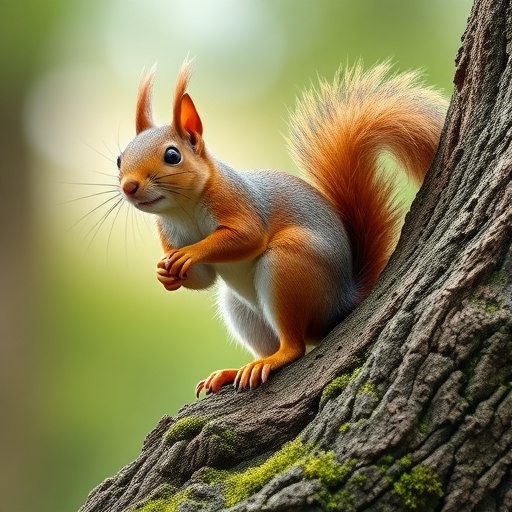
Recent research conducted by the University of Exeter’s Centre for Research in Animal Behaviour reveals that wild grey squirrels display a remarkable willingness to expend extra energy and time to obtain higher-quality food, diverging significantly from behaviors observed in laboratory settings. The study meticulously investigated the squirrels’ preferences when presented with two food types: almond pieces, a highly preferred food, and pumpkin seeds, considered less desirable. These items were offered on poles at varying heights to simulate increasing difficulty, enabling researchers to measure the squirrels’ valuation of reward relative to effort.
The findings are compelling. Even when almonds were set at significantly greater heights, requiring squirrels to climb more challenging and slippery poles, the inclination for almonds only diminished slightly. This contrasts with previous studies on captive animals, where increased physical effort usually led to a steep decline in the value ascribed to a reward. The implication is clear: in the wild, the squirrels’ natural habitat and ecological context foster a different cost-benefit analysis that prioritizes the quality of food over the exertion required to obtain it.
Lead author Yavanna Burnham emphasized the importance of studying decision-making in natural environments, stating that “the squirrels in our study were willing to work harder for the better food.” This behavior reflects an evolutionary advantage, whereby investing extra effort supports better nutrition and survival outcomes, especially when high-quality resources are scarce. The study thus reinforces a fundamental principle in animal ecology — flexibility in foraging strategies based on environmental variables and resource availability.
Notably, the research also highlights social dimensions impacting foraging choices. It was observed that less dominant squirrels tended to opt for the easier-to-access, lower-quality pumpkin seeds more frequently. This likely stems from a heightened risk assessment, where subordinate individuals avoid climbing higher or exerting more effort to reduce the chance of losing the reward to more dominant rivals who might displace them. Such social influences illustrate the complexity of decision-making in communal settings and how status can dictate resource access strategies.
Senior author Dr. Lisa Leaver detailed the nuanced nature of these choices, remarking that the study “helps us understand how animals decide how much time and effort to invest.” Her insights underscore the variability and adaptiveness of animal behavior, suggesting that unlike rigid models predicting optimality in decision-making, actual behavior reflects a sophisticated appraisal of competing demands and potential risks. Moreover, the parallels to human economic behavior — weighing immediate cheap gains against delayed but superior benefits — suggest convergent evolution in cognitive evaluation mechanisms.
The study’s methodology involved systematically testing 11 individual wild squirrels in the University of Exeter’s Streatham Campus, amassing over 4,000 individual choices. This extensive dataset allowed for robust statistical analysis, giving confidence in the reproducibility and reliability of the results. Utilizing naturalistic food preferences and physically imposing challenges ensured ecological validity, a critical factor often missing in lab-based experimental paradigms.
Importantly, this research contributes to our understanding of how effort discounting operates beyond simplified laboratory contexts. Whereas captive animal studies typically involve contrived scenarios devoid of social competition and environmental complexity, this study’s design embraced such real-world factors, offering fresh perspectives on the evolution of foraging behavior and reward valuation. The nuanced behaviors observed reinforce the idea that cognitive and ecological considerations are deeply intertwined in wild animal populations.
Beyond its theoretical contributions, the findings have broader implications for wildlife management and conservation. Understanding how animals value food rewards based on environmental and social pressures can inform habitat design, resource provisioning, and conflict mitigation strategies. For example, acknowledging that subordinate animals may be socially pressured into less nutritious resources can guide interventions aiming to promote equitable access to food and improve overall population health.
The study’s authors advocate for continued research in wild populations, arguing that natural behaviors are richer and more informative than those observed under artificial conditions. This sentiment resonates with a growing trend in behavioral ecology to prioritize field research and integrate multifaceted influences — such as social hierarchy, spatial complexity, and individual variation — into models of animal decision-making.
Published in the journal Animal Behaviour on March 26, 2026, this study titled “Pole position: social influences on discounting behaviour in wild grey squirrels” bolsters our understanding of animal psychology by revealing the interplay of physical effort, reward quality, and social context in shaping behavior. It offers a vivid example of how animals constantly negotiate trade-offs in their daily existence, challenging preconceptions and inviting fresh inquiry into the adaptive significance of foraging choices.
Funded by the Natural Environment Research Council, the research exemplifies the value of interdisciplinary approaches, combining animal psychology, behavioral ecology, and social analysis to unravel the sophisticated mechanisms underlying animal decisions. As the field increasingly acknowledges the limitations of lab-based paradigms, studies like this serve as a clarion call for grounding insights within the complexity of the wild.
In summary, this study illuminates the resilience and sophistication of wild animals, demonstrating that grey squirrels will climb literally higher and exert more effort to secure a superior reward, especially under natural social conditions where risk and status influence practical decisions. Their behavior illustrates an evolutionary strategy that favors quality and long-term benefit over effortless but lesser gains, reshaping how scientists consider discounting and valuation outside controlled environments.
Subject of Research: Decision-making and foraging behavior in wild grey squirrels, focusing on effort discounting and social influence.
Article Title: Pole position: social influences on discounting behaviour in wild grey squirrels.
News Publication Date: 26 March 2026
Web References: DOI 10.1016/j.anbehav.2026.123535
References: University of Exeter, Centre for Research in Animal Behaviour; Natural Environment Research Council.
Image Credits: Yavanna Burnham
Tags: animal decision-making in natural environmentsanimal motivation for preferred foodclimbing behavior in squirrelsecological study of squirrelseffort-based reward valuationenergy expenditure for food rewardsgrey squirrels food preferencenatural vs laboratory animal behaviorsquirrels choosing high-value snacksUniversity of Exeter animal studywild squirrel feeding behaviorwildlife behavioral research