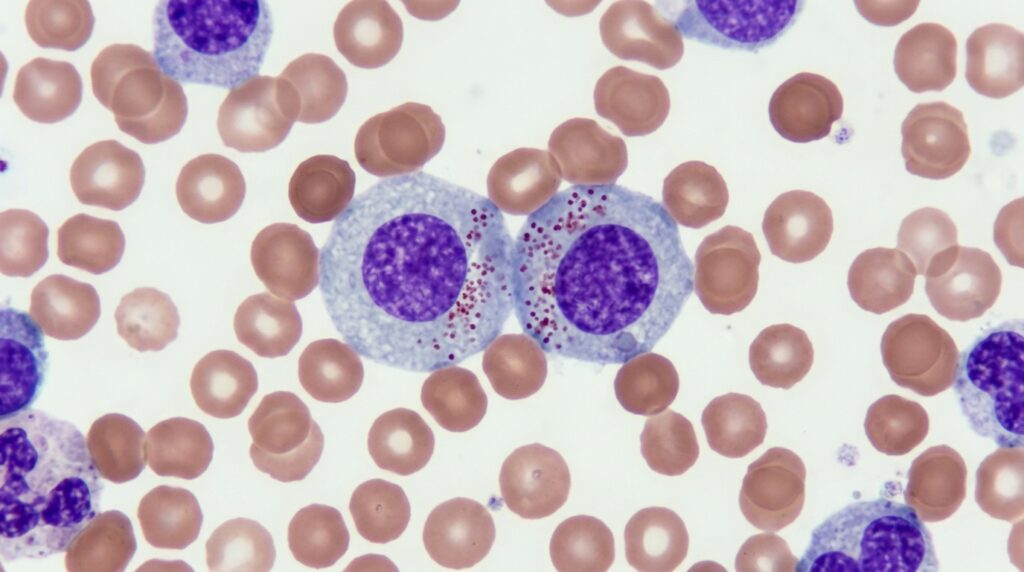
Researchers in Iraq have identified mutations in the STAT3 gene in patients with large granular lymphocytic leukemia, a rare lymphoproliferative disorder that arises in either cytotoxic T cells or natural killer cells. The study, published in Discover Oncology, set out to determine how often the two mutations Y640F and D661Y occur in T-cell and NK-cell forms of the disease and whether their presence tracks with specific clinical features.
Large granular lymphocytic leukemia, abbreviated LGL, exists in two main variants: T-LGL, which involves mutated cytotoxic T cells, and NK-LGL, which involves abnormal natural killer cells.
To detect these mutations, the team used tetra-primer amplification refractory mutation system PCR, a laboratory technique that allows simultaneous testing for two sequence variants in a single reaction.
The researchers found that lymphocytosis, the need for treatment, and pure red cell aplasia were significantly more frequent in T-LGL compared with NK-LGL, with statistical significance at P ≤ 0.01 and P ≤ 0.05. Neutropenia and anemia, by contrast, showed no statistically significant difference in incidence between the two disease variants.
White blood cell counts also differed between the groups. The median WBC count was 7.3 × 10⁹/L in T-LGL patients and 9.6 × 10⁹/L in NK-LGL patients, a difference that reached significance at P ≤ 0.05.
When the researchers compared patients whose leukemia carried a STAT3 mutation with those without one, several clinical features stood out. Anemia, pure red cell aplasia, and rheumatoid arthritis were significantly different between the mutated and non-mutated groups at P ≤ 0.01.
Other features, including neutropenia, thrombocytopenia, autoimmune hemolytic anemia, and the specific cell type involved, whether natural killer or T cell, did not differ significantly between mutated and non-mutated cases.
The LGL count itself, a direct measure of the leukemic cell burden, was lower in patients with STAT3 mutations. The median LGL count was 2.30 ± 0.08 × 10⁹/L in the mutated group compared with 4.50 ± 0.19 × 10⁹/L in the non-mutant group, a difference significant at P ≤ 0.01.
Between the two specific mutations, Y640F and D661Y, no significant difference was observed in either T-LGL or NK-LGL. The authors conclude that both mutations play an important role in the pathogenesis of NK-LGL and T-LGL and are associated with increased disease severity and abnormal clinical parameters.
Subject of Research: STAT3 mutations Y640F and D661Y in T-cell and NK-cell large granular lymphocytic leukemia and their association with clinical features
Article Title: Mutations Y640F and D661Y and their relationship with large granular lymphocytic leukemia in NK and T-cells
Article References: Bresam, S., Nimr, H. K., Obaid, B. H., & Nimr, N. K. (2026). Mutations Y640F and D661Y and their relationship with large granular lymphocytic leukemia in NK and T-cells. Discover Oncology. https://doi.org/10.1007/s12672-026-06241-0
Image Credits: AI Generated
DOI: 10.1007/s12672-026-06241-0
Keywords: STAT3, large granular lymphocytic leukemia, T-LGL, NK-LGL, Y640F, D661F, tetra-primer ARMS PCR, pure red cell aplasia, rheumatoid arthritis, lymphocytosis, cytotoxic lymphocytes, Discover Oncology