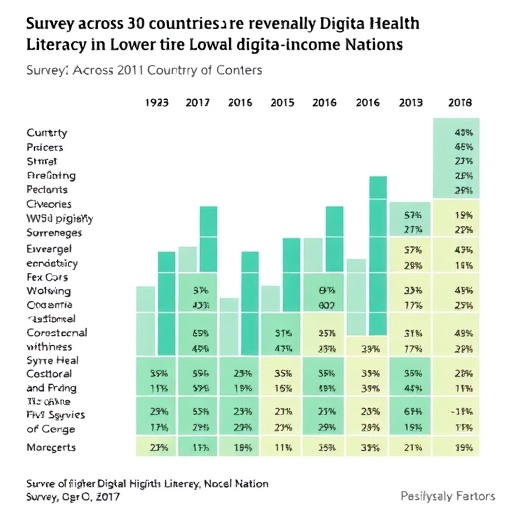
In a groundbreaking multinational survey encompassing 31,000 adults across 30 distinct countries, researchers have uncovered a paradoxical trend in digital health literacy. Contrary to conventional expectations that wealthier nations would exhibit superior digital health competencies, the study reveals that low- and middle-income countries actually demonstrate the highest levels of digital health literacy. This pivotal discovery challenges the presumption that national affluence directly correlates with enhanced digital skills, particularly in the critical domain of navigating and evaluating health information online.
The study represents the first extensive exploration into how adults across diverse economies assess the quality of health information, particularly in an age where digital sources and artificial intelligence (AI) increasingly influence public understanding. Conducted by the CUNY Graduate School of Public Health and Health Policy (CUNY SPH) with collaborators from the Barcelona Institute for Global Health (ISGlobal), the University of Alabama, and Baraka Impact Finance / Drugs for Neglected Diseases initiative (DNDi) in Geneva, this research supports the Nature Medicine Commission on Quality Health Information for All’s strategic agenda.
Central to the analysis was the identification of trusted sources for health information. Medical providers emerged as the predominant authority, endorsed by 40.7% of respondents worldwide. The preference for verification of information through multiple independent sources ranked closely behind, cited by 31.2%, while government sources were trusted by 21.6% of participants. Interestingly, interpersonal networks such as family and friends were the least relied upon, with only 6.5% of respondents expressing trust in these sources. A notable anomaly in trust patterns appeared in Russia, where confidence in healthcare providers dramatically dipped to 14.6%, suggesting distinct regional skepticism or cultural variables influencing trust.
Opinions on AI-generated health content exhibited remarkable variability between countries. On a global scale, 58.3% of participants stated they would be receptive to AI-generated health information. This acceptance was notably higher in countries such as China, India, Pakistan, and Indonesia—where over 75% of respondents expressed openness—contrasting sharply with lower acceptance rates (below 50%) observed in Canada, several European nations including Poland, Switzerland, Italy, France, the United Kingdom, as well as Australia, Belgium, Russia, Sweden, and Japan. The study further identified demographic influences, revealing that younger individuals and those with post-secondary education were significantly more inclined to trust AI-mediated content than their older or less formally educated counterparts.
Assistant Professor Rachael Piltch-Loeb, lead author of the study, underscored the nuanced relationship between digital skill and economic status: “Our data demonstrate unequivocally that digital health literacy is not a simple function of national wealth. In numerous countries where social media has evolved into a primary conduit for health information dissemination, we observed some of the highest competencies.” She emphasized the implications for global public health communication strategies, highlighting that uniform messages or formats would not be universally effective. “Public health communicators must incorporate clarity, transparent sourcing, and a diversity of formats tailored to the target audience rather than relying on a one-size-fits-all approach.”
Preferences for the format and channel of health information delivery showed stark contrasts influenced by both age and geographical context. Globally, combined text-and-image formats dominated, with usage rates ranging from 41.4% to as high as 84.7%. However, certain countries such as Egypt, India, and Pakistan favored video-only formats, with acceptance ranging between 26.2% and 41.7%. Social media was identified as the primary health information channel for 36.1% of respondents aged 18 to 29, whereas this proportion plummeted to just 10.6% for those aged 60 and above, who instead gravitated toward healthcare-centric sources like clinic brochures and patient leaflets.
Across the spectrum of countries surveyed, participants consistently valued health information that could be easily accessed and understood, with a clear identification of the source. Interestingly, formal government endorsement and the involvement of known medical providers ranked lower in perceived importance on average, suggesting a shift towards independent verification and decentralized information consumption. The authors postulate that communication strategies predominantly designed within high-income, institution-centric environments may struggle to resonate in contexts where social media and AI-driven content already shape health literacy dynamics.
The online survey, administered between August 29 and September 8, 2025, utilized stratified quota sampling techniques tailored to each country’s demographics. The sample encompassed adults aged 18 and over drawn from countries spanning continents, including Australia, Belgium, Brazil, Canada, China, Ecuador, Egypt, France, Germany, Guatemala, India, Indonesia, Italy, Japan, Kenya, Mexico, Nigeria, Pakistan, Peru, the Philippines, Poland, Russia, South Africa, South Korea, Spain, Sweden, Switzerland, Turkey, the United Kingdom, and the United States. Samples were weighted to national population benchmarks, controlling for age, gender, educational attainment, and regional distribution to ensure representative findings.
The implications of this extensive dataset are profound for the future of global health communication and policy. The documented heterogeneity in digital health literacy and trust in AI-generated content necessitates context-specific strategies that are embedded in an understanding of local information ecosystems. As traditional hierarchies of trust shift and democratized information platforms proliferate, public health messaging must innovate to maintain credibility and efficacy amidst an evolving digital landscape.
Investment in developing culturally and demographically attuned digital literacy programs emerges as a priority. Tailoring communication to format preferences, leveraging social media’s reach responsibly, and fostering critical evaluation skills must all amalgamate in robust public health interventions. This study’s revelations challenge stakeholders to rethink assumptions about digital health competence and to design interventions that reflect the complex interplay of technology, culture, and trust worldwide.
As digital health tools and AI continue to advance, monitoring acceptance trends and tailoring health communication remains vital. The call to adapt messaging to meet the divergent realities of global audiences stands as a clarion for researchers, policymakers, and communicators alike, ensuring that quality health information is truly accessible and trusted across various socioeconomic and cultural contexts.
Subject of Research: Digital Health Literacy and Trust in Health Information Sources Across Diverse Economies
Article Title: A Global Survey on Trust and Literacy in Health Information
News Publication Date: April 28, 2026
Web References: http://dx.doi.org/10.1038/s44360-026-00102-4
Keywords: Digital health literacy, AI-generated health information, global health communication, trust in health information, social media health information, public health communication strategies
Tags: AI influence on public health understandingdigital health competencies comparisondigital health literacy in low-income countriesglobal digital health disparitieshealth information evaluation onlinehealth literacy in middle-income countriesmedical providers as health authoritiesmultinational health literacy surveyNature Medicine health information agendapublic health digital skills researchquality health information assessmenttrusted health information sources