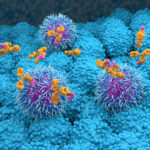
![EMMI is used across Terray's entire pipeline, identifying and optimizing novel chemical scaffolds. [Credit: Terray]](https://www.genengnews.com/wp-content/uploads/2025/12/CDS7-copy-1.png "CDS7 copy 1")
Terray Therapeutics has achieved its first discovery milestone in the company’s multi-target collaboration with Bristol Myers Squibb (BMS). Under the terms of the agreement, which began in 2023, Terray will discover and develop small molecule compounds against a set of targets nominated by BMS. BMS will subsequently assume responsibility for development and commercialization.
While therapeutic details of the milestone have not been disclosed, Terray describes the target as “novel and difficult to drug,” and representative of the company’s Experimentation Meets Machine Intelligence (EMMI) platform.
The AI drug discovery biotech was founded in 2018 by CEO Jacob Berlin, PhD, based on an ultraminiaturized chip technology, about the size of a nickel, which measures small molecule binding affinity at an unprecedented scale.
The proprietary hardware, termed tArray, was originally designed by Kathleen Elison, PhD, a graduate from Berlin’s City of Hope academic lab and currently principal scientist at Terray. tArray is now the heart of fit-for-purpose data generation for the EMMI platform. Based in Monrovia, California, Terray has since grown to 130 employees.
Generalizing beyond the training data remains a major challenge for AI models and often causing proposed drug candidates to resemble existing patented compounds. To address this gap, tArray’s large scale data generation aims to assist the discovery of drugs that lie outside molecules that have already been tested.
“The core platform at Terray is to rapidly iterate around novel areas of chemical space to solve what couldn’t be solved before,” emphasized Berlin in an interview with GEN.
Terray collects target-molecule interactions at a rate of one billion measurements per quarter. The company describes its full 13 billion measurement dataset, as “the largest global database of binding data.”
In addition to the BMS collaboration, Terray has partnered with Calico Life Sciences to address age-related diseases and Odyssey Therapeutics for transcription factor therapies. Terray’s lead asset is a brain-penetrant inhibitor for multiple sclerosis that is a product of the EMMI platform.
Which drugs to test
EMMI’s AI stack is grounded in its reasoning model, named COATI, which understands chemistry to guide scientists through a “generate, predict, and select” workflow. Berlin states that COATI’s recent updates have seen a dramatic increase in the ability to traverse far in chemical space, and achieve fine-grained, precision in chemical structure for drug discovery.
![Overview of EMMI's AI stack [Credit: Terray]](https://www.genengnews.com/wp-content/uploads/2025/12/EMMI-1024x588.png)
Picking the wrong set of molecules to synthesize can set a program back for months to years, and contributes strongly to high costs and failure rates. To address this gap, Terray recently announced updates to its drug candidate selection workflow.
“Determining the optimal set of compounds to synthesize and test is ultimately where AI meets experimental reality,” said Berlin.
Terray’s global potency prediction model (TerraBind), which is trained on both public and the proprietary data, produces thousands of molecules for potential synthesis and testing per cycle. Given the large scale of data, re-training TerraBind to quantify prediction uncertainty to assist candidate selection is too computationally expensive. To address this challenge, the new workflow leverages epistemic neural networks (Epinets), which incorporate joint predictions and uncertainty estimates into the selection process.
In a retrospective benchmarking test, Terray applied the method to identify the most potent compound in a set of approximately 50,000 molecules using a dataset of literature EGFR inhibitors. Compared to prior selection approaches that did not account for uncertainty and were limited to filtering for chemically similar designs, the new Epinets method reached the same potency as the average final performance three times faster and four times better based on IC50 potency measurements.
Looking ahead, Terray will incorporate additional features such as absorption, distribution, metabolism, and excretion (ADME) properties, and synthesis/assay cost and time, and extend selections from single-cycle to multi-cycle to further improve efficient discovery and success rates.