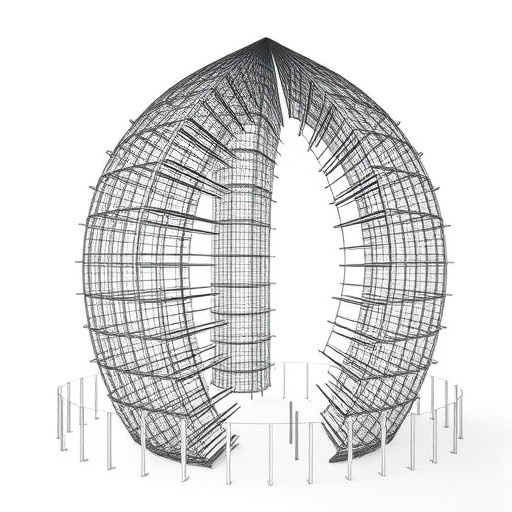
In a groundbreaking development poised to reshape the understanding and engineering of cylindrical structural components, researchers have unveiled an innovative test-based methodology for assessing collapse behavior in helically wound and layered cylindrical structures. This novel approach promises to significantly enhance the reliability and safety assessments of cylindrical constructs employed in various high-stakes engineering applications, including aerospace, civil infrastructure, and energy pipelines.
Historically, the analysis of cylindrical structures composed of helically wound and layered materials has presented profound challenges due to their complex mechanical interactions and anisotropic properties. Traditional analytical methods often fall short in capturing the nuanced interplay between layers and winding orientations under collapse-inducing loads. The research led by Zhang, Y., Saneian, M., Bai, Y., and their collaborators introduces what is termed the “test-based equivalent-material method,” which effectively bridges the gap between experimental data and predictive modeling.
At the heart of this methodology lies an innovative equivalence principle that translates the intricate multi-layered helically wound architecture into an experimentally validated simplified material representation. By conducting targeted mechanical tests, the researchers derive effective material properties that encapsulate the aggregate response of the layered system. This surrogate material model then facilitates robust numerical simulations, enabling precise collapse qualification without resorting to prohibitively detailed layer-by-layer analyses.
One of the major advantages of this approach is its scalability and adaptability. Engineers and designers can apply the equivalent material parameters obtained through relatively straightforward tests to a wide range of cylindrical structures, regardless of size or specific material compositions. This dramatically reduces the computational costs and time traditionally associated with finite element models of complex laminates, streamlining the design and certification process for structures susceptible to buckling and other collapse modes.
The structural integrity of helically wound cylinders is crucial in multiple industrial sectors. For instance, high-pressure pipelines transporting oil and gas frequently employ helically wound steel strips to enhance strength and durability. Similarly, aerospace components such as pressure vessels for fuel storage and fuselage sections rely on layered composites to achieve superior performance-to-weight ratios. Recognizing the critical nature of these applications, the test-based equivalent-material method offers a pragmatic pathway to ensure these structures can withstand extreme conditions without catastrophic failure.
Delving deeper, the researchers meticulously examined the influence of winding angle, layer thickness, and material anisotropy on the effective mechanical behavior. Their experimental protocols involved subjecting prototype samples to axial compression, torsion, and combined loadings while rigorously monitoring deformation and failure patterns. By correlating these results with equivalent material properties, they established a robust calibration framework that captures subtle nonlinearities and failure mechanisms intrinsic to layered helically wound cylinders.
A particularly innovative aspect of the work is the incorporation of nonlinear collapse phenomena into the equivalent-material representation. Classical linear elastic or even simple nonlinear models often inadequately predict collapse, especially for layered structures where progressive delamination, local buckling, and material yielding interact in complex ways. The team’s method incorporates advanced constitutive modeling informed by experimental evidence, thereby extending predictive capabilities into the ultimate collapse regime with remarkable accuracy.
Moreover, the proposed methodology aligns excellently with ongoing efforts in digital twin technology and real-time structural health monitoring. By building a validated equivalent material model from test data, engineers can integrate this model into digital twins for continuous prediction of structural performance under operational loads. This fusion of experimental validation and digital simulation heralds a new era in proactive maintenance and failure prevention for critical infrastructure.
Application-wise, the method has already demonstrated its potential in prototype development phases. The team tested cylindrical structures representative of submarine pressure hulls and composite overwrapped pressure vessels, both of which undergo stringent safety certification. The test-based equivalent-material method facilitated rapid iterative design modifications while maintaining high fidelity in predicting collapse loads, thus shortening development cycles and improving design confidence.
From a practical viewpoint, the reduction of experimental complexity stands out. Whereas traditional methods might require exhaustive testing of multiple individual layers, orientations, and bonding conditions, this approach consolidates testing into a manageable set of representative experiments. The derived equivalent material parameters effectively embody the net structural response, enabling engineers to bypass onerous microscale testing without sacrificing accuracy.
Fundamentally, this research contributes to the broader scientific discourse on multiscale modeling in composite materials. The challenge of reconciling microscale structural features with macroscale performance is a longstanding issue. By implementing a test-based equivalency strategy, the researchers provide a tangible methodology that harmonizes the scales through empirical calibration rather than purely theoretical assumptions or computational homogenization.
In terms of future directions, the team envisions extending their framework to incorporate environmental degradation factors such as moisture ingress, temperature fluctuations, and fatigue-induced damage accumulation. These variables critically influence collapse behavior in real-world settings, and integrating them into the equivalent-material paradigm will bolster the method’s practical utility.
Additionally, the adaptability of this method suggests promising integration with emerging additive manufacturing techniques. Layered and helically wound structures produced by 3D printing could be experimentally characterized using this approach to tailor equivalent materials for bespoke designs, unlocking unprecedented customization in lightweight, high-strength structural components.
Ultimately, this test-based equivalent-material method stands as a transformative advance in engineering science, merging experimental rigor with computational efficiency to unravel the complexities of helically wound layered cylindrical structures. The impact spans multiple disciplines, offering a robust, scalable tool for ensuring structural safety in an array of critical applications — from aerospace to energy infrastructure, shaping the future of advanced materials and design methodologies.
This innovation, published in the prestigious journal Communications Engineering in 2026, signifies a major leap forward in predicting collapse phenomena, providing engineers and researchers with a powerful new instrument to tackle complex structural challenges. Its implications for enhancing durability, reliability, and safety herald a significant milestone in structural engineering research.
In summary, by deftly combining empirical testing with advanced material modeling, Zhang and colleagues have unlocked an effective pathway to understand and predict the collapse of helically wound and layered cylinders. Their work paves the way for safer, more efficient designs, enabling engineers to push the boundaries of structural performance in demanding environments — a testament to the fusion of innovation and practical engineering excellence.
Subject of Research: Collapse qualification and mechanical behavior of helically wound and layered cylindrical structures using an experimental equivalent-material method.
Article Title: Test-based equivalent-material method for collapse qualification of helically wound and layered cylindrical structures.
Article References:
Zhang, Y., Saneian, M., Bai, Y. et al. Test-based equivalent-material method for collapse qualification of helically wound and layered cylindrical structures. Commun Eng (2026). https://doi.org/10.1038/s44172-026-00699-0
Image Credits: AI Generated
Tags: aerospace cylindrical structure safetyanisotropic material behavior in cylinderscivil infrastructure cylindrical componentsenergy pipeline structural assessmentexperimental validation of structural modelshelical structure collapse analysishelically wound cylindrical structureslayered cylindrical component testingmechanical testing for collapse predictionnumerical simulation of helical structuressimplified material modeling for layered structurestest-based equivalent-material method