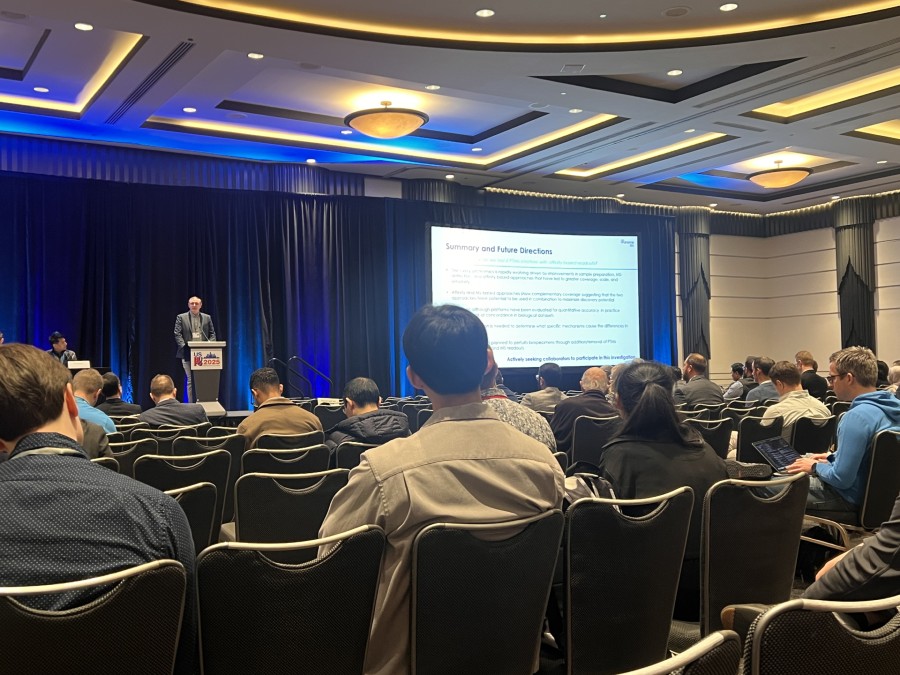
The annual meeting of the US Human Proteome Organization, held this year in Philadelphia, may be smaller than some other scientific gatherings that take place throughout the year, but for attendees, it is an excellent opportunity to share the latest research and catch up on some of the advances from the field of proteomics.
That includes the launch of tools that could simplify their work in the lab like the Flex Proteomics Workstation, Opentrons’ newest automated system for running common proteomics workflows including preparing mass spectrometry samples. The workstation automates steps such as protein digestion, quantification, labeling, and purification. The workstation combines a liquid handling platform with an on-deck plate reader, heater-shaker, and magnetic block. Some of the benefits to researchers include the ability to run different proteomics sample preparation workflows from pre-existing verified protocols developed by the Opentrons’ team or they can develop new protocols themselves.
![Opentrons' Flex Proteomics Workstation at US HUPO 2025 [Credit: GEN]](https://www.genengnews.com/wp-content/uploads/2025/03/Opentrons-Flex-Station-194x300.jpg)
James Atwood, general manager of robotics at Opentrons, told me in a conversation about the launch that the workstation was the company’s solution to some key challenges for proteomics labs. After installing some 10,000 robots around the world, “we have good visibility into what customers are doing” and where their pain points are, he said. For a number of years, “a significant portion of our install base has been automating portions of the pre-mass spec, proteomic sample prep workflow.”
At the same time, Opentrons had been investing in developing and verifying its library of proteomics protocols and making them available to customers. “I think it really came down to seeing people doing portions of these workflows and then making the decision that we can deliver a solution to the market that … goes all the way from protein quantification to purified peptides ready for mass spectrometry.”
Pricing for the workstation is in the mid-five figures which Opentrons thinks will appeal to labs with “modest budgets and limited space.” Lower cost is one of the main reasons that Hanno Steen, PhD, has invested in several Opentrons workstations instead of other automated platforms. Steen is the director of the proteomics center at Boston Children’s Hospital and a professor of pathology at Harvard Medical School.
His introduction to Opentrons platforms dates back to the emergence of the COVID-19 virus. “The NIH asked whether I could join a project that included the processing of 10,000 samples,” he explained. Running that many samples manually was not feasible so Steen began exploring automation platforms. “Opentrons was just by far the most cost-efficient option,” he said and that led him to purchase his first system in 2020. Three months later, he purchased a second system to have “more flexibility and redundancy” for people in his lab.
Atwood explained that Opentrons is able to keep the costs of its platforms down by making the components in-house and by being intentional about system design. For example, “We’ve made a number of software investments [that] allow us to have more flexibility in our hardware tolerances,” he said. “Because we can correct for some of those tolerances in the software, we don’t have to drive artificially restrictive constraints on the tolerances of our raw material components, and that drives the cost down.”
In the last year, Steen purchased two new Flex workstations. Compared to the older models, which were more bare bones, the Flex “is a more mature system” with greater functionality, he told me. For example, with the older models, “we basically needed somebody to manually move plates around.” In contrast, the Flex system easily moves plates and samples and that makes it possible to run more elaborate workflows.
Current breakthroughs, future directions
US HUPO is one of those meetings that Steen looks forward to each year. He sits on the organization’s advisory board and was one of the chairs of this year’s meeting. “I’m always kind of biased towards US HUPO,” he told me, in part because it’s smaller than some other scientific conferences with a more laid-back atmosphere and ample opportunities for attendees to network.
I asked Steen about themes from the conference that stood out to him. He noted that there is a lot of conversation about doing high-throughput proteomics experiments but there are not many groups working on it as yet, something he found surprising. “There’s still quite a bit of reluctance but I think that’s definitely going to come,” he said.
For Parag Mallick, PhD, Nautilus Biotechnology’s founder and chief scientist and a member of the US HUPO advisory board, one of the highlights of this year’s meeting was a session on the future of proteomics. At Nautilus, scientists are developing a platform with two modes, one that supports broad-scale measurement of proteins, and a second for ultra-high resolution measurement of individual proteins and associated proteoforms. In recent times, Nautilus has used its technology in a number of neurodegenerative disease studies in partnership with different groups. In the last six months, they have introduced an assay for measuring tau and about 2000 proteoforms of the protein, and used it in several studies to understand the role of tau proteoforms in disease progression.
Rather than looking back on what has already been done, “it really was interesting to think about where we want to be 15 years from now,” he told me. “What does the field look like? What things do we need to put in place today so that we can evolve towards that future?”
Conversations like these are important as the scientific field moves increasingly towards a multi-omics approach to disease. “Historically, proteomics was a field that was solely dominated by tool developers,” he said. “Now we’re seeing a greater appreciation from the non-proteomics world for the accessibility of proteomics. We’re seeing more people cross over from genomics to proteomics and really looking at multi-omics.”
One of the key themes that emerged from the session was the broadening ecosystem of tools and methods for measuring protein activity. “Different scientists are asking different questions and [now] they’ve got a menu of different tools. I think of it as being about to pick a book off the shelf,” Mallick said. And some tools might work better for some use cases than others. That means “when we think about the future, we are going to have to identify which tool we want for asking and answering which question.” Also, “how do we integrate data across different types of protein measurement modalities, that’s not something [the field] had to deal with before, let alone how we think about spatial and integrating with other omics.”
Opentrons’ Atwood believes robotic platforms will be increasingly important for proteomics workflows and experimental setups. “The time to generate a proteome is dramatically reduced. We’re now in a world where it’s conceivable to run a sample and generate thousands of protein data points within minutes,” he said. That has created a “tremendous sample prep burden” for lab staff who still have “to prepare, purify, quantify, and normalize their samples before [they] go into the mass spectrometer. I think we’re at the age now where robotics is going to be required in the lab if you want to execute experiments at scale.”
Artificial intelligence tools could gain ground
Part of the session on the future of proteomics focused on the use of artificial intelligence (AI) in proteomics. “What does that look like for how we design experiments and interpret data and how we write papers?” Mallick said. Already, there are some in the proteomics community that have begun using AI for specific tasks such as matching spectra to protein identifications. “I think we are beginning to see AI being used on integrating across large datasets but that is currently a challenge for the field,” he told me. “Many different labs have different protocols. How does one integrate data that was collected with different methodologies? That is a substantial barrier to building a foundation model of proteomics.”
Getting there will require establishing standards and best practices for proteomics experiments “so that we can really get to the place where we have large volumes of data needed by modern AI tools to build these kinds of foundational models,” he said. It’s something that organizations like World HUPO and US HUPO, as well as the National Institute of Standards and Technologies, are already starting to think about. “Those sets of organizations are going to be really important drivers of this.”