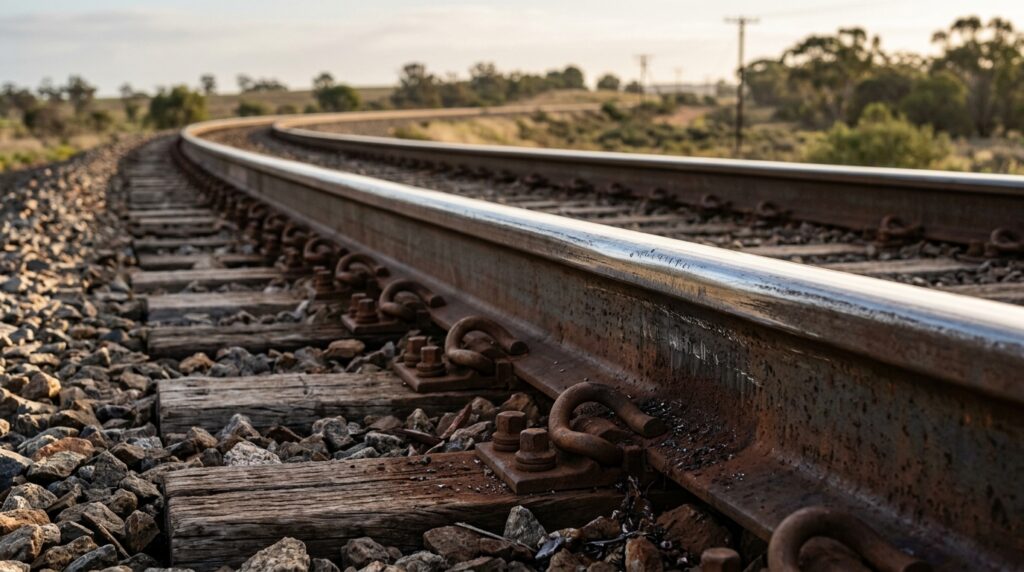
Multibody dynamic simulations of heavy haul operations demonstrate that wheel tread hollowness and track gauge widening generate sharply contrasting wear and rolling contact fatigue patterns between the high and low rails of curved track. Investigating conditions representative of Sweden’s northern Malmbanan iron ore corridor, researchers found that maintenance strategies established to mitigate high rail wear fail to address rolling contact fatigue on the inner low rail of small-radius curves. The computational study, conducted by Om Prakash Yadav, Jonathan Leung, Matthias Asplund, Mats Berg, and Sebastian Stichel, modeled vehicle-track interactions to evaluate how progressive profile degradations alter contact dynamics. Their numerical evaluations reveal that while freshly ground high rails experience negligible rolling contact fatigue due to elevated wear rates removing surface cracks, the low rail suffers substantial fatigue under both worn and ground conditions. Furthermore, wheel hollowness exerts a far stronger governing influence over low-rail fatigue than track gauge widening, exposing critical limitations in standard railway track maintenance regimes.
The investigation focused on Sweden’s strategic Malmbanan line, specifically examining the northern loop between Kiruna and Riksgränsen, an infrastructure section characterized by an exceptionally dense concentration of sharp curves. Heavy haul iron ore trains operating along this corridor typically run with a length of 750 meters, comprising 68 wagons hauled by two six-axle locomotives with each wagon carrying a 30-tonne axle load when fully loaded. Following track upgrades and the introduction of heavier freight traffic during the mid-2000s, track managers observed accelerated rail degradation, predominantly in curves having radii below 850 meters. Although optimized profiles and cyclic grinding successfully mitigated fatigue damage across tangent tracks, large-radius curves, and the outer high rails of tight curves, low rails continued to suffer severe rolling contact fatigue and spalling. Because redesigning rolling stock or altering existing track geometry requires substantial capital expenditure, the study focused on optimizing maintenance limits within existing infrastructure parameters.
To capture realistic contact physics without conducting costly field trials, the research team developed a multibody simulation model utilizing GENSYS software. The simulated vehicle represented a Fanoo040 iron ore wagon equipped with Motion Control M976 three-piece bogies, previously validated against operational measurements. Simulations evaluated fully loaded wagons traversing a circular curve with a radius of 594 meters and a cant of 63 millimeters at a constant operating speed of 60 kilometers per hour. Under these conditions, the calculated cant deficiency was roughly 5 millimeters, indicating that the simulated freight vehicles negotiated the curve very close to equilibrium speed. Track geometry variations incorporated measured irregularity data recorded directly prior to tamping, with the starting location kept identical across all parametric cases to preserve comparability. Contact interactions across up to three simultaneous contact points per wheel were simulated using the GENSYS coupling routine wr_coupl_pe3, modeling normal stiffness through linear contact springs and tangential creep forces using Kalker’s FASTSIM algorithm implemented as a Fasim lookup table.
The parametric study examined five distinct worn wheel profiles with tread hollowness magnitudes measuring approximately 0.0, 0.5, 1.0, 1.5, and 2.1 millimeters, measured from an automated wayside inspection station and compared against nominal WP4 profiles. Wheel hollowness was evaluated as the radial difference between the minimum tread radius near the running band and the maximum radius located near the field side. These wheel profiles were paired with two distinct rail lifecycle conditions: worn rail profiles measured prior to maintenance grinding and freshly ground profiles restored to nominal geometry based on MB1 high rail and MB6 low rail templates derived from UIC60E1 rails with a 1:30 inclination. Simulations spanned average track gauges ranging from nominal 1435 millimeters up to 1460 millimeters, encompassing the formal 1450-millimeter maintenance intervention limit established by the infrastructure manager. A baseline friction coefficient of 0.5 represented dry, unlubricated contact at tread and flange interfaces, while comparative simulations at 0.35 and 0.2 evaluated moderate and low friction regimes.
Wear intensity was quantified through the frictional energy dissipation rate, or wear number T-gamma, which the authors extended beyond conventional longitudinal and lateral creep products to incorporate spin creep moments and spin creepages at each contact point. Rolling contact fatigue initiation risk was modeled through the surface fatigue index derived from shakedown theory, evaluated using the rolling_fatigue_3 GENSYS routine. To reconcile the shakedown formulation with the physical reality that active surface wear continuously erodes incipient microcracks, the researchers applied an empirical creepage-based penalty correction factor. Based on mechanical creepage thresholds of 0.0025 and 0.0035, the correction maintains a full weighting factor of unity at low creepage where fatigue cracks accumulate, then progressively reduces the calculated fatigue index to zero as creepage approaches 0.0035 and abrasive wear dominates. An aggregate curve fatigue severity indicator was subsequently calculated by multiplying the mean positive surface fatigue index by the proportion of circular curve length exhibiting positive fatigue values, with curve transitions discarded.
Under dry baseline conditions, simulations revealed that freshly ground rail profiles generate substantially higher wear numbers across the rail head than worn profiles, an effect observed on both the outer high rail and inner low rail. For the high rail, maximum rail head wear numbers reached approximately 250 Joules per meter under worn conditions, whereas ground rails produced values near 300 Joules per meter across a broader operational envelope. This severe initial wear occurs because freshly ground rail geometry does not conform perfectly to worn wheel profiles, generating intense localized contact stresses until the rail profile wears into a conformal shape over several operating days. On the gauge face of the high rail, sliding-dominated contact produced extreme wear numbers reaching up to 720 Joules per meter. Because contact creepage in the flange region consistently exceeded 0.005, the immense abrasive wear completely eradicated surface cracks, resulting in zero rolling contact fatigue contribution from high-rail gauge face contact.
In contrast to wear trends, high-rail rolling contact fatigue was entirely suppressed under ground rail conditions because elevated contact energy dissipation exceeded the 90 Joules per meter threshold where the wear penalty function diminishes crack retention. Under worn high-rail conditions, rolling contact fatigue peaked at a wheel hollowness of 1.5 millimeters when average track gauge was 1440 millimeters, and at 1.0 millimeter hollowness when track gauge widened to 1445 millimeters. On the low rail, however, wear numbers were markedly lower, reaching only about 125 Joules per meter under worn conditions—roughly half that observed on the high rail. Because these lower energy dissipation values failed to cross the threshold required for natural crack removal, rolling contact fatigue proved substantially more severe on the low rail. Peak low-rail fatigue indices reached 0.15 under worn conditions and 0.10 under ground conditions. Notably, low-rail fatigue peaked sharply under ground conditions when wheel hollowness was between 0.0 and 0.5 millimeters, reaching five times the corresponding high-rail fatigue magnitude.
Global and local sensitivity analyses conducted across the simulation matrix illuminated differing mechanical drivers governing high-rail and low-rail degradation under worn rail profiles. On the high rail, wear was locally and globally most sensitive to wheel hollowness, followed by friction and track gauge, whereas rolling contact fatigue was dominated globally by track gauge widening, with friction and wheel hollowness exhibiting secondary influence. On the low rail, wear was primarily governed by the friction coefficient, followed by wheel hollowness and track gauge. Conversely, low-rail rolling contact fatigue exhibited nearly equal, substantial sensitivity to all three parameters simultaneously. Parametric simulations evaluating moderate and low friction coefficients demonstrated that reducing interface friction decreases lateral steering forces, causing vehicles to experience increased angle of attack and higher creepages across the wheel tread. Consequently, reduced friction produced higher rail head wear but diminished rolling contact fatigue across both rails, while flange wear dropped precipitously because tangential forces fell within saturated creepage regions.
The simulated interaction between wheel hollowness and track gauge widening revealed critical operational safety implications regarding wheel contact positions across low rails. While total leading wheelset lateral forces increased with track gauge to a maximum of roughly 100 kilonewtons in a 496-meter curve—consistent with permissible field limits—and derailment coefficients remained below 0.35 against an established threshold of 0.8, contact patch kinematics presented severe operational hazards. As track gauge widened beyond the 1450-millimeter maintenance limit, the wheel-rail contact band on hollow wheels migrated progressively toward the outer field edge of the wheel tread. At gauge values approaching 1460 millimeters, contact localized dangerously close to the false flange and tread edge for hollow-worn wheels, introducing high contact stresses and running instability risks. Only the worn profile with zero hollow wear maintained a stable contact band centered safely away from the tread edge across all evaluated gauge widening levels, confirming that excessive gauge widening cannot be safely tolerated to promote crack-eroding wear.
Synthesizing these findings into practical maintenance recommendations, the authors conclude that railway operators can achieve significant asset life extension by lowering the intervention limit for wheel tread hollowness from 1.5 millimeters down to 1.0 millimeter. Restricting wheel hollowness below 1.0 millimeter maintains modest wear rates and suppresses rolling contact fatigue across all permissible track gauge ranges, thereby reducing the required frequencies of mechanical rail grinding and track re-gauging. If lowering wheel maintenance thresholds is economically unviable, infrastructure managers should restrict gauge widening limits to 1445 millimeters on sharp curves to contain low-rail fatigue. Furthermore, the discovery that low-rail fatigue peaks sharply on ground profiles paired with slightly worn wheels highlights that wheel reprofiling must not be scheduled immediately following rail grinding campaigns. The researchers emphasize that these conclusions reflect fully loaded wagon models operating with uniform wheel profiles across all wheelsets, noting that ongoing subsequent investigations will examine empty wagon dynamics and asymmetric wheel wear distributions across individual axles.
Subject of Research: Wheel hollowness and gauge widening effects on wheel-rail damage in heavy haul operations
Article Title: Influence of wheel hollowness and gauge widening on wheel–rail interaction and damage in heavy haul operations
Article References: Yadav, O. P., Leung, J., Asplund, M., Berg, M., & Stichel, S. (2026). Influence of wheel hollowness and gauge widening on wheel–rail interaction and damage in heavy haul operations. Railway Engineering Science. https://doi.org/10.1007/s40534-026-00431-w
Image Credits: AI Generated
DOI: 10.1007/s40534-026-00431-w
Keywords: wheel hollowness, gauge widening, wheel-rail interaction, rolling contact fatigue, heavy haul railway, Malmbanan, GENSYS simulation, multibody dynamics, surface fatigue index, wear number, rail grinding, shakedown theory, creepage, low rail damage, high rail wear, derailment coefficient, friction management, iron ore transport