
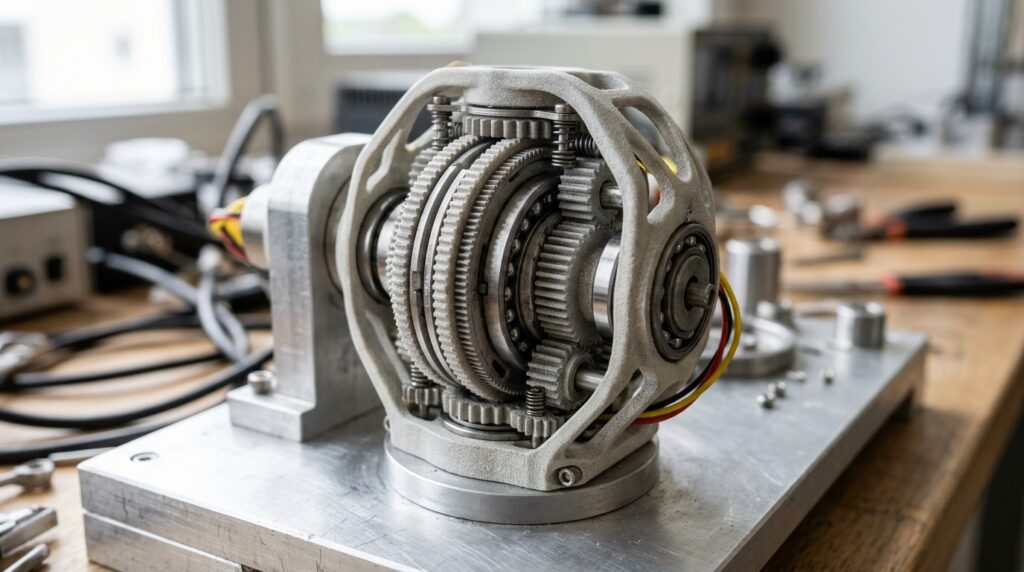
Published in Discover Robotics, the study presents a fully functional actuator with a 120:1 gearing ratio that maintains excellent haptic performance, a capability traditionally compromised by conventional gearmotors. The work addresses a significant design conflict in robotics where increasing gearing improves torque density but typically degrades the haptic responsiveness required for safe human-robot interaction. By introducing a fluidic clutch between the motor and the gear train, the system decouples the motor’s inertia and friction from the actuator output, allowing for high torque transmission while preserving low backdriving loads.
The central challenge in developing such actuators lies in the manufacturing of miniature magnetorheological clutches. At gearing ratios above 100:1, the clutches must be extremely small, low in friction, and low in inertia to prevent the compounded effects of friction and inertia from overwhelming the actuator’s responsiveness. Previous experimental demonstrations of this dual-chain architecture were limited to gear ratios of 60:1, with theoretical models suggesting benefits at higher ratios but lacking experimental proof. The current study bridges this gap by detailing a specific design and fabrication process for multi-disk clutches that can be integrated into a fully operational robotic joint.
The manufacturing process relies on Selective Laser Melting, a metal 3D printing technique, to create nested clutch assemblies. A unique feature of this approach is the ability to print the output disk assembly directly intertwined with the input disk assembly in a single print. This nested design eliminates the need for complex assembly of thin disks and spacers, which is difficult at small scales. However, the printing process requires careful orientation to manage support structures. The disks are printed vertically to ensure supports are only required beneath the outer diameter, avoiding the narrow gaps between the disks where supports could hinder rotation or cause damage.
Material selection presents a specific constraint for magnetic circuits in 3D printed components. While low-carbon steels like AISI 1010 are ideal for their high magnetic permeability, the specific printer used in this study, the Mlab 200R, is compatible only with 17-4 PH stainless steel. This material has lower magnetic properties, necessitating design adjustments to ensure magnetic flux is directed through the magnetorheological fluid rather than bypassing it through unintended pathways. The researchers employed mesh structures and spike-like features to increase magnetic reluctance in non-functional areas, effectively channeling the flux through the shear interface where torque is generated.
Post-printing operations are critical to achieving the precision required for a functional clutch. The as-printed surface finish is too rough for sealing or precise alignment, with roughness values measured between 28 and 44 micrometers. Consequently, all functional surfaces undergo CNC machining. To facilitate this, a dedicated triangular machining support is integrated into the clutch design, allowing the part to be securely held in a three-jaw chuck despite its out-of-roundness. Additionally, the assembly is subjected to a polishing bath using silicon carbide particles to remove satellite particles—small molten metal droplets ejected during printing—which could otherwise hinder free rotation or cause rubbing between the disks.
The experimental characterization of the actuator was conducted at two gearing ratios: 60:1 and 120:1. The 120:1 configuration was achieved by adding a 2:1 belt drive to a base actuator with a 61.12:1 ratio. Static torque tests revealed that at 4 amperes, the maximum torque reached was 58 Newton-meters for the 60:1 ratio and 110 Newton-meters for the 120:1 ratio. Although the 120:1 curve did not reach the theoretically expected 116 Newton-meters, likely due to belt efficiency or coupling slippage, it demonstrated the high torque capability of the system. Hysteresis was observed between ramp-up and ramp-down phases, a typical characteristic of magnetorheological systems that does not impede control performance.
Power consumption during static torque holding was also evaluated. The results showed that doubling the gearing ratio to 120:1 halved the power consumption compared to the 60:1 ratio for the same torque output. The lowest torque-specific power consumption at 250 rpm was 2.79 Watts per Newton-meter for the 60:1 ratio and 1.45 Watts per Newton-meter for the 120:1 ratio. These findings suggest that high-gearing magnetorheological actuators can be more energy-efficient when holding heavy payloads.
Bandwidth tests, which measure the actuator’s responsiveness, indicated a phase-limited maximum effective bandwidth of 100 Hz for the 60:1 ratio and 65 Hz for the 120:1 ratio. Magnetorheological fluids are known for their fast response times, typically in the order of milliseconds, and these results confirm that the actuator maintains high responsiveness even at high gearing. Backdrivability, the ability of the actuator to be driven externally, was assessed by manually actuating the lever arm. The actuator exhibited low overall backdriving resistance, amounting to only 8.1% of its maximum torque when unpowered and 3.9% when operating in slip mode. This low resistance is crucial for safety and smooth interaction with humans.
In dynamic power tests, the 120:1 actuator demonstrated the ability to deliver a maximum output power of 2 kilowatts. The test involved accelerating a 25-pound payload attached to a lever arm, with the actuator reaching 1170 degrees per second in 0.2 seconds under a nearly constant torque of 100 Newton-meters. The corresponding electrical power was 2.7 kilowatts, indicating an efficiency of 74%. Oscillations in torque and mechanical power were observed after clutch engagement, attributed to torsional resonances in the torque cell and couplings. These results highlight the actuator’s capacity to handle high-power dynamic tasks while maintaining the haptic qualities necessary for collaborative robotics.
Comparison with commercial actuators, specifically Maxon High Efficiency Joints, revealed that the magnetorheological actuator with 120:1 gearing outperformed the commercial units with 28:1 gearing on all key metrics. These metrics include backdriving load, static power-specific performance, torque-to-mass, torque-to-inertia, and power-to-mass. The higher gearing ratio, combined with the low-friction and low-inertia clutches, allows for superior performance without the trade-offs typically seen in conventional gearmotors. Additionally, the magnetorheological actuator eliminates backlash at the joint level and offers impact resistance due to the viscous coupling of the clutches.
Despite these promising results, the study acknowledges several limitations and areas for future improvement. The 3D printing process used is not yet mature, with challenges related to printing resolution, post-machining precision, and the limited range of printable magnetic materials. The current use of 17-4 PH stainless steel is sub-optimal compared to low-carbon steels, and the development of new soft magnetic printable powders is an active area of research. The 120:1 actuator remains a proof-of-concept prototype designed with conservative safety factors. Future work will focus on optimizing the design for higher gearing ratios, such as 150:1, and understanding the behavior of magnetorheological fluid at millimetre scales and high operating speeds.
This research paves the way for a new generation of robotic actuators that combine high torque and power density with the haptic capabilities required for transparent human-robot interaction. By solving the manufacturing challenges of miniature magnetorheological clutches, the study demonstrates that high gearing ratios are no longer a barrier to haptic performance.
Subject of Research: A highly-geared haptic actuator using 3D printed magnetorheological clutches
Article Title: A highly-geared haptic actuator using 3D printed magnetorheological clutches
Article References: Lhommeau, P., & Plante, J.-S. (2026). A highly-geared haptic actuator using 3D printed magnetorheological clutches. Discover Robotics, 2(1), Article 7. https://doi.org/10.1007/s44430-026-00019-3
Image Credits: AI Generated
DOI: 10.1007/s44430-026-00019-3
Keywords: highly-geared, haptic, actuator, printed, magnetorheological, clutches, scientific research