
CSO, Company Director
Optibrium
In early-phase drug discovery, we do a good job of tracking the obvious productivity metrics, like compound attrition rates, hit-to-lead timelines, and computational resource spend. Other costs are harder to capture on dashboards, but contribute to overall efficiency just the same.
There’s time lost waiting for every email response, compounded when teams are split across multiple sites or time zones. There is effort spent by team members extracting and preparing the data they need for their specific role. There is work required to consolidate the ever-evolving picture of compounds and their data into a single, coherent story, often just in time for a project meeting. Institutional knowledge walks out the door when a colleague moves on, leaving the next person to reconstruct not just what was tried, but why. And often, the lessons learned on one project never make it to the next, because there’s no obvious place to capture or share them.

Product Manager
Optibrium
Some of these issues may be symptoms of poor coordination. Others we perhaps consider as the cost of running a complex business. But should we simply accept this? It’s tempting to point the finger at team members; if only they talked more, shared more, or documented better. However, the real focus should be on the infrastructure and how to get it working for you, rather than against you.
The illusion of collaboration
R&D efficiency and productivity are among the biggest challenges in drug discovery. The industry has responded in part by increasing its collaboration efforts through specialist partnerships, open innovation networks, and an ever-growing suite of digital tools. Yet pharmaceutical R&D costs continue to rise (up to £3.7 billion in 2023), while the number of new drugs approved annually remains relatively stagnant1. This tells us that current models aren’t yet delivering the results we need.
There are several collaboration tools that we use regularly. Platforms like Slack, Jira, and shared documents have proven genuinely useful, changing how teams communicate and manage shared projects. But the frictions of duplicated efforts, version confusion, and lost knowledge persist. That’s because they’ve been designed for generic use cases and not drug discovery.
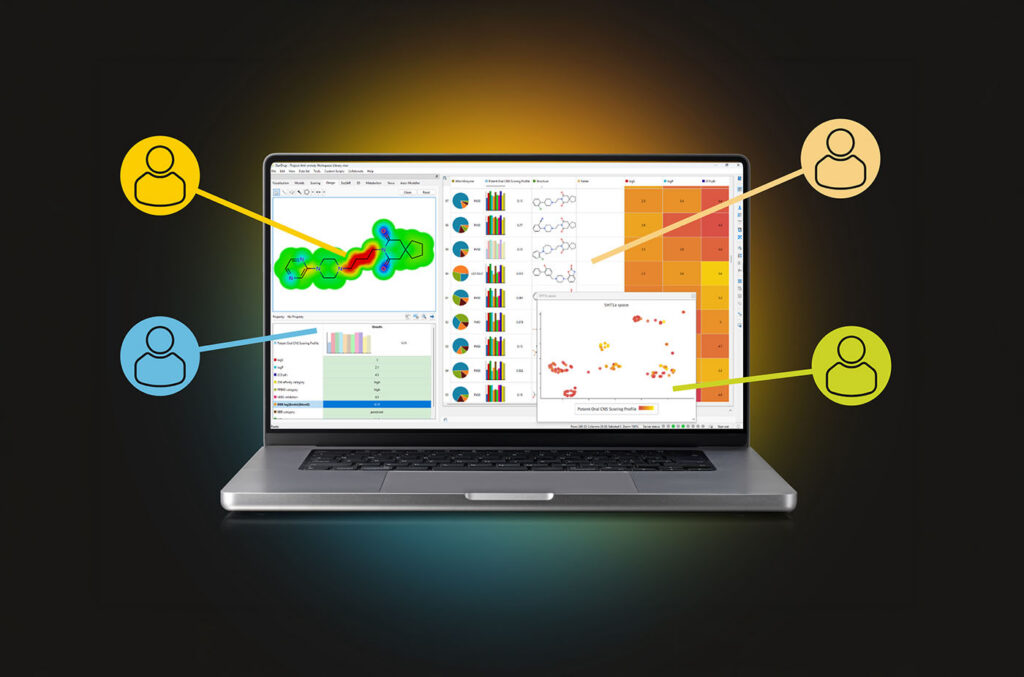
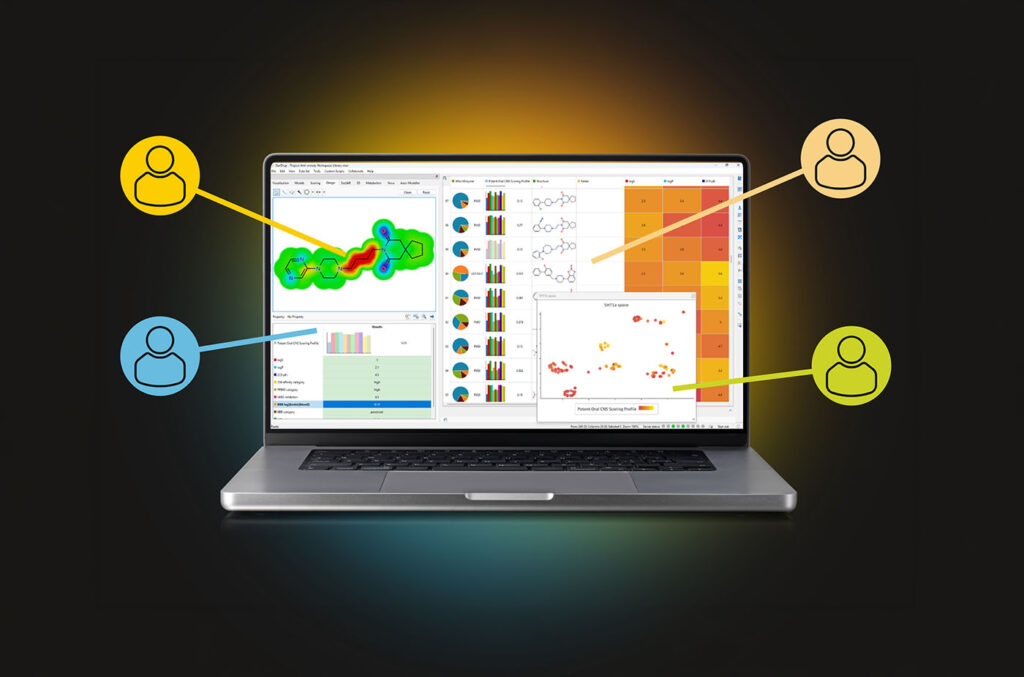
Computational drug design generates a lot of data in distinct and complex formats, including molecular structures, 3D conformations, assay results, and multidimensional scoring profiles. The tools built for documents and spreadsheets aren’t designed to handle this. The result is fragmented workflows and lost insights; not because people won’t collaborate, but because the infrastructure can’t coordinate.
What coordination actually requires
What does genuine coordination in drug discovery look like in practice? It comes down to three things:
1. Individual freedom within a shared reality
Having a shared reality is the obvious part. In drug discovery, that means that everyone on the team needs access to the same underlying compounds and data. However, individual freedom is less obvious. In a team, every person doesn’t need to interact with the data in the same way. For example, while the project lead may want to explore the complete project data set while investigating new opportunities, individual members of their team may be focused on understanding and expanding different chemical series.
Most collaborative platforms assume that a shared view equals a shared understanding, but in drug discovery, forcing everyone into a shared view of the data creates bottlenecks and leads to users with different goals tripping over each other. What’s needed is the freedom for exploration that allows individuals to view and analyze data in their own way, then share findings when they’re ready, without broadcasting every intermediate step to the whole team.
2. A single source of truth with real-time synchronization
A shared reality is only valuable if it stays that way over time. Drug discovery is a dynamic process; new compounds are designed, experimental assays and predictive models yield new data, and priorities shift as teams learn. A snapshot shared in last week’s meeting is already history a week later.
What’s needed is an environment where new compounds, data, and analyses are shared automatically across the team, without manual uploads or chasing for updates. By minimizing the gap between data generation and visibility, we can start to work in the quick, iterative feedback cycles that drive efficient discovery.
This also eliminates a scenario you might find familiar: two chemists advocating for different compound series because they’re working from different versions of the same data. That’s not a scientific debate; that’s an infrastructure failure.
3. Persistent knowledge capture
While real-time synchronization keeps us aligned on where we are with a project, it’s also important to understand how we got there. That means not just capturing the data, but also the rationale behind the decisions. Why was this series deprioritized? What concerned us about this scaffold? What information was missing when we made that call?
Without answers to these questions, new team members start from scratch, and experienced ones repeat avoidable mistakes. Too often, this reasoning lives in emails, slide decks, or even just in people’s memories, and it vanishes when they move on. Instead, we need an automatic, comprehensive record of both the “what” and the “why,” so that teams get the full value of their accumulated knowledge.
What makes a tool fit for purpose
Beyond these three principles, there are other practical considerations that determine how well a platform can meet the demands of computational drug discovery.
- Native handling of chemical data: Structures need to be searchable objects, not static images. A platform needs to work fluently with SMILES strings, descriptors, and 3D conformations.
- Performance at scale: We have access to larger compound libraries than ever before, and any software needs to be able to keep up in real-time.
- Vendor-neutral integration: Discovery teams rely on a suite of in-house and third-party systems, including databases, modeling tools, and compound registration platforms. Any system that promises coordination should be able to connect to these equally, and not just those from a single provider.
- Ease of use: Any approach that requires specialist training to operate just introduces friction from the start. It needs to be intuitive enough that it stays out of the way of the science.
- Granular access control: Discovery often involves working with CROs, academic partners, or other external collaborators. You need to be able to provide sufficient access to relevant data without exposing proprietary information.
Is effective collaboration valuable
In the last year, how much time did your team lose to the friction of getting information to the right people, whether that was waiting on responses, preparing data for meetings, or consolidating multiple versions of the same data set? And how much of what your team learned last year will be easily accessible to the team working on a related project two years from now?
We’re collaborating more than ever, but productivity isn’t keeping pace. The missing piece is a coordination layer built for the realities of computational drug discovery; one that gives individuals the freedom to explore, keeps everyone working from the same current data, and preserves the knowledge that makes each design cycle smarter than the last.
These are the costs that don’t show up on dashboards, but they’re precisely where the opportunity lies.
Edmund Champness is the chief scientific officer and company director at Optibrium and Rae Lawrence, PhD, is product manager at Optibrium.
References
- Fernald KDS, Förster PC, Claassen E, Linda. The pharmaceutical productivity gap – incremental decline in R&D efficiency despite transient improvements. Drug Discovery Today. 2024;29(11):104160-104160. doi.org/10.1016/j.drudis.2024.104160