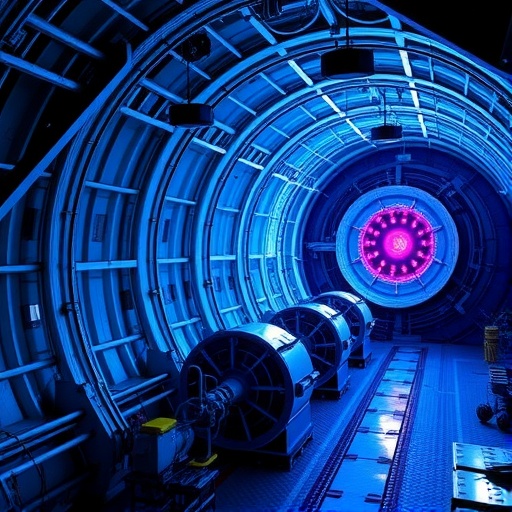
It may sound like science fiction: an experiment named NEMESIS operating deep underground, waiting to reveal the universe’s hidden schemes. But at the Sanford Underground Research Facility (SURF), the story is far more grounded—and in many ways more exciting to physicists.
NEutron MEasurementS In SURF (NEMESIS) targets a stubborn source of confusion in underground data: bursts of neutrons known as high neutron multiplicity events. These occur when high-energy cosmic-ray muons penetrate surrounding material and trigger nuclear interactions, producing showers of neutrons that can mimic or obscure signals in rare-event searches.
For experiments that rely on extreme sensitivity, this background is more than an inconvenience—it is a diagnostic problem. Without a clearer picture of where and why these neutron bursts happen, researchers must work around an uncertainty that can limit how confidently they interpret potential discoveries.
The collaboration’s motivation is sharpened by earlier studies, including work conducted at the Pyhäsalmi mine in Finland, where researchers reported intriguing anomalies in similar event classes. Those measurements paused when the mine closed and the infrastructure was slated to flood, but the research momentum found a new home at SURF.
At SURF’s Black Hills State Underground Campus (BHUC), the team plans a depth-based strategy. By taking measurements at different elevations—such as the 4850 Level and a prospective station nearer the surface on the 1700 Level—they will vary the muon flux and thus test whether the anomalies scale in a way consistent with known backgrounds.
Crucially, the goal is not only to catalog neutrons but to determine whether the anomalies could be generated by conventional processes or something more extraordinary. One speculative possibility is dark matter: if dark matter interactions or associated mechanisms contribute to neutron signatures, the depth dependence could reveal it.
NEMESIS is led by Alexander Barzilov, with Thomas Ward as chief scientist from TechSource Inc., and Wladyslaw Trzaska contributing from the University of Jyväskylä. Their plan emphasizes “twin systems” running simultaneously on multiple levels, paired with multiple neutron detectors to cross-check results against changing cosmic-ray conditions.
While NEMESIS is an indirect hunt, it complements SURF’s direct dark matter efforts, including the LUX-ZEPLIN experiment. As researchers stress, robust conclusions require multiple proofs—and long-shot experiments sometimes become the breakthroughs that reshape a field.
In the end, NEMESIS isn’t a villain’s plot. It’s a precision instrument in the fight against uncertainty—one that could either demystify a confusing background or point toward a surprising new pathway for understanding the dark sector.
Subject of Research: High neutron multiplicity events as a potential (indirect) probe of dark matter background
Article Title: Evidence for anomalies in muon-induced neutron emissions from Pb
News Publication Date: 30-Jun-2026
Web References: http://dx.doi.org/10.1016/j.nuclphysa.2026.123389
References: 10.1016/j.nuclphysa.2026.123389
Image Credits: Photo by Stephen Kenny
Keywords
Dark matter, neutron background, cosmic-ray muons, underground physics, SURF, BHUC
Tags: and advancements in neutrino and dark matter detectionbackground suppression techniquescosmic-ray muon flux measurementscosmic-ray muon interactionsdeep underground laboratory researchhigh neutron multiplicity event analysisinternational collaboration in underground physicsneutron shielding methodsphysics research at Sanford Underground Facilityrare-event detection challengesresearchers aim to better understand neutron productionunderground depthsunderground physics experiments