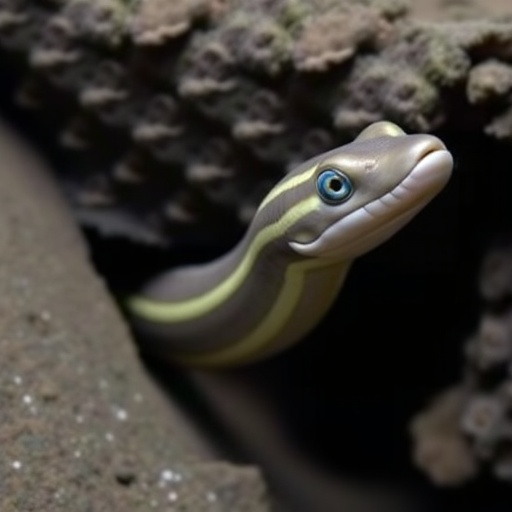
An international team of researchers has identified a new genus and species of subterranean fish living in the water-filled sediments beneath the Indo-Gangetic Plain in Bihar, northern India. The tiny, colourless animal, named Gangaichthys indonepalicus, is the first stygobitic fish recorded from the Gangetic Basin, revealing an unexpected form of vertebrate life in one of South Asia’s most densely populated and intensively used landscapes.
Stygobitic animals spend their entire lives in underground aquatic environments, including caves, groundwater channels and alluvial aquifers. These habitats are permanently dark, often low in food and separated from surface ecosystems by layers of sediment. Fish that evolve in such conditions commonly display a distinctive suite of adaptations: their eyes may become reduced or covered by skin, pigmentation can disappear, and sensory systems may become more important than vision. Gangaichthys indonepalicus, which measures approximately four centimetres long, exhibits several of these characteristics, suggesting that it is highly specialised for life below ground.
The discovery began with a short video uploaded to TikTok in 2024. The footage showed a minute fish emerging from a hand-operated water borewell near the border between India and Nepal. Its unusual appearance immediately attracted attention because no stygobitic fish were known from the region. The animal’s elongated body and earthworm-like form suggested that it might belong to the Chaudhuriidae, a family commonly known as earthworm eels, but its morphology appeared sufficiently distinctive to warrant a detailed investigation.
“The unique morphology of the fish in the video, and the fact that there are no known stygobitic fish known from the region, motivated us to track down the species to ascertain its identity,” the researchers said. Confirming the animal’s identity required more than a single observation. The scientists needed intact specimens for anatomical examination, genetic analysis and comparison with related species, but obtaining them proved exceptionally difficult because the fish inhabit underground water systems rather than accessible surface streams.
The research team, comprising scientists from the Thackeray Wildlife Foundation in Mumbai, Shivaji University, the Shanghai Synchrotron Radiation Facility of the Chinese Academy of Sciences and the Zoological Survey of India, conducted fieldwork around local handpumps and wells in Bihar. These borewells draw water from aquifers beneath the Indo-Gangetic Plain, a vast geological region formed largely from sediments deposited by the Ganges and its tributaries. To search for the fish, researchers manually pumped thousands of litres of groundwater from selected sites.
The first specimen appeared only after approximately 2,000 litres of water had been extracted. Unfortunately, it was damaged during the process and died immediately. Researchers continued pumping the same borewell, eventually recovering a second specimen after an additional 500 litres. This individual remained intact and was later designated as the holotype, the single physical specimen formally used to define the species. In taxonomy, the holotype serves as a permanent reference for identifying the species and comparing it with future discoveries.
Detailed examination revealed a combination of anatomical features that separates the fish from all previously described members of its family. The body is unpigmented and translucent, an appearance consistent with the absence of sunlight in its habitat. Its eyes are reduced and concealed beneath the skin, indicating that vision has become less useful over evolutionary time. The fish also apparently lacks ribs, a feature that may be associated with its unusually flexible, slender body and movement through narrow subterranean spaces. These traits were evaluated alongside other characteristics of the skull, skeleton and external anatomy.
The researchers used micro-computed tomography, or micro-CT, to investigate the specimen without destroying it. This imaging technique produces high-resolution three-dimensional reconstructions from a series of X-ray scans, allowing scientists to examine minute bones and internal structures. Such data are particularly valuable when only one intact specimen is available. Genetic analysis was then combined with the anatomical evidence to determine the fish’s evolutionary position. The results confirmed that it does not simply represent an unusual population of a known earthworm eel, but belongs to a completely distinct genus within the family Chaudhuriidae.
The name Gangaichthys means “fish of the Ganga,” referencing the river system that defines the region and supports millions of people through water, agriculture, fisheries and livelihoods. The species name indonepalicus reflects its occurrence near the international border between India and Nepal. The discovery extends the known distribution of subterranean fishes and highlights how little scientists know about aquifers beneath apparently familiar environments. While caves and isolated groundwater systems are often recognised as biodiversity hotspots, alluvial aquifers can remain largely unexplored, even when they supply water to local communities.
The researchers say the finding illustrates both the biological richness of India and the major gaps that remain in documenting it. India spans multiple climatic zones, geological formations and biogeographic regions, yet many species have never been formally described. In subterranean habitats, the challenge is especially severe: animals may be extremely small, rare, difficult to capture and restricted to water systems that are inaccessible without specialised fieldwork. The appearance of Gangaichthys indonepalicus in a borewell demonstrates that even routine groundwater infrastructure can provide clues to hidden ecosystems. At the same time, it raises questions about the species’ distribution, population size, ecology and vulnerability to groundwater extraction and pollution. Further sampling will be needed to determine whether this miniature fish occupies a broad network of aquifers or survives only in a small, isolated portion of the Indo-Gangetic Plain.
Subject of Research: Discovery and description of a new subterranean fish genus and species from alluvial aquifers in Bihar, India.
Article Title: Gangaichthys indonepalicus, a new genus and species of miniature stygobitic earthworm eel (Synbranchiformes, Chaudhuriidae) from alluvial aquifers in the Indo-Gangetic Plain, Bihar, northern India
Web References: ZooKeys research article; ZooKeys; DOI link
References: ZooKeys, DOI: 10.3897/zookeys.1289.188089
Image Credits: Ishan Agarwal
Keywords: Gangaichthys indonepalicus, subterranean fish, stygobitic fish, earthworm eel, Chaudhuriidae, Indo-Gangetic Plain, Bihar, groundwater, aquifers, biodiversity, new species, micro-CT scanning, evolutionary adaptation
Tags: blind and pigmentless fishcave and aquifer ecosystemsGangaichthys indonepalicusgroundwater habitat researchIndo-Gangetic Plain biodiversitynew fish genus and speciesrare fish species Indiastygobitic adaptations in fishsubterranean aquatic ecosystemsTikTok scientific discoveryunderground aquatic biodiversityUnderground fish discovery