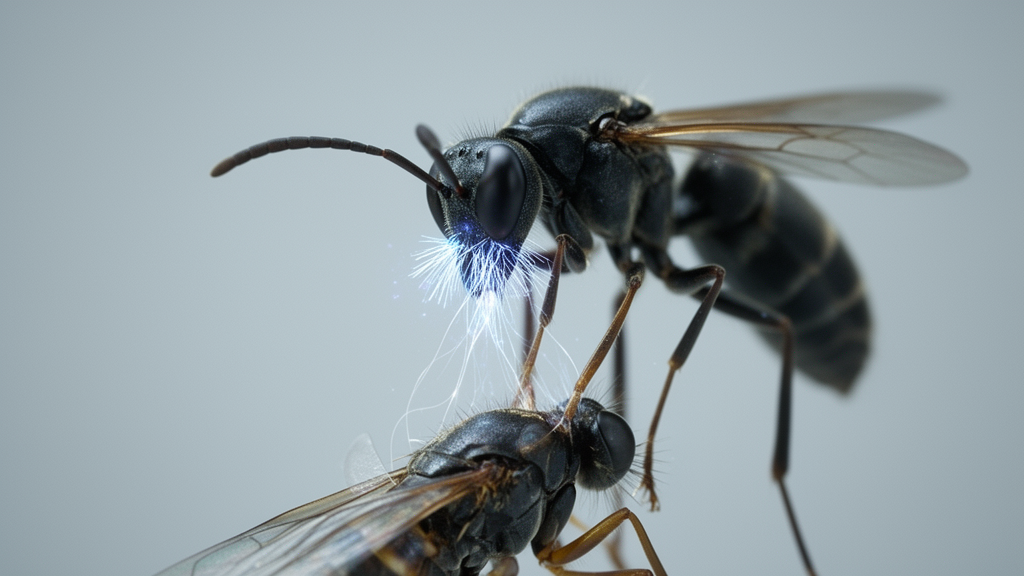
Host DNA retained on the cuticle of adult parasitoid wasps can reveal the species from which they emerged, according to a controlled laboratory study that introduces a non-destructive molecular method for identifying parasitoid–host associations. Researchers washed recently emerged Lariophagus distinguendus wasps with a buffer, extracted DNA from the wash, and used mitochondrial DNA barcoding to match the sequences with either the granary weevil Sitophilus granarius or the drugstore beetle Stegobium paniceum. The host was identified in 35 of 72 analyzed samples, a detection rate of 49%. The results establish the feasibility of cuticular barcoding under laboratory conditions, but they do not yet show that the method can identify unknown hosts reliably from field collections.
Parasitoid wasps are important natural enemies of other insects and are often highly specialized in their host relationships. Yet their ecology remains poorly documented, partly because many species are small and because adult wasps collected with sweep nets or Malaise traps usually arrive without information about the organisms they parasitized. Traditional rearing can establish a host association, but it is time-consuming and difficult for minute wasps that attack hidden larvae, eggs or insects living inside plant structures. Molecular approaches to trophic interactions, including DNA metabarcoding and the analysis of gut contents, can detect more links, although they may require destructive sampling of collected wasps and can be limited by the availability and detectability of potential hosts.
The new approach draws on the fact that an insect’s exoskeleton can preserve traces of organisms encountered during development. L. distinguendus is a solitary ectoparasitoid that develops on beetle larvae concealed in grain kernels or similar enclosed environments. Its larva crawls over and feeds externally on the host, and contact with the host and its remains during adult emergence can leave host DNA on the newly emerged wasp. The researchers adapted a washing protocol previously developed for ants, placing each wasp in 200 microliters of buffer, vortexing the sample for one minute and transferring the liquid for DNA extraction. This procedure allowed the wasp itself to remain available for subsequent examination.
For the experiment, the wasps came from the Department of Chemical Ecology at the University of Hohenheim and had been reared in the laboratory on larvae of S. granarius grown in wheat grains or S. paniceum grown in koi pellets. The researchers analyzed 109 wasps from the granary weevil treatment, including 78 females and 31 males, and 69 from the drugstore beetle treatment, including 49 females and 20 males. The molecular comparison used 72 samples drawn equally from the two host treatments and included both individual wasps and pools of five wasps, with samples divided between freezing at minus 20 degrees Celsius and preservation in 99.6% ethanol.
Three beetles from each host species were destructively sampled to create reference sequences and test primer performance. Four mitochondrial cytochrome oxidase I primer pairs were evaluated on host tissue, and two produced the strongest amplification bands: LCO1490/HCO2198, a standard barcoding pair, and Jerry/Pat, a pair used mainly for beetles. Products with strong bands were purified and sequenced by bidirectional Sanger sequencing. Forward and reverse reads were assembled into consensus sequences, low-quality regions were trimmed, primer sequences were removed, and ambiguous or conflicting positions were inspected manually before the resulting sequences were compared with the two host reference sequences.
The Jerry/Pat primers amplified the correct beetle host in all 35 samples with successful host identification, whereas the standard LCO1490/HCO2198 pair detected host DNA in 13 samples, each of which was also positive with Jerry/Pat. No significant difference was detected between the success rate for pools and the rate for individual wasps, indicating that a single specimen could sometimes supply enough recoverable host DNA for identification. Among individual wasps, sex was not associated with detection success. The experiment did find a significant difference between preservation methods: frozen wasps produced more host detections than ethanol-preserved wasps, with a Pearson chi-squared statistic of 5.56, one degree of freedom and a p-value of 0.018.
Detection also depended on the host species. Samples from wasps reared on S. granarius had a higher correct amplification rate than those from wasps reared on S. paniceum, a difference with a chi-squared statistic of 26.91, one degree of freedom and a p-value below 0.001. The researchers could not determine why. Both beetles develop inside a closed food resource and therefore provide comparable opportunities for direct contact, so the result may reflect differences in DNA persistence, but the study did not measure degradation rates in the two hosts. The analysis also detected DNA from the parasitoid itself in 23 samples. Two samples contained additional DNA, one identified as Wolbachia and the other as human DNA, indicating the susceptibility of these low-biomass extracts to biological and laboratory contamination.
The findings apply specifically to laboratory-reared wasps of one ectoparasitoid species, two known beetle hosts, two preservation methods and a standard barcoding protocol. The overall 49% success rate was higher than a previously reported 24% for parasitoid gut-content analysis using standard barcoding and Sanger sequencing, although the studies differed in design and cannot be treated as a controlled comparison. The 49% figure also combines single-wasp and pooled samples, with each pool counted as one experimental unit. Environmental exposure may reduce performance in the field because host DNA can be washed from a wasp, degraded by ultraviolet radiation or temperature, or mixed with DNA from unrelated organisms encountered during sampling.
Several technical modifications could address those limitations. A metabarcoding workflow may be more sensitive to fragmented DNA than the single-locus sequencing used here, while smaller mini-barcode markers could target shorter DNA fragments. The extraction procedure could also be optimized by testing different elution volumes and incubation times to recover smaller amounts of template. Universal primers or primer mixtures would be needed to discover unknown hosts rather than only detect the two species used as references. Future laboratory and field studies would need to compare endoparasitoid and ectoparasitoid life histories, polyphagous and host-specialist systems, different adult emergence behaviors, time since emergence, contamination from non-host organisms, and environmental storage conditions.
Even with these uncertainties, the method offers a way to obtain host information from adult wasps collected without direct observation of parasitism while preserving the specimens as vouchers for morphological identification. Detecting a host sequence from a successfully developed adult may also provide stronger evidence of host suitability than finding eggs laid in an unsuitable host, because those eggs are likely to fail to develop. The authors propose combining cuticular barcoding with rearing and other traditional methods to expand interaction networks, reveal associations involving hidden hosts or taxonomically difficult groups, and investigate biological-control agents and non-target host use. They also identify possible applications in multitrophic network studies, biodiversity monitoring and evolutionary research, although those wider uses remain prospective until the method’s performance is established outside the laboratory.
Subject of Research: DNA barcoding of host traces on adult parasitoid wasps
Article Title: Cuticular Barcoding—A Novel Method for Host Identification From Adult Parasitoid Wasps
Article References: Haas‐Renninger, M., Haas, M., Stothut, M., Krehenwinkel, H., Steidle, J. L. M., & Krogmann, L. (2026). Cuticular Barcoding—A Novel Method for Host Identification From Adult Parasitoid Wasps. Ecology and Evolution, 16(10), Article e74529. https://doi.org/10.1002/ece3.74529
Image Credits: AI Generated
DOI: 10.1002/ece3.74529
Keywords: parasitoid wasps, DNA barcoding, host identification, cuticular DNA, molecular ecology, ecological networks, non-destructive sampling, insect conservation, biological control, environmental DNA, Cuticular, Barcoding