Massachusetts Institute of Technology engineers have used a machine-learning algorithm to identify a formulation of lipid nanoparticles that remained functional after two months at 37 degrees Celsius or one year at room temperature. In preclinical studies, mice given the resulting Covid-19 messenger RNA vaccine showed immune responses equivalent to those produced by a reference formulation similar to the one used by Moderna. The work provides early evidence for a way to reduce some RNA vaccine candidates’ dependence on ultracold storage, but it does not establish human shelf life, safety, efficacy or readiness for commercial distribution.
Messenger RNA is fragile and can degrade, so vaccines based on it are carried inside lipid nanoparticles, or LNPs, that protect the RNA and help deliver it into cells. The MIT release says conventional RNA–LNP vaccines generally need storage at minus 20 to minus 80 degrees Celsius. Those temperatures can complicate shipping and access where dependable cold-storage infrastructure is limited.
More heat-tolerant formulations could also support delivery methods that require a vaccine to remain solid before use. The reported results are limited, however, to selected formulations, antigens, laboratory procedures and mouse experiments rather than a broad demonstration across commercial RNA products. The researchers sought to improve the stability of LNPs resembling those used in FDA-approved Covid-19 vaccines.
Earlier work by the team had produced polymer-stabilized particles able to withstand higher temperatures, but those particles differed from the approved formulations targeted in the new study. The team had also explored excipients such as sugars, salts and polymers in its earlier efforts to stabilize LNPs. Reusing those ingredients in the targeted formulations did not quickly yield complete stability, prompting the researchers to seek a more efficient way to identify promising combinations and their ratios.
To accelerate that search, the engineers developed a machine-learning approach with researchers from MIT’s Computer Science and Artificial Intelligence Laboratory. The algorithm was designed to make useful predictions from small experimental datasets, an important constraint because running thousands of formulation experiments would be difficult. It began by analyzing nearly 50 FDA-approved excipients.
For each candidate, the researchers measured its ability to stabilize an LNP carrying mRNA that encoded firefly luciferase, a protein that produces bioluminescence. After delivering the particles to cells, they measured the emitted light as a functional indicator of mRNA protection and expression. From that screening, the team selected five promising excipients and asked the algorithm to predict the ratios most likely to produce stable particles resembling those used for Moderna’s Covid-19 vaccine.
The researchers tested two candidate formulations at a time in cells, fed the experimental results back into the algorithm and generated further predictions. This iterative cycle continued for several rounds before one formulation was considered sufficiently promising for animal testing. The team said the guided process took only a few weeks, substantially shorter than the months spent previously screening available excipients and testing combinations without algorithmic guidance.
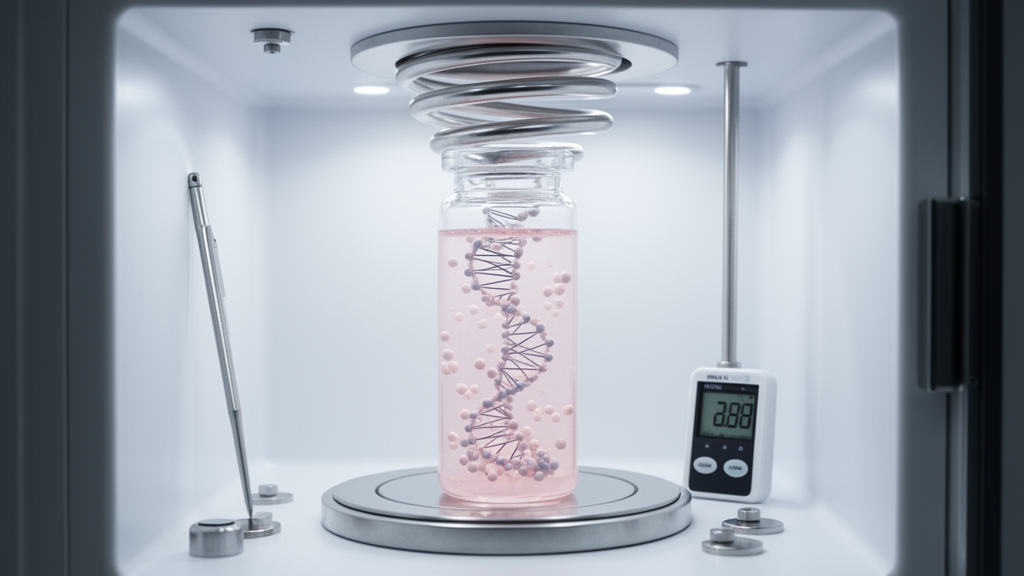
For the animal experiment, the selected particles were used to package Covid-19 mRNA antigens and were dehydrated through vacuum drying. The dried vaccine was then stored either at 37 degrees Celsius, equivalent to 98 degrees Fahrenheit, for two months or at room temperature for one year. Mice vaccinated with the stored particles generated immune responses equivalent to those in mice given a vaccine carried by LNPs similar to the original Moderna formulation.
These observations support the stability of the tested formulation under the specified storage conditions and time periods, but they do not mean that every antigen, payload or manufacturing process would receive the same protection. The researchers also used the heat-resistant formulation in solid microneedle patches containing a SARS-CoV-2 antigen. Applied to mice, the patches produced immune responses similar to those generated by injectable RNA vaccines.
Microneedle patches contain many small needles that dissolve on contact with the skin and release their contents. A formulation able to tolerate higher temperatures could ease some handling and transport requirements for such solid products. The patch experiment was nevertheless a proof of concept: the release does not report human trials, clinical protection, stability outside the tested conditions or performance during large-scale manufacturing and distribution.
The same algorithm was also applied to another LNP composition resembling the formulation used in Pfizer’s Covid-19 vaccine. That composition used the same excipients as the Moderna-like formulation developed in the study but in different proportions. The authors propose that, once a heat-resistant combination has been found for a particular LNP, it could potentially be adapted to carry different mRNA payloads.
That possibility extends beyond the Covid-19 and SARS-CoV-2 antigens directly tested, so it remains a development prospect rather than a demonstrated result of the reported experiments. The peer-reviewed study, “Accelerated discovery of thermostable mRNA–lipid nanoparticle vaccines using data-efficient AI,” was published in Nature Biotechnology. Ana Jaklenec, a principal investigator at MIT’s Koch Institute for Integrative Cancer Research, and Robert Langer, the David H. Koch Institute Professor, were senior authors; graduate student Jinbi Tian and postdoctoral fellow Khanh Tran were lead authors.
The work was supported in part by the Gates Foundation. Overall, the study shows how small-scale cell measurements and iterative machine-learning guidance can accelerate formulation screening. Its central finding is preclinical: selected AI-guided RNA vaccine formulations retained function after specified periods of warm or room-temperature storage and generated comparable immune responses in mice.
Subject of Research: Machine-learning-guided development of heat-stable mRNA lipid nanoparticle vaccine formulations
Article Title: New formulation helps RNA vaccines withstand high temperatures
Article References: New formulation helps RNA vaccines withstand high temperatures. Original publication (Bibliographic details unavailable.)
Image Credits: AI Generated
DOI: Not provided
Keywords: mRNA vaccines, lipid nanoparticles, vaccine stability, machine learning, thermal stability, excipients, microneedle patches, SARS-CoV-2, mouse studies, formulation design, formulation, helps