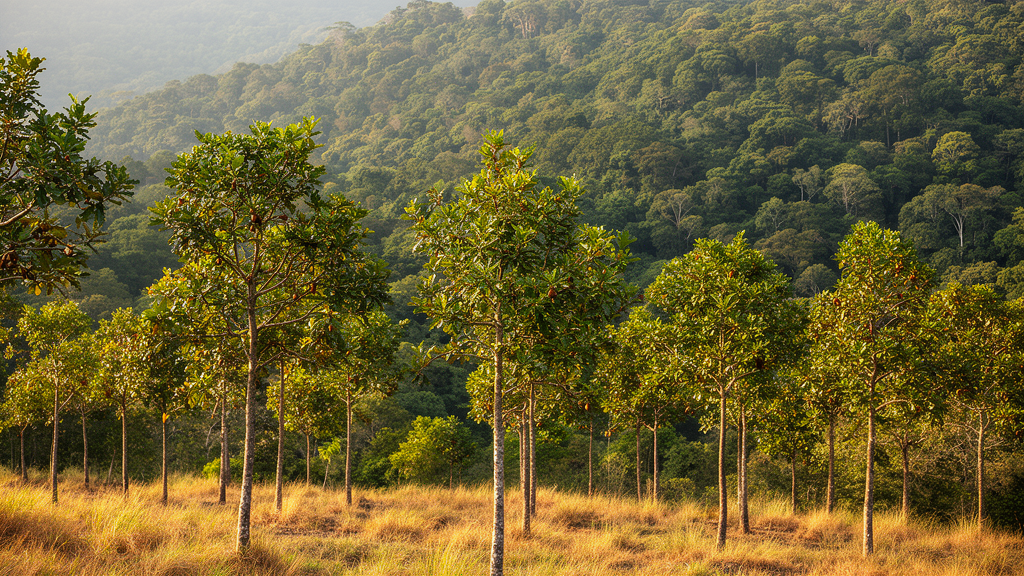
The researchers found that Quercus longinus var. kuoi persisted in a southern refugium on the Hengchun Peninsula during the Last Glacial Maximum, whereas northern and high-elevation populations were established after the ice age. Based on the combined evidence, the authors propose recognizing the refugial lineage as a distinct species, Quercus kuoi. The study tested whether postglacial range expansion was purely neutral or instead involved environmental filtering of standing genetic variation.
Genomic and ecological analyses indicated that the southern refugial population represented the ancestral lineage, while populations farther north and at higher elevations arose following postglacial range expansion. Allele frequencies associated with temperature and soil variables shifted markedly between the refugial population and newly colonized northern populations, consistent with climate-driven sorting of ancestral variation during expansion. Because these findings were partly correlative, the results support a sieving hypothesis rather than demonstrating a single causal mechanism.
Environment-associated genetic outliers were concentrated near genes with putative functions in membrane transport, stress response, signaling and photosynthesis. Gradient forest projections predicted that cold-associated adaptive variation would be retained in expanding northern populations, while the southern refugial lineage would become differentiated in adaptive composition under warmer postglacial environments. Similarity between adaptive and genome-wide projections indicated that the broad geographic pattern was not unique to the candidate loci.
The researchers also examined morphology, geographic distribution, population structure, phylogenetic placement, ecological niche differentiation and lineage-specific adaptive divergence to support the proposed recognition of Q. kuoi as a species. Under the proposed mechanism, expanding populations encountered different environmental conditions that filtered genetic variants already present in ancestral populations, helping lineages diverge across heterogeneous habitats. The study’s authors described the evidence as convergent but partly correlative, so the findings do not establish that climate sieving alone caused speciation or show how broadly the mechanism applies beyond the studied Taiwanese oak complex.
Subject of Research: Postglacial expansion and adaptive genetic variation in Taiwan’s Quercus longinus oak complex
Article Title: Postglacial expansion and sieving of adaptive variation contribute to speciation in a subtropical oak complex
Article References: Sun, P.-W., Chao, C.-T., Chang, J.-T., & Liao, P.-C. (2026). Postglacial expansion and sieving of adaptive variation contribute to speciation in a subtropical oak complex. BMC Plant Biology. https://doi.org/10.1186/s12870-026-10175-8
Image Credits: AI Generated
DOI: 10.1186/s12870-026-10175-8
Keywords: Quercus kuoi, Taiwan oaks, postglacial expansion, adaptive variation, climate sieving, plant speciation, standing genetic variation, environmental genomics, refugial lineage, tropical endemism, Postglacial, expansion