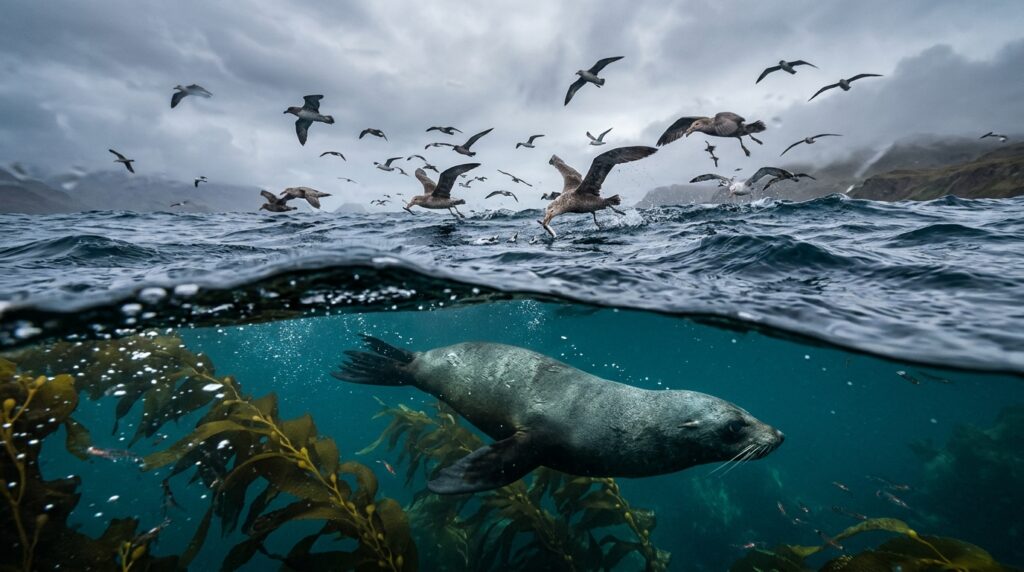
On a windswept island in the southern Indian Ocean, twelve species of seabirds and fur seals crowd onto the same shores to breed, all drawing on the same surrounding waters for food. A three-year study of carbon and nitrogen stable isotopes in their blood now shows that although each species’ foraging niche shifted markedly between seasons and years, the way these predators divide resources among themselves remained remarkably stable. The findings, based on more than a thousand blood samples collected from 2015 to 2018 on sub-Antarctic Marion Island, suggest that coexistence in this crowded predator community depends on flexible individual foraging layered over a persistent community-wide division of labor.
Researchers sampled up to 20 individuals of each species along the island’s south and south-east coast during two seasons each year: autumn in April and the following summer from December through February. The species included four albatrosses—wandering, grey-headed, sooty and light-mantled—two giant petrels, four penguins—king, gentoo, macaroni and eastern rockhopper—and two fur seals, sub-Antarctic and Antarctic. Whole blood, which integrates diet over roughly two to four weeks in seabirds and potentially longer in mammals, was analyzed for its ratios of carbon-13 to carbon-12 and nitrogen-15 to nitrogen-14. In this framework, carbon isotopes broadly indicate where an animal forages in space, while nitrogen isotopes reflect its trophic position, or how far up the food chain it feeds.
The team used these isotope values to map each species’ stable isotopic niche, a two-dimensional space called δ-space, and tracked how its size and position changed over time. On average, 18 samples per species were collected each autumn and 17 each summer, though some species could not be sampled in every period because of differing breeding schedules and fieldwork constraints. The researchers tested three hypotheses: that niche size varies seasonally with changing foraging constraints, that niche position shifts seasonally and between years due to changes in resource distribution or underlying isotopic baselines, and that despite this temporal variability, resource partitioning within functional groups is maintained.
The first hypothesis was broadly supported. The isotopic niches of all 12 species varied significantly between seasons in terms of either size or two-dimensional location. Yet consistent seasonal patterns in niche size across years emerged for only two species: Antarctic fur seals had larger niches during summer, while southern giant petrels had larger niches during autumn. The remaining flying species showed similar niche sizes but significantly different positions between seasons. For the four penguin species and the sub-Antarctic fur seal, both size and position varied across time without an evident pattern.
Seasonal differences appear tied to life-history demands rather than random environmental noise. Grey-headed and sooty albatrosses, for example, forage farther from the island while incubating in summer than while rearing chicks in autumn, and grey-headed albatrosses shift to foraging south of the island during chick-rearing, consuming Antarctic prey. Antarctic fur seals show an even starker contrast: during summer, females are constrained by the need to return to shore to nurse pups, but once pups are weaned in April, their foraging range expands dramatically. Individual females then split into two distinct strategies, some traveling north to the Sub-Antarctic Front to feed on mesopelagic fish and cephalopods, others moving south of the Antarctic Polar Front to forage on lower trophic-level prey, most likely Antarctic krill. This behavioral dichotomy explains the much larger isotopic niche observed in autumn.
Inter-annual variability told a different story depending on foraging mode. Flying species—albatrosses and giant petrels—showed largely consistent niche sizes within seasons across the three years, with few exceptions. Diving species—penguins and fur seals—were far more variable, with niche area or location differing significantly between years in nearly every within-season comparison. The researchers attribute this to the restricted foraging ranges of diving predators, which cannot travel vast distances quickly and are therefore more exposed to year-to-year changes in local prey availability. Flying birds, able to cover enormous distances, can buffer themselves against such variability.
A striking pattern emerged in the isotope trajectories themselves. Most species showed progressively declining autumn carbon and nitrogen isotope values over the three years. Species known to forage at or south of the Antarctic Polar Front—including king penguins, southern giant petrels, and wandering, light-mantled and grey-headed albatrosses—exhibited progressively lower carbon isotope values. This coincided with the Antarctic Polar Front moving closer to Marion Island as the years progressed. Because travel time to waters south of the front determines how much time an animal can actually spend foraging there, the front’s southward shift likely drove these increasingly negative carbon values. Notably, northern giant petrels and sooty albatrosses, which forage almost exclusively north of the island during summer, did not share this declining pattern, strengthening the link between frontal movement and isotope change.
The researchers also considered whether these shifts might simply reflect changes in the isotopic baselines of the food web rather than actual changes in predator behavior. Spatial gradients of carbon and nitrogen isotopes at the base of the marine food web respond quickly to environmental variability, and monthly isoscape models show stronger latitudinal gradients in phytoplankton carbon isotopes during summer than autumn. However, the blood isotope values of most predators decreased between summer and autumn even though the regional baseline increased, making it unlikely that baseline dynamics alone explain the observed patterns. The congruent trajectories across multiple species instead point to real changes in where and at what trophic level these predators were feeding.
The third and most consequential finding concerns community structure. Despite all this temporal churn in individual species’ niches, the degree of overlap between species within functional groups—flying versus diving—remained consistent within seasons across years. Wandering albatrosses and southern giant petrels showed greater resource partitioning during autumn, while grey-headed and sooty albatrosses partitioned more during summer. Among penguins, only eastern rockhoppers showed a clear seasonal difference in partitioning, while king, macaroni and gentoo penguins maintained consistent levels throughout, with the exception of high partitioning in the 2015 and 2017 summers for gentoo and king penguins. When fur seals were included in the analysis, partitioning levels were higher and seasonal patterns clearer.
This persistent partitioning carries a deeper implication. The researchers argue that such consistent segregation among predators indicates that resources in this system are either historically or presently limited, forcing species to divide food along trophic and spatial axes to avoid competitive exclusion. This contrasts with Antarctic environments, where super-abundant krill may allow closely related predators to overlap extensively without penalty. The consistency of seasonal partitioning here also suggests a degree of predictability in resource availability despite the inherently variable oceanography of the region. The study acknowledges limitations: sample sizes per species per period ranged from 6 to 20, potentially underrepresenting within-population variation from sex, age and individual specialization, and the isotopic approach cannot distinguish specific prey taxa or capture vertical gradients in isotope values. Still, the core message stands: in a dynamic marine environment, these twelve predators adjust their foraging year by year, yet the architecture of their shared resource space holds firm, a pattern consistent with classical niche theory predicting that animals adjust foraging behavior during food scarcity to reduce interspecific competition.
Subject of Research: Temporal dynamics of trophic niches and resource partitioning among sympatric seabirds and fur seals on sub-Antarctic Marion Island
Article Title: Dynamic Resource Partitioning in a Marine Predator Community
Article References: Carpenter‐Kling, T., Connan, M., Reisinger, R. R., Makhado, A. B., Ryan, P. G., & Pistorius, P. A. (2026). Dynamic Resource Partitioning in a Marine Predator Community. Ecology and Evolution, 16(11), Article e74579. https://doi.org/10.1002/ece3.74579
Image Credits: AI Generated
DOI: 10.1002/ece3.74579
Keywords: stable isotopes, resource partitioning, Marion Island, seabirds, fur seals, trophic niche, sub-Antarctic, foraging ecology, niche theory, marine predators, seasonal variation, isotopic nestedness