
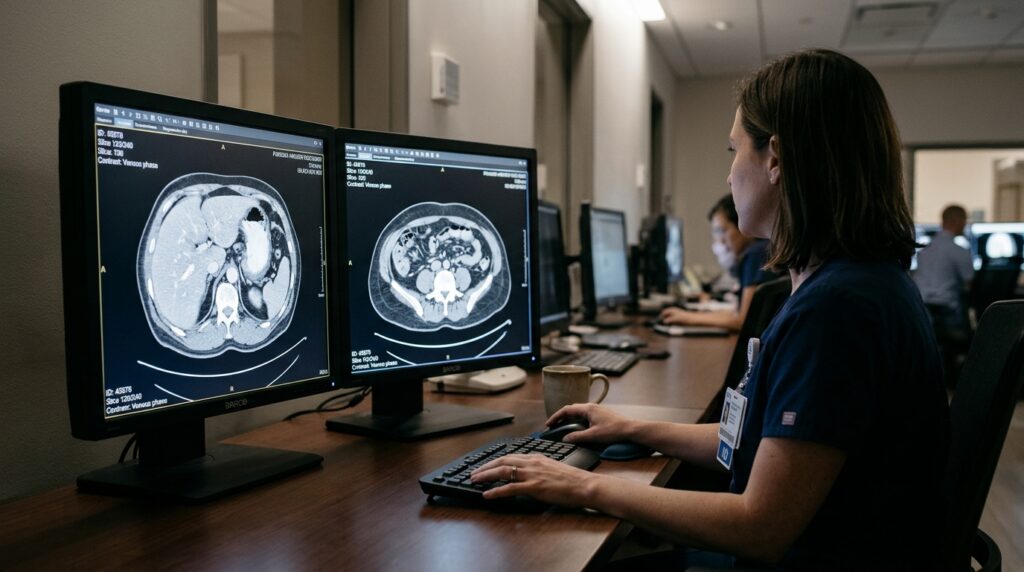
Doctors treating locally advanced gastric cancer face a persistent uncertainty: the same neoadjuvant chemotherapy regimen that shrinks tumors dramatically in one patient may do little in another. A multicenter cohort study now reports that a machine learning model integrating clinical data, tumor imaging features, and body composition measurements can anticipate that response before treatment begins, with strong discrimination across retrospective, external, and small prospective validation cohorts.
The study, published in BMC Medicine, analyzed 1,568 patients with locally advanced gastric cancer. Of these, 1,150 patients from six centers were used for model development and validation, 352 patients formed a real-world incremental cohort, and 66 patients came from two prospective trials registered as ChiCTR2000030414 and NCT03718624. All patients were candidates for neoadjuvant chemotherapy, a standard treatment for this disease in which anti-cancer drugs are given before surgery to shrink tumors and improve surgical outcomes.
The research team built the model, named NeoGEM, from three types of information. Clinical features captured patient and disease characteristics. Radiomic features were extracted from pre-treatment CT scans of the tumors themselves, quantifying patterns of texture and intensity that are invisible to the naked eye. Uniquely, the model also incorporated radiomics from the L3 level of the spine, a standard anatomical landmark for assessing body composition, measuring muscle and fat distribution that reflects the host’s overall physiological state. Feature selection combined statistical testing with LASSO regression, a technique that shrinks coefficients to eliminate redundant variables, before a multimodal ensemble architecture integrated the surviving clinical and radiomic features into a single prediction.
Performance figures reported by the authors are notable. In the training cohort, NeoGEM achieved an area under the receiver operating characteristic curve, or AUC, of 0.888, with an accuracy of 0.809. An AUC of 1.0 represents perfect discrimination between responders and non-responders, while 0.5 represents chance-level performance. Discrimination remained comparable across internal validation cohorts (AUC 0.870–0.875), external cohorts (AUC 0.859–0.877), and prospective cohorts (AUC 0.864–0.867). The model also showed stable performance across different chemotherapy regimens and treatment cycle subgroups, suggesting its predictions are not an artifact of one particular drug combination or dosing schedule.
A particularly important test came from the real-world incremental cohort of 352 patients. In this group, radiological rather than pathological response was used as the reference standard, a departure from the pathological assessment used elsewhere in the study. NeoGEM still maintained good discrimination in this setting, achieving an AUC of 0.840. The authors interpret this as supportive evidence of broader clinical applicability, since radiological assessment is often the practical measure available in routine clinical workflows before surgery takes place.
Comparisons against simpler alternatives showed a consistent advantage for the integrated approach. NeoGEM achieved higher AUCs than models built from clinical variables alone, tumor radiomics alone, or body-composition radiomics alone, across the validation cohorts examined. This pattern supports the study’s central hypothesis: that host-related factors such as body composition carry predictive information that tumor-focused models miss. Existing predictive models, the authors note, have often neglected these host-related features despite growing evidence that a patient’s metabolic and muscular state influences how cancer and its treatment unfold.
Beyond immediate response prediction, the NeoGEM score showed associations with longer-term outcomes. In the study cohort, patients were stratified into low and high score groups, and the two groups differed markedly in survival. Five-year overall survival was 35.5 percent in the low-score group versus 62.4 percent in the high-score group, and five-year disease-free survival was 21.5 percent versus 50.8 percent, with both comparisons reaching statistical significance at P < 0.001. These are observational associations from the study cohort rather than causal demonstrations, and they suggest the score may carry prognostic information beyond its immediate role in predicting treatment response.
An exploratory transcriptomic analysis added a biological dimension to the findings. Tumors from patients with high NeoGEM scores showed enrichment of immune-related pathways and higher infiltration of CD4-positive and CD8-positive T cells, along with FCGR3A-positive cells, a population that includes natural killer cells and other immune effector types. The authors describe this analysis as exploratory, and it does not establish a causal mechanism, but it hints that the imaging and body composition features captured by the model may correlate with distinct tumor immune microenvironments that influence how patients respond to chemotherapy.
The authors conclude that NeoGEM showed consistently good discrimination across retrospective, external, and small prospective validation settings, suggesting potential utility for response stratification in patients with locally advanced gastric cancer. They also suggest that integrating body-composition radiomics may improve predictive performance while providing additional host-related biological context. The prospective validation cohorts were small, at 66 patients combined, and the real-world incremental cohort relied on radiological rather than pathological response assessment, so further validation in larger prospective settings would be needed before routine clinical deployment. As a preprint-shared article published early for faster access, the version is subject to further edits before the final Version of Record appears. If the reported performance holds, the approach could eventually help clinicians tailor neoadjuvant strategies for gastric cancer patients, sparing predicted non-responders from ineffective toxicity while intensifying therapy for those most likely to benefit.
Subject of Research: A multimodal model predicting neoadjuvant chemotherapy response in locally advanced gastric cancer using clinical, tumor radiomics, and body composition features
Article Title: Multimodal prediction of neoadjuvant chemotherapy response in locally advanced gastric cancer: a multicenter cohort study
Article References: Ding, P., Guo, H., Yang, J., Chen, S., Ma, S., Yang, S., Yang, Y., Tian, Y., Gu, R., Long, H., Meng, N., Li, X., Zhang, L., Meng, L., & Zhao, Q. (2026). Multimodal prediction of neoadjuvant chemotherapy response in locally advanced gastric cancer: a multicenter cohort study. BMC Medicine. https://doi.org/10.1186/s12916-026-05123-0
Image Credits: AI Generated
DOI: 10.1186/s12916-026-05123-0
Keywords: gastric cancer, neoadjuvant chemotherapy, radiomics, body composition, machine learning, prediction model, CT imaging, multimodal model, tumor response, clinical oncology, transcriptomics, BMC Medicine