
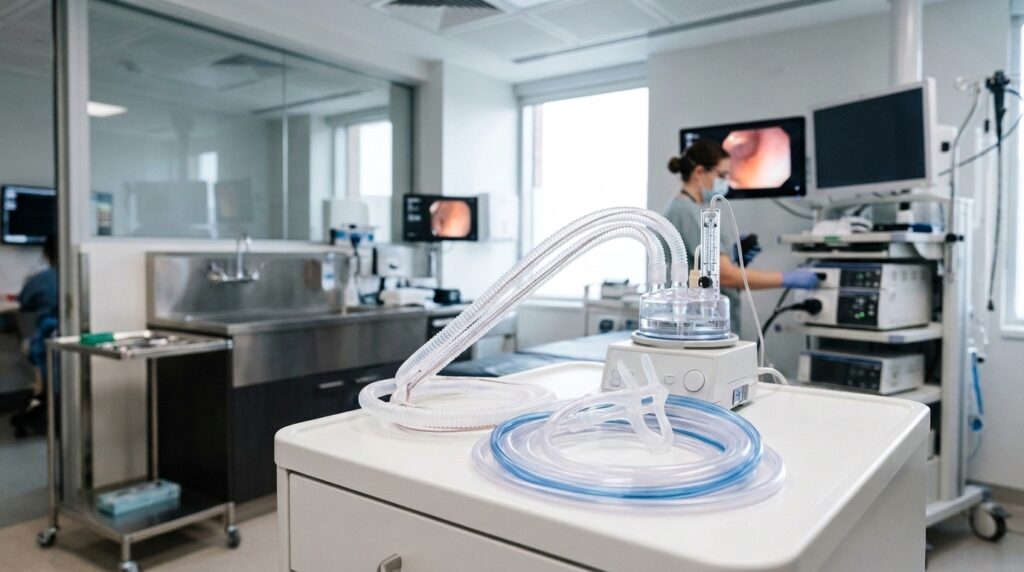
Hypoxemia is the most common adverse event during sedated gastrointestinal endoscopy, and a new single-center retrospective study suggests that the way oxygen is delivered may make a dramatic difference in one of the highest-risk settings: urgent endoscopy for acute nonvariceal upper gastrointestinal bleeding. In the study, published in BMC Gastroenterology, patients who received high-flow nasal oxygen, or HFNO, during anesthesiologist-supervised propofol sedation experienced far fewer drops in blood oxygen and needed far fewer rescue airway maneuvers than patients supported with a conventional nasal cannula.
The research team compared two oxygenation strategies in 114 adult patients who underwent endoscopy within 24 hours of presenting with acute nonvariceal upper gastrointestinal bleeding. All procedures were performed under propofol sedation supervised by an anesthesiologist. One group of 67 patients received HFNO at flow rates of 20 to 70 liters per minute with an inspired oxygen fraction, or FiO2, of 1.0, meaning pure oxygen. The other group of 47 patients received a conventional nasal cannula at 2 to 4 liters per minute, which delivers an estimated FiO2 of only 0.28 to 0.37.
The primary outcome was intraprocedural desaturation, defined as a peripheral oxygen saturation, or SpO2, of 92 percent or lower sustained for at least 10 seconds. The contrast between the groups was stark. Desaturation occurred in 3 of 67 patients in the HFNO group, or 4.5 percent, compared with 19 of 47 patients in the conventional cannula group, or 40.4 percent. Rescue airway maneuvers were needed in 4 patients, or 6.0 percent, in the HFNO group versus 24 patients, or 51.1 percent, in the conventional group. Both differences were statistically significant, with p values below 0.001.
Secondary outcomes reinforced the pattern. The lowest intraprocedural SpO2 was among the measures tracked, and post-procedural arterial blood gas values showed that patients in the HFNO group had a higher PaO2 after the procedure, 143 mmHg compared with 94 mmHg in the conventional cannula group, a difference that was also statistically significant. Total propofol dose was another secondary outcome recorded in the study. Notably, post-procedural arterial carbon dioxide, or PaCO2, did not differ between the two groups, suggesting that the higher oxygen delivery did not come at the cost of carbon dioxide retention in this cohort.
Because this was a retrospective cohort study rather than a randomized trial, the two groups were not identical at the start. The HFNO group was older, with a median age of 76 years compared with 67 years in the conventional cannula group, and had a lower baseline SpO2 of 94 percent versus 96 percent, as well as higher American Society of Anesthesiologists physical status scores, a measure of overall fitness for anesthesia. These differences were statistically significant, with a p value of 0.005 for age, 0.001 for baseline SpO2 and 0.014 for ASA status.
To account for these imbalances, the researchers used multivariable logistic regression adjusted for the baseline variables that differed between the groups, specifically age and baseline SpO2. After adjustment, HFNO remained associated with lower odds of desaturation, with an adjusted odds ratio of 0.036 and a 95 percent confidence interval of 0.008 to 0.173. The odds of needing rescue airway maneuvers were similarly lower with HFNO, with an adjusted odds ratio of 0.036 and a 95 percent confidence interval of 0.009 to 0.145. In practical terms, patients supported with HFNO had roughly 97 percent lower adjusted odds of both outcomes in this cohort.
The authors are careful about what the comparison can and cannot show. As the HFNO group also received a markedly higher FiO2, the findings reflect a comparison of two oxygenation strategies rather than an isolated device effect, and this imbalance is identified as the principal limitation of the study. The HFNO strategy combined high flow rates with pure oxygen, while the conventional cannula delivered modest flow with a much lower oxygen concentration, so the advantage could stem from the flow, the oxygen concentration, or both. The authors call for randomized trials using equivalent FiO2 to disentangle these effects.
The clinical context matters. Urgent endoscopy for acute nonvariceal upper gastrointestinal bleeding is a demanding procedure: patients may be hemodynamically unstable, the airway is shared between the endoscopist and the anesthesiologist, and sedation with propofol suppresses breathing while the procedure itself can provoke reflexes that compromise oxygenation. Desaturation during such procedures can force interruptions, require airway rescue, and in severe cases lead to hypoxic injury. A strategy that keeps SpO2 stable could therefore make urgent bleeding endoscopies safer and smoother, though the retrospective design means the results show association rather than proven causation.
For now, the study adds to a small but growing body of evidence on respiratory support in urgent endoscopy, an area where data have been scarce compared with the elective setting, where HFNO has already been shown to reduce hypoxemia. The authors conclude that in patients undergoing sedated endoscopy for acute nonvariceal upper gastrointestinal bleeding, the HFNO strategy was associated with fewer desaturation events and rescue airway maneuvers than the conventional nasal cannula strategy. Whether that advantage holds when both strategies deliver the same oxygen concentration remains a question for future randomized trials, but for clinicians weighing how to oxygenate unstable bleeding patients during sedation, the single-center findings offer a compelling, if preliminary, signal.
Subject of Research: Respiratory support strategies during sedated endoscopy for acute nonvariceal upper gastrointestinal bleeding
Article Title: Comparison of respiratory support with high-flow nasal oxygen versus conventional nasal cannula during sedated endoscopy for acute nonvariceal upper gastrointestinal bleeding: A single-center retrospective study
Article References: Taşkapılı, K., & Sağlam, O. (2026). Comparison of respiratory support with high-flow nasal oxygen versus conventional nasal cannula during sedated endoscopy for acute nonvariceal upper gastrointestinal bleeding: A single-center retrospective study. BMC Gastroenterology. https://doi.org/10.1186/s12876-026-05541-7
Image Credits: AI Generated
DOI: 10.1186/s12876-026-05541-7
Keywords: high-flow nasal oxygen, endoscopy, upper gastrointestinal bleeding, hypoxemia, propofol sedation, desaturation, rescue airway maneuvers, retrospective cohort study, oxygenation strategies, arterial blood gas, anesthesiology, gastroenterology