
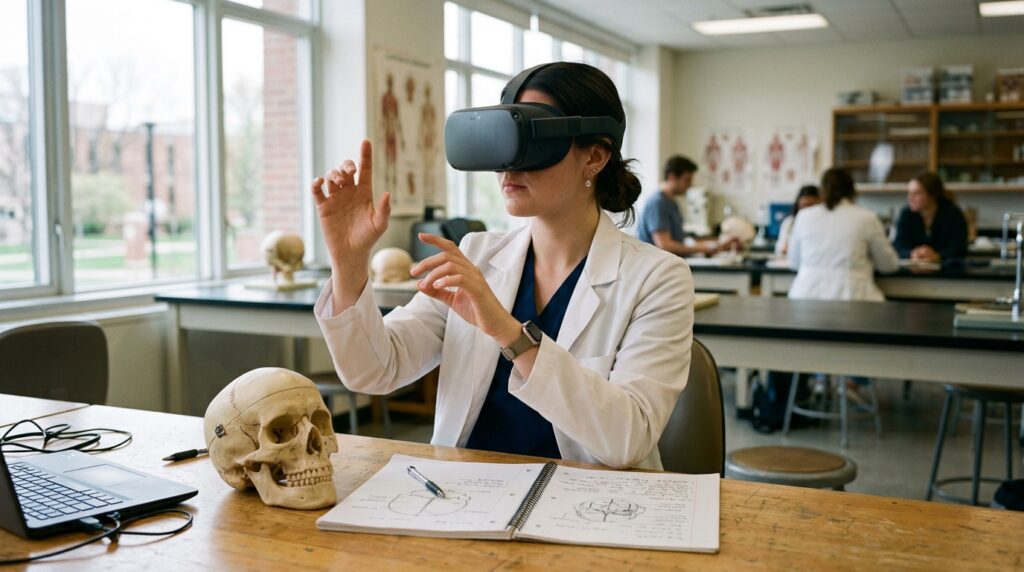
Medical students who learned facial muscle anatomy using immersive virtual reality demonstrated significantly higher knowledge scores than peers who studied the same material on a traditional smart screen, according to a randomized controlled trial conducted at the University of Sumer in Iraq. The study, published in Advances in Simulation, provides direct evidence that interactive, three-dimensional virtual environments can enhance short-term learning outcomes for complex anatomical structures compared to conventional two-dimensional screen-based instruction. While both groups showed improvement after the learning session, the virtual reality group maintained a statistical advantage in both immediate post-test performance and a two-week follow-up assessment. This research addresses a specific gap in medical education literature, as previous studies have largely focused on surgical training or other anatomical regions, leaving the effectiveness of virtual reality for undergraduate facial muscle anatomy largely unexplored.
The study was designed to compare an immersive, interactive virtual reality experience with a conventional smart-screen lesson. The primary research questions examined whether virtual reality led to greater learning gains, whether knowledge retention after two weeks was higher, and whether students reported different levels of presence and enjoyment. The researchers hypothesized that the ability to actively explore and manipulate three-dimensional anatomical models would support the interpretation of spatial relationships more effectively than passive observation of static images. Facial muscles form a dense and overlapping system, requiring a clear three-dimensional understanding of structure and orientation, which makes them particularly difficult to study using conventional flat displays.
Forty-eight second-year medical students participated in the trial, which took place between October and December 2025. Participants were randomly assigned to either the virtual reality group or the smart-screen group using a random number generator. The virtual reality group consisted of 23 students, while the smart-screen group included 25 students. All participants had prior exposure to facial anatomy but no previous experience with virtual reality-based learning. The study received ethical approval from the Research Ethics Committee of the College of Medicine, University of Sumer, ensuring that participation was voluntary and informed consent was obtained from all students.
In the virtual reality condition, students completed a 15-minute session using an Oculus Quest 3 headset. They used the Human Anatomy VR application to explore an interactive three-dimensional model of facial muscles. This allowed students to rotate the model, zoom in, and select individual muscles to view their names and details. The session was supervised by an anatomy instructor, but students worked individually and were not allowed to ask content-related questions during the session. In contrast, the smart-screen group attended a 15-minute PowerPoint lesson delivered by the same instructor. The content was identical to the virtual reality condition but was presented in a two-dimensional, non-interactive format where students only observed the material without directly interacting with the anatomical structures.
Knowledge was assessed using a 15-item multiple-choice test administered at three time points: before the session, immediately after the session, and two weeks later. The test was designed to measure students’ ability to understand concepts related to anatomy rather than simply recalling names or locations. Two experienced anatomy instructors reviewed the test to ensure alignment with learning objectives and content accuracy. Additionally, participants completed questionnaires to measure perceived presence and enjoyment. The presence scale consisted of five items, while the enjoyment scale included three items, both using a five-point Likert scale. Internal consistency for these measures was acceptable, with Cronbach’s alpha values of 0.823 for presence and 0.807 for enjoyment.
Descriptive statistics revealed that both groups started with similar low pre-test scores, with the virtual reality group averaging 4.46 and the smart-screen group averaging 4.40. After the learning session, scores increased in both conditions, but the virtual reality group achieved a higher mean post-test score of 9.46 compared to 8.20 for the smart-screen group. At the two-week follow-up, scores declined in both groups, yet the virtual reality group maintained a higher mean score of 7.00 compared to 5.88 for the smart-screen group. Repeated measures analysis of variance showed a significant main effect of time, indicating that performance changed across the three measurement points. There was also a significant main effect of group, with the virtual reality group showing higher overall performance when scores were averaged across all time points.
A significant interaction between time and group indicated that the learning trajectories differed between the two conditions. Post-hoc comparisons confirmed that the virtual reality group scored significantly higher than the smart-screen group at both the post-test and follow-up stages. To further examine these differences, the researchers calculated learning gain scores by subtracting pre-test scores from post-test scores. The virtual reality group achieved significantly greater learning gains, with a mean of 5.00, compared to 3.80 for the smart-screen group. This difference was statistically significant with a moderate effect size. However, when analyzing retention scores by subtracting post-test scores from follow-up scores, no significant difference was found between the groups, suggesting that the rate of knowledge decay was similar across both conditions.
The results suggest that the higher performance observed in the virtual reality group at follow-up was primarily due to greater initial learning gains rather than superior retention over time. Both groups experienced a decline in scores from the post-test to the follow-up stage, indicating that the benefits of the intervention were not sustained in terms of retention rate. This finding is crucial for interpreting the long-term value of virtual reality in medical education. The data implies that while immersive technology can enhance the initial acquisition of complex spatial knowledge, it does not necessarily protect against the natural forgetting process that occurs over a two-week period without additional reinforcement.
Students in the virtual reality condition also reported significantly higher levels of perceived presence and enjoyment compared to those in the smart-screen condition. The mean presence score for the virtual reality group was 3.78, compared to 3.38 for the smart-screen group. Similarly, perceived enjoyment was higher in the virtual reality group, with a mean of 4.04 versus 3.61 for the smart-screen group. Open-ended responses from students highlighted these differences in experience. Students in the virtual reality group described actively exploring the content, moving around structures, and adjusting their viewpoints. In contrast, students in the smart-screen group described the session as familiar and easy to manage, but noted that interaction with the material was limited and learning was primarily observational.
Several limitations must be considered when interpreting these findings. The study was conducted at a single institution with a relatively small sample size, which limits the generalizability of the results to other higher education settings. Furthermore, the study did not isolate virtual reality as a single variable; the differences between the conditions included not only the delivery method but also the level of interactivity and learner engagement. Therefore, the observed benefits may be attributed to the interactive nature of the activity rather than the virtual reality technology itself. The novelty of the experience for first-time users may also have influenced the results, as some participants reported initial discomfort or difficulty with the controls, which became less prominent as the session progressed.
The knowledge test used in the study was not formally pilot-tested or psychometrically validated prior to the research, which may limit the strength of the measurement. Although the order of questions and answer options was randomized to minimize familiarity effects, some degree of familiarity with the test items could still have influenced performance. The intervention was also limited to a single 15-minute session, meaning the findings reflect immediate and short-term responses rather than long-term educational outcomes. It remains unclear whether the observed patterns would persist over time or change as students become more familiar with the learning format through repeated exposure.
Despite these limitations, the study provides valuable insights into the potential of immersive technology in anatomy education. The findings suggest that virtual reality may be most effective when used to support active engagement with spatially complex content, rather than as a replacement for all conventional instructional methods. The ability to manipulate three-dimensional models and explore spatial relationships directly may enhance the initial understanding of complex anatomical structures. Future research should aim to separate the effects of immersion, interactivity, and instructional design to better understand how each factor contributes to learning outcomes. Additionally, studies involving multiple institutions and larger samples would help to improve the generalizability of these findings and determine the long-term impact of virtual reality on medical student education.
As virtual reality technology becomes more accessible in educational settings, this study highlights the importance of thoughtful implementation. Instructors should consider the practical issues of physical comfort and ease of use, particularly for students encountering the technology for the first time. Short orientation periods and manageable session lengths can help minimize discomfort and allow students to focus on the learning content. By integrating virtual reality alongside existing instructional methods, educators can leverage the benefits of active engagement and spatial exploration to enhance the learning experience for medical students studying complex anatomical regions.
Subject of Research: Learning facial muscle anatomy using virtual reality simulation: a randomized controlled study among medical students in Iraq
Article Title: Learning facial muscle anatomy using virtual reality simulation: a randomized controlled study among medical students in Iraq
Article References: Al-Fayyadh, F., Jabar, A. A. S. A., & Gilányi, A. (2026). Learning facial muscle anatomy using virtual reality simulation: a randomized controlled study among medical students in Iraq. Advances in Simulation, 11(1), Article 79. https://doi.org/10.1186/s41077-026-00475-2
Image Credits: AI Generated
DOI: 10.1186/s41077-026-00475-2
Keywords: Learning, facial, muscle, anatomy, virtual, reality, simulation, randomized, controlled, medical, students, Iraq