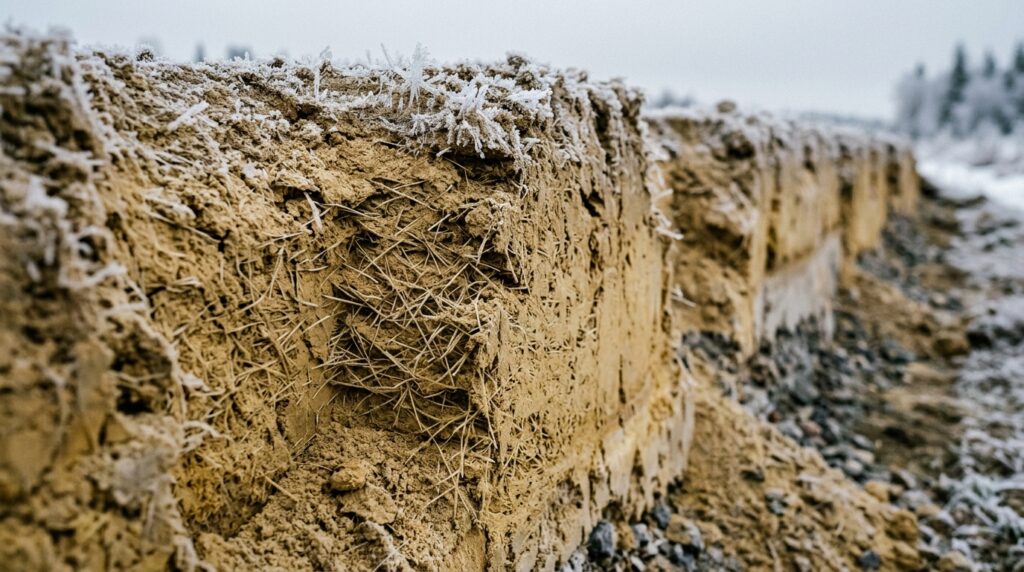
Engineers in seasonally frozen regions face a persistent problem: each winter, moisture in the soil beneath roads and railways freezes and expands, then thaws and settles, weakening the ground with every cycle. A new laboratory study reports that mixing polypropylene fibers into loess can substantially slow this degradation, with the best results at a fiber content of 0.75 percent. The work, published in Discover Applied Sciences, examined how fiber-reinforced loess responds to repeated dynamic loading after being subjected to freeze–thaw cycles, offering a possible route to more durable subgrades in cold climates.
The research team used a GDS dynamic triaxial apparatus with controlled temperature to test loess specimens containing 0, 0.25, 0.5, 0.75, and 1.0 percent polypropylene fibers. Each formulation was exposed to 0, 1, 3, 5, and 7 freeze–thaw cycles before dynamic testing. This combination of variables allowed the researchers to separate the effects of fiber reinforcement from the cumulative damage caused by seasonal freezing and thawing, and to observe how the two processes interact.
The measurements focused on four key quantities: dynamic stress, dynamic elastic modulus, dynamic modulus ratio, and damping ratio along the backbone curve. The dynamic elastic modulus reflects the stiffness of the soil under cyclic loading, while the damping ratio describes how much vibration energy the material dissipates. Tracking these properties across different fiber contents and cycle counts revealed a consistent pattern: polypropylene fibers enhance the dynamic properties of loess, but the benefit peaks at a specific dosage rather than increasing indefinitely.
At the optimum content of 0.75 percent, the dynamic modulus ratio increased by 13 percent after zero freeze–thaw cycles, 17 percent after one cycle, 21 percent after three cycles, 30 percent after five cycles, and 51 percent after seven cycles, relative to untreated loess.
The advantage does not extend to every dosage. When the polypropylene content rose beyond 0.75 percent, the dynamic improvement declined.
Freeze–thaw cycling degraded the dynamic behavior of the loess regardless of fiber content. For any given fiber dosage, dynamic stress, dynamic modulus ratio, dynamic elastic modulus, and damping ratio all decreased as the number of cycles increased. The degradation was not linear, however: the measured properties tended to stabilize after five cycles.
Beyond the raw measurements, the researchers investigated the dynamic coupling behavior of the fiber-reinforced loess and its freeze–thaw degradation characteristics. Using the experimental data, they built models describing both the polypropylene fiber reinforcement and the freeze–thaw degradation, intended to elucidate the reinforcement mechanism of the modified loess.
The practical context for the work is traffic infrastructure. Freeze–thaw heave and thaw settlement are described as inevitable phenomena affecting soils in seasonally frozen regions, and under repeated traffic loading these processes significantly reduce the strength and stability of subgrades.
The authors state that the findings provide a theoretical basis for the design and improvement of loess subgrades in seasonally frozen regions. The study is a controlled laboratory investigation on prepared specimens, so field performance under real traffic, drainage, and climate conditions would require further validation. Nevertheless, the combination of a clear optimum fiber content, a quantified degradation plateau after five cycles, and predictive reinforcement models gives engineers a concrete starting point for specifying fiber-stabilized loess where freeze–thaw damage threatens the longevity of transport infrastructure.
Subject of Research: Effects of polypropylene fiber content and freeze–thaw cycles on the dynamic behavior of loess for subgrade engineering
Article Title: Dynamic response and damage evolution of polypropylene fiber-reinforced loess subjected to freeze–thaw cycles
Article References: Li, S., Zhong, Z., Wu, B., Ma, Y., Lin, Q., He, H., & Sheng, Y. (2026). Dynamic response and damage evolution of polypropylene fiber-reinforced loess subjected to freeze–thaw cycles. Discover Applied Sciences. https://doi.org/10.1007/s42452-026-09808-2
Image Credits: AI Generated
DOI: 10.1007/s42452-026-09808-2
Keywords: loess, polypropylene fibers, freeze–thaw cycles, dynamic triaxial testing, subgrade, dynamic modulus, damping ratio, soil reinforcement, seasonally frozen regions, geotechnical engineering, Dynamic, response