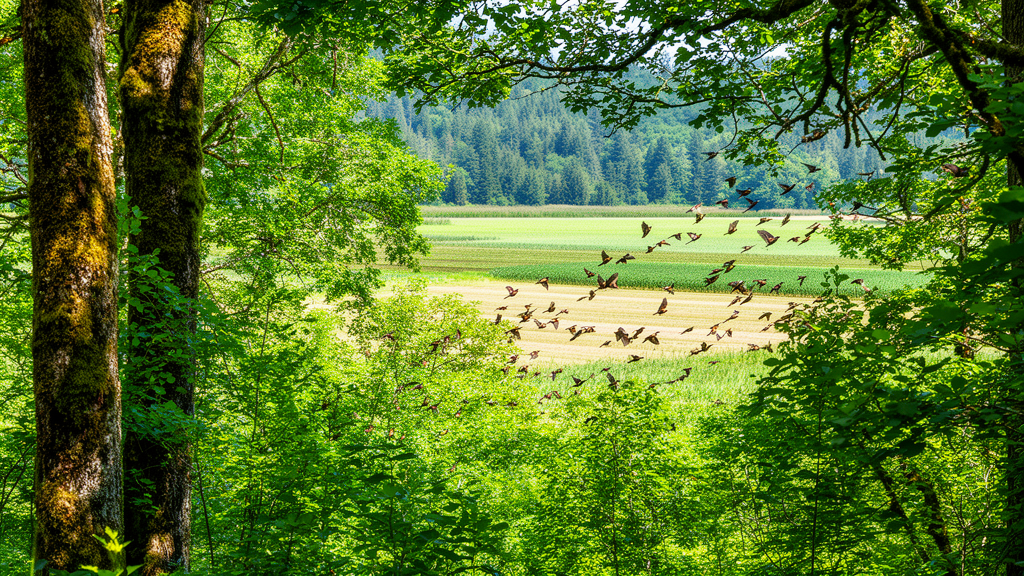
Forest conditions in the landscape surrounding national parks play a more influential role in determining bird presence within protected boundaries than the internal forest structure itself, according to a multi-scale study published in the journal Landscape Ecology. Researchers led by quantitative ecologist Elise Zipkin and doctoral student Bruna Amaral at Michigan State University analyzed 17 years of long-term bird monitoring data gathered between 2006 and 2023 across eight national parks in the northeastern United States. Their statistical analysis revealed that for the majority of the 16 bird species evaluated, the ecological state of the forest beyond park perimeters was the primary factor dictating whether a species was present inside the reserve.
The findings address a critical ecological setting, as approximately 3.5 billion birds migrate to North America each year to breed, relying on national parks as nesting havens and stopover grounds. While these reserves are designated to protect wildlife from threats such as hunting and commercial development, populations of eastern forest birds have declined by an estimated 17 percent over the past half-century. Previous research has demonstrated that many bird species continue to experience population declines even within protected lands, underscoring the necessity of understanding how environmental factors across different spatial scales influence species persistence.
To investigate these dynamics, the research team partnered with the National Park Service, utilizing survey records collected annually during the summer breeding season. In these standardized efforts, volunteer observers returned to identical monitoring stations to record vocalizations from regional avifauna, including the distinctive calls of downy woodpeckers, wood thrushes, and ovenbirds. Amaral, Zipkin, and their colleagues paired these bird observations with structural measures of forest habitat assessed across multiple spatial extents, ranging from fine-scale patches within 400 meters of a sighting to the expansive boundaries of the entire surrounding county.
The study confirmed that local vegetation within a bird’s immediate vicinity remains biologically meaningful. Immediate forest stand characteristics supply essential resources where birds forage, conceal nests, and seek shelter from predators. Habitat requirements varied considerably across species at this local level; for example, stands characterized by dense shrub cover supported higher numbers of black-throated blue warblers, whereas forest tracts containing mature trees with thick trunks supported greater abundances of red-eyed vireos. However, when researchers expanded their analytical lens, local habitat conditions proved to be only a partial determinant of overall bird presence.
Across broader spatial scales, conditions in the neighboring landscape outside park borders consistently outweighed internal park conditions for most examined species. Brown creepers, for instance, showed a strong tendency to occupy national parks that were buffered on the outside by extensive stands of mature trees with open understories, with little statistical sensitivity to the forest structure located inside park borders. As Amaral noted, an internally intact park situated within a degraded regional matrix may fail to support target bird species if external landscape connectivity and structure are compromised.
The researchers noted that fledgling ecology offers a plausible functional mechanism for this landscape-scale dependence. Following nesting, juvenile birds must disperse from natal sites, navigating the broader landscape to gain independence and build sufficient reserves prior to embarking on their southward migration.
While global assessments indicate that protected areas host greater avian richness and are five times more effective at stemming species declines than unprotected land, the authors emphasized that parks cannot conserve migratory species in isolation. Because conservation outcomes within reserves depend heavily on surrounding conditions, management efforts must extend across administrative boundaries. Land stewardship decisions on adjoining private lands, including farms and residential properties, can generate beneficial spillover effects that directly reinforce the conservation value of national parks.
The research was conducted by Amaral and Zipkin in collaboration with co-authors Jeffrey W. Doser, Aaron Weed, and Kate Miller. Pinpointing the precise spatial scales at which surrounding forests influence avian occurrence is especially vital because birds across North America are in trouble, explained Zipkin, who directs Michigan State University’s Ecology, Evolution, and Behavior program.
The investigation also highlighted how collaborative stewardship can expand the practical reach of conservation reserves, particularly relatively small protected parcels whose internal boundaries cannot encompass entire regional ecosystems. Supported by research grants from the National Science Foundation alongside the National Park Service’s Inventory and Monitoring Division, the project demonstrated that understanding scale-dependent forest structures provides actionable guidance for regional conservation. By identifying how external forest cover sustains birds within reserve borders, the authors showed that safeguarding North American bird populations requires integrating protected parklands with the broader landscapes that envelop them.
Subject of Research: Influence of surrounding landscape forest structure on bird occurrence within national parks
Article Title: Protecting forests outside parks benefits the birds within
Article References: Protecting forests outside parks benefits the birds within. Original publication (Bibliographic details unavailable.)
Image Credits: AI Generated
DOI: Not provided
Keywords: Landscape Ecology, forest structure, national parks, bird conservation, Michigan State University, National Park Service, Elise Zipkin, Bruna Amaral, multi-scale analysis, eastern forest birds, breeding season, fledgling dispersal, brown creepers, black-throated blue warblers, red-eyed vireos, downy woodpeckers, wood thrushes