Neurosurgical researchers have demonstrated the technical feasibility and safety of combining fluorescence-guided surgery with intraoperative photodynamic therapy using a novel integrated drug-device platform in a patient with newly diagnosed glioblastoma. The technical case report, published as part of an ongoing Phase I/II clinical investigation, marks the initial clinical implementation of the Pentalafen-Heliance Solution. This system pairs an oral 5-aminolevulinic acid formulation with a dedicated balloon-based light delivery diffuser to identify tumor margins and directly target residual malignant cells during surgical resection.
Glioblastoma presents profound surgical challenges because infiltrative tumor cells routinely extend beyond contrast-enhancing margins identified on preoperative magnetic resonance imaging. Over the past decade, fluorescence-guided surgery using 5-aminolevulinic acid has expanded across neuro-oncology, increasing rates of gross total resection and extending progression-free survival compared with conventional white-light techniques. However, because local recurrences predominantly arise at or immediately adjacent to the resection cavity boundary where infiltrative cells evade surgical removal and standard adjuvant regimens, intraoperative photodynamic therapy has re-emerged as an intervention to administer localized cytotoxic treatment to the surrounding cavity tissue.
The clinical case involved a 64-year-old woman who presented with progressive headaches, visual field deficits, and cognitive symptoms. Preoperative magnetic resonance imaging identified a heterogeneously enhancing right temporo-occipital lesion accompanied by vasogenic edema and midline shift, consistent with a high-grade glioma. Following clinical evaluation, the patient was enrolled in the clinical trial evaluating the combined Pentalafen-Heliance platform to assess whether standardized light delivery could be incorporated safely into routine neurosurgical operative workflows.
Four hours prior to induction of anesthesia, the patient received the oral Pentalafen formulation. Under fluorescence guidance, surgeons achieved a gross total resection of the enhancing tumor mass.
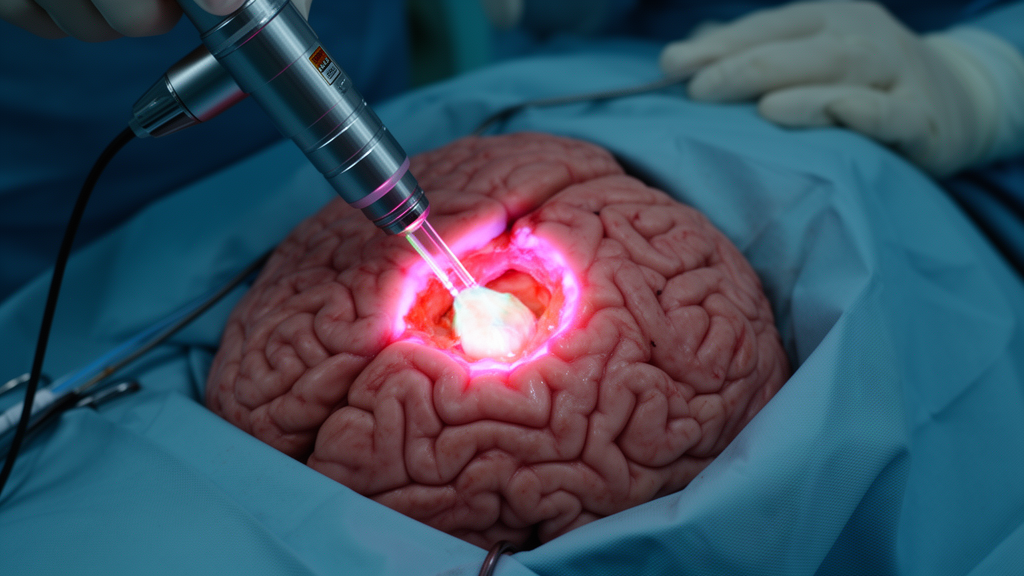
Immediately following tumor removal, the team initiated the intraoperative photodynamic therapy sequence within the newly formed resection cavity. The Heliance inflatable balloon diffuser was positioned directly within the surgical defect and inflated with a lipid emulsion. The emulsion-filled balloon conformed closely to the cavity walls, establishing uniform circumferential light distribution, while a pneumatic articulated arm stabilized the device to prevent shifting and preserve continuous contact with tissue margins throughout the illumination process.
The optical protocol administered a standardized light dose of 200 joules per square centimeter across the balloon surface. Treatment duration and the specific illumination scheme were derived directly from the volume of diffusing fluid required to expand the balloon to the cavity dimensions. To optimize tumor cell destruction, the platform employed a fractionated delivery schedule consisting of repeated laser activation phases interspersed with defined dark intervals, a regimen designed to provide reproducible intracavitary exposure tailored to cavity volume.
The biological rationale for fractionated delivery rests on preclinical investigations demonstrating that interrupted illumination cycles enhance photodynamic cytotoxicity compared with continuous laser exposure. Repeated dark intervals permit transient tissue reoxygenation within the illuminated field, which supports renewed generation of cytotoxic reactive oxygen species upon subsequent laser activation.
This application advances techniques established in earlier trials, notably the INDYGO clinical study and its five-year follow-up evaluations. The initial INDYGO protocol established that delivering a 200 joules per square centimeter intraoperative photodynamic dose via an intracavitary balloon was safe, with four of the initial ten treated patients surviving at five years. While INDYGO utilized an older-generation balloon paired with Gleolan, the current report evaluates a unified drug-device system specifically engineered to minimize variance in light distribution and streamline operational integration.
The patient experienced an uncomplicated operative and perioperative course, with the intracavitary therapy adding only a brief sequence to the standard procedure. The patient was discharged home on postoperative day two, initiated standard adjuvant chemoradiotherapy at week three, and remained neurologically stable with no evidence of radiographic recurrence at her three-month clinical follow-up examination.
The authors emphasized that while these findings demonstrate procedural feasibility and short-term safety without prolonging hospitalization or delaying oncologic therapies, the evidence originates from an isolated technical case report. Definitive conclusions regarding therapeutic efficacy, progression-free survival, and overall survival will require systematic evaluation within larger patient cohorts.
The regulatory status of 5-aminolevulinic acid reflects a clear distinction between approved diagnostic tools and experimental therapeutics. While the Food and Drug Administration has approved 5-aminolevulinic acid for fluorescence-guided surgery in high-grade gliomas, its application as a photosensitizer for intraoperative photodynamic therapy remains under active clinical investigation. The technical case report, published in the Journal of Neuro-Oncology Discovery by Dr. Constantinos G. Hadjipanayis and colleagues, documents the first clinical administration of the Pentalafen-Heliance Solution within an ongoing Phase I/II trial. This platform evaluates an oral formulation alongside a dedicated intracavitary diffuser designed as a unified drug-device system. In evaluating this system in a glioblastoma patient, investigators assessed whether standardized therapeutic illumination could integrate safely into conventional neurosurgical workflows without increasing perioperative morbidity.
The surgical necessity for intracavitary therapeutics arises from the aggressive infiltrative biology of high-grade gliomas. Over the preceding decade, fluorescence guidance using 5-aminolevulinic acid has improved surgical oncology by increasing gross total resection rates and extending progression-free survival compared with white-light visualization. Nonetheless, most glioblastoma recurrences arise locally at or near the resection margin. Residual tumor cells routinely infiltrate brain parenchyma beyond visible contrast-enhancing borders, evading surgical resection and resisting standard adjuvant therapies. Delivering localized cytotoxicity to these infiltrative cells via intraoperative photodynamic therapy provides a direct approach to treat vulnerable cavity margins immediately after maximal safe resection, before post-surgical adjuvant therapies commence.
Operational integration was demonstrated during the patient’s right temporo-occipital craniotomy. Preoperative magnetic resonance imaging showed a heterogeneously enhancing lesion with vasogenic edema and midline shift. The surgical team paired neuronavigation with a voice-controlled robotic-assisted exoscope to carry out fluorescence-guided visualization and complete resection. The patient developed no acute complications or cerebral edema on postoperative imaging, achieved discharge on postoperative day two, and commenced adjuvant chemoradiotherapy at three weeks without treatment delays.
Uniform light distribution across complex surgical cavity geometries represents a primary technical requirement for photodynamic therapy. In this case, surgeons positioned the Heliance balloon diffuser inside the temporo-occipital resection cavity and inflated it with a lipid emulsion. Because surgical defects feature irregular anatomical boundaries, the conformable balloon expands to match cavity contours. To prevent displacement during illumination, the device was anchored using a pneumatic articulated arm.
The optical dosimetry strategy used in the trial standardizes energy delivery while adjusting for patient-specific cavity dimensions. The clinical protocol specified a light dose of 200 joules per square centimeter at the balloon surface. Rather than employing fixed timing, the system derived both the total illumination duration and the delivery scheme directly from the volume of lipid emulsion needed to fill the balloon. This fluid-derived calibration provides a reproducible method for prescribing standardized energy across variable resection cavities. Instead of delivering light continuously, the platform administered energy through a fractionated protocol consisting of repeated laser activation phases separated by fixed dark intervals.
This integrated platform represents a technical progression from earlier protocols, notably the INDYGO clinical trial. In the INDYGO study, investigators established that delivering 200 joules per square centimeter via an intracavitary balloon was safe and feasible, with four of the first ten treated patients surviving at five years. However, the original INDYGO protocol used an older balloon diffuser paired with Gleolan, a product developed primarily for fluorescence visualization. The Pentalafen-Heliance Solution was specifically engineered as a unified drug-device system to reduce optical variability and streamline operative implementation. Because this report describes a single patient within a technical case study, and analyzed no broader datasets, confirming long-term efficacy, recurrence prevention, and survival benefits requires prospective evaluation in larger cohorts.
Subject of Research: Intraoperative photodynamic therapy and fluorescence-guided surgery for glioblastoma using an integrated 5-ALA drug-device platform
Article Title: Fluorescence-guided surgery and intraoperative photodynamic therapy for the treatment of glioblastoma: a technical case report
Article References: Reyes, J. S., Almeida, T., Bouras, A., Boggs, K., Drappatz, J., & Hadjipanayis, C. G. (2026). Fluorescence-guided surgery and intraoperative photodynamic therapy for the treatment of glioblastoma: a technical case report. Journal of Neuro-Oncology Discovery, 1(1), Article 1. https://doi.org/10.1007/s44499-025-00001-4
Image Credits: AI Generated
DOI: 10.1007/s44499-025-00001-4
Keywords: glioblastoma, photodynamic therapy, fluorescence-guided surgery, 5-aminolevulinic acid, Pentalafen, Heliance, balloon diffuser, resection cavity, high-grade glioma, exoscope, neuronavigation, fractionated illumination, chemoradiotherapy, INDYGO trial, reactive oxygen species, temporo-occipital lesion, intracavitary light dosimetry