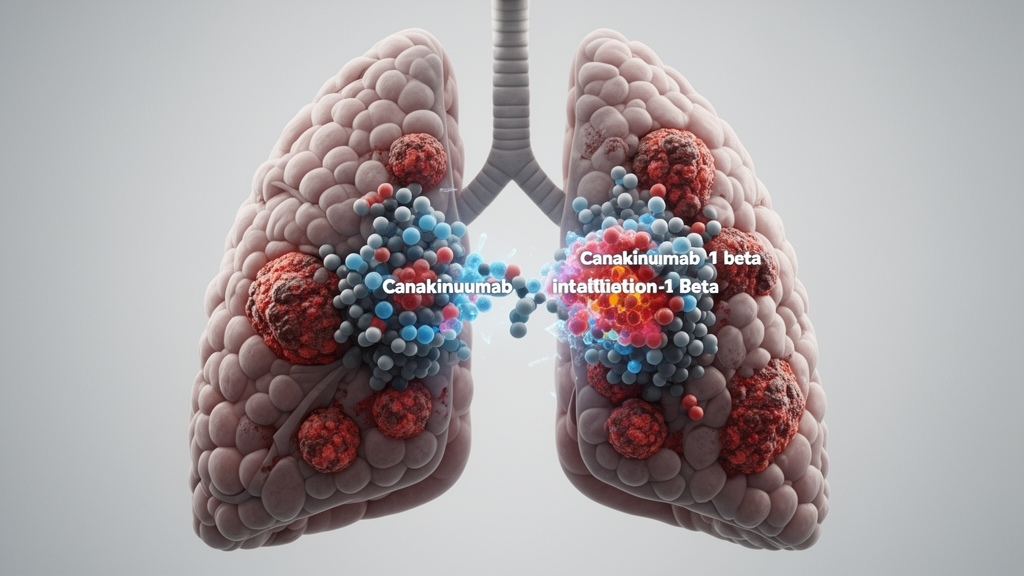
In an open-label, non-randomized phase I/II clinical investigation designated as the CHORUS trial, adding the interleukin-1 beta monoclonal antibody canakinumab to standard concurrent chemoradiotherapy followed by durvalumab consolidation generated a twenty-four-month progression-free survival rate of sixty-seven percent among patients presenting with unresectable stage III non-small cell lung cancer. Investigators measured survival endpoints starting from the date of radiotherapy initiation rather than following subsequent consolidation, demonstrating outcomes that substantially exceeded the prespecified historical benchmark of forty-six percent established by the landmark PACIFIC regimen. Across the prespecified efficacy cohort of thirty-two evaluable individuals, the lower boundary of the prespecified one-sided ninety percent confidence interval reached fifty-six point five percent, confirming that the early-phase clinical trial met its primary survival objective. Furthermore, the verified overall survival rate reached ninety-three percent at twelve months and seventy-three percent at twenty-four months of clinical tracking, with median progression-free survival and median overall survival not reached at a median patient follow-up duration of twenty-five months.
Standard definitive management for individuals diagnosed with locally advanced, unresectable stage III non-small cell lung cancer has long relied on definitive thoracic radiotherapy administered concurrently with platinum-based doublet chemotherapy, followed by consolidative programmed death-ligand 1 checkpoint blockade with durvalumab. Although consolidation immunotherapy introduced meaningful survival improvements over historical chemoradiotherapy alone, long-term disease management remains challenging because a substantial fraction of patients experience tumor relapse or distant metastatic spread within two years of concluding initial therapy, and numerous patients never begin consolidation due to disease progression or severe chemoradiation toxicities. Prior clinical attempts to intensify therapeutic outcomes by administering immune checkpoint inhibitors concurrently with definitive chemoradiation or by introducing dual PD-1 and CTLA-4 blockade during consolidation have failed to demonstrate definitive survival superiority in phase III evaluations. These collective therapeutic hurdles have directed clinical researchers toward evaluating novel mechanistic strategies that intercept upstream counter-regulatory pathways triggered by thoracic irradiation, seeking to prevent therapy-induced immunosuppression rather than relying solely on post-radiation immune stimulation.
Thoracic radiation delivers targeted cytotoxic damage that promotes immunogenic tumor cell death and liberates tumor-associated antigens, yet local tissue disruption simultaneously triggers adverse counter-regulatory inflammatory cascades within irradiated tissues and the surrounding microenvironment. Specifically, ionizing radiation can stimulate intracellular inflammasome assembly, which drives the enzymatic maturation and systemic release of the proinflammatory cytokine interleukin-1 beta. Elevated interleukin-1 beta signaling orchestrates the recruitment and systemic expansion of immunosuppressive myeloid-derived suppressor cells while fostering regulatory T-cell accumulation and impairing cytotoxic CD8-positive T-cell effector functions. Preclinical investigations have revealed that radiation-induced inflammatory cascades mobilize myeloid-derived suppressor populations that inhibit antitumor immunity, directly contributing to treatment resistance and compromised local tumor control. By contrast, selective neutralization of interleukin-1 beta in experimental animal models suppresses the peripheral recruitment of myeloid-derived suppressor cells, restores cytotoxic T-cell functionality, and enhances radiosensitivity, establishing a strong biological rationale for administering canakinumab concurrently with definitive chemoradiotherapy.
Canakinumab functions as a high-affinity, fully human monoclonal antibody designed to bind selectively to and neutralize circulating interleukin-1 beta, preventing its engagement with cell-surface interleukin-1 receptors. Although earlier large-scale evaluations within the global CANOPY clinical development program failed to establish broad survival benefits in unselected advanced or adjuvant lung cancer populations, retrospective and subset analyses from the CANOPY-1 trial demonstrated improved progression-free survival when canakinumab was combined with chemotherapy and pembrolizumab in patients whose tumors exhibited low T-cell inflammation and immunosuppressive baselines. Unlike prior trials that administered the antibody primarily in metastatic or post-surgical settings, the CHORUS study integrated canakinumab directly into concurrent thoracic irradiation to intercept the acute inflammatory response at its onset. The clinical protocol enrolled forty-one patients across multiple Memorial Sloan Kettering Cancer Center facilities, encompassing the primary Manhattan campus alongside regional clinical sites across New Jersey, Long Island, and Westchester, between June 2021 and May 2023.
Among the forty-one enrolled study participants, thirty-seven patients received at least one scheduled dose of canakinumab, constituting the modified intention-to-treat safety cohort, while thirty-two met protocol specifications for the primary efficacy analysis by initiating consolidation therapy. Five patients were excluded from the primary efficacy assessment due to patient consent withdrawal, receipt of consolidative tyrosine kinase inhibitor therapy, early treatment-related toxicity, non-study-related mortality, and surgical resection. Baseline clinical characteristics within the thirty-two efficacy patients showed a median age of seventy years, ranging from forty-six to eighty-three years, with eighteen female and fourteen male participants. Sixty-nine percent of patients presented with locally advanced stage IIIB or IIIC disease, fifty-nine percent exhibited lung adenocarcinoma histology, sixty-six percent maintained an Eastern Cooperative Oncology Group performance status of zero, and eighty-eight percent reported a documented cigarette smoking history. Among twenty-nine patients with evaluable programmed death-ligand 1 tumor proportion scores, fourteen were negative, seven had scores between one and forty-nine percent, and eight demonstrated scores of fifty percent or higher.
The study protocol mandated definitive external beam radiation delivered via intensity-modulated radiation therapy or volumetric-modulated arc therapy to a planned cumulative dose of sixty Gray in conventional daily two Gray fractions, which thirty-one patients received while one received fifty-six Gray. Concurrent chemotherapy regimens included carboplatin combined with paclitaxel in sixteen patients, carboplatin combined with pemetrexed in ten patients, cisplatin with pemetrexed in three patients, and cisplatin with etoposide in three patients. During chemoradiation, canakinumab was administered subcutaneously at a fixed dose of two hundred milligrams every three weeks for up to three cycles starting with the first radiation fraction, with twenty-nine patients completing at least two subcutaneous doses and eighteen receiving all three. Following restaging imaging, non-progressing patients initiated intravenous durvalumab administered per standard schedules alongside intravenous canakinumab at two hundred milligrams every four weeks for up to twelve additional cycles, with patients completing a median of seven consolidation cycles and thirty-eight percent receiving ten or more cycles.
Initial tumor assessments performed per RECIST version 1.1 criteria immediately following the completion of chemoradiotherapy and canakinumab, but prior to initiating durvalumab consolidation, demonstrated an objective response rate of seventy-four percent with a ninety-five percent confidence interval spanning fifty-five to eighty-eight percent. Notably, forty-eight percent of evaluable patients achieved at least a fifty percent reduction in target lesion measurements at this very first post-radiation imaging timepoint. The confirmed overall objective response rate across the entire study timeline reached eighty-one percent, with a ninety-five percent confidence interval ranging from sixty-four to ninety-three percent. In secondary survival analyses, the twelve-month progression-free survival rate reached seventy-five percent, while the twenty-four-month cumulative incidence of locoregional failure was fourteen percent. A post hoc sensitivity evaluation encompassing the entire modified intention-to-treat cohort of thirty-seven patients yielded a two-year progression-free survival rate of sixty-six percent and a two-year overall survival rate of seventy-one percent, underscoring consistency across analytical definitions.
Serial evaluation of circulating tumor DNA using the high-depth Memorial Sloan Kettering-ACCESS next-generation sequencing platform revealed rapid molecular disease clearance that closely paralleled the observed radiographic responses. While all thirty-two patients in the efficacy cohort demonstrated detectable circulating tumor DNA mutations at baseline prior to receiving therapy, rapid clearance occurred following initiation of canakinumab and chemoradiotherapy. At the first on-treatment blood draw collected at a median of three weeks, thirty-three percent of thirty evaluable patients had achieved undetectable circulating tumor DNA levels. By the second on-treatment assessment at a median of six point two weeks, twenty out of thirty evaluable patients, representing sixty-six percent, had cleared detectable tumor DNA. Furthermore, at the third sampling timepoint, taken at a median of fifteen point two weeks from treatment start, sixty-nine percent of twenty-nine evaluable patients retained undetectable circulating tumor DNA, and one-third of the remaining positive patients displayed declining variant allele frequencies.
Multiparameter peripheral blood immune monitoring highlighted distinct cellular trajectories that separated clinical responders achieving complete or partial radiographic remissions from non-responding patients with stable disease. Patients experiencing confirmed objective responses exhibited attenuated expansion of circulating monocytic myeloid-derived suppressor cells across treatment, whereas patients with stable disease demonstrated marked early enrichment of myeloid suppressors by week three with a false discovery rate q-value of zero point zero four. Similarly, flow cytometry identified that cytotoxic CD8-positive T-cell subsets expressing the inhibitory immune checkpoint receptor CTLA-4, as well as proliferating Ki67-positive CTLA-4-positive CD8-positive T cells, expanded prominently in non-responders while remaining suppressed in responding patients. Parallel profiling of an independent prospective cohort comprising nine patients treated with standard chemoradiotherapy without canakinumab demonstrated a sharp rise in circulating interleukin-1 beta at week six, an early increase in interleukin-6 at week three, and significant accumulation of myeloid-derived suppressor cells, reinforcing the immunomodulatory action of canakinumab.
Safety analyses conducted across the thirty-seven patients who received at least one canakinumab administration demonstrated that the combination regimen was manageable and showed no canakinumab-related deaths. Grade 3 to 4 adverse events attributed to canakinumab occurred predominantly during the chemoradiotherapy phase, consisting of grade 3 neutropenia in four patients, grade 4 neutropenia in one patient, grade 3 febrile neutropenia in one patient, and grade 3 lymphopenia in one patient. During consolidative durvalumab therapy, documented grade 3 canakinumab-related toxicities included single occurrences of pulmonary infection, fatigue, and hypertension, none of which led to the permanent discontinuation of consolidative durvalumab. All-cause pneumonitis of any attribution developed in nine of thirty-seven patients, representing an overall incidence of twenty-four percent, with seven patients experiencing grade 2 events and two experiencing grade 3 events. Univariable Cox proportional hazards regression indicated that baseline PD-L1 expression, patient age, ECOG performance status, and histologic subtype were not significantly associated with progression-free survival, whereas stage IIIB or IIIC disease predicted inferior survival compared to stage IIIA.
Interpretation of the CHORUS trial findings remains constrained by several methodological limitations inherent to its single-arm, non-randomized phase I/II investigation, including a modest sample size of thirty-two evaluable patients treated exclusively within a single specialized tertiary academic cancer center network. Because canakinumab was administered both during concurrent chemoradiation and during durvalumab consolidation, the trial cannot isolate the independent therapeutic contribution of interleukin-1 beta inhibition within each individual treatment phase. Additionally, the study was conducted during the global coronavirus disease 2019 pandemic, which resulted in treatment interruptions, protocol discontinuations, and one documented infection-related death during consolidation. Comparative immunologic analyses were similarly constrained by the modest size of the parallel standard-of-care correlative cohort, and peripheral blood immune profiling may not fully capture local tumor-microenvironmental dynamics. Nevertheless, the convergence of favorable survival metrics, rapid tumor shrinkage, early molecular circulating DNA clearance, and restrained myeloid suppression provides strong biological proof-of-concept supporting randomized phase III confirmation of concurrent interleukin-1 beta blockade in unresectable stage III lung cancer.
Subject of Research: Evaluation of canakinumab combined with chemoradiotherapy and consolidation durvalumab for unresectable stage III non-small cell lung cancer in the phase I/II CHORUS trial
Article Title: Canakinumab with chemoradiation and durvalumab consolidation in unresectable stage III non-small cell lung cancer: the phase I/II CHORUS trial
Article References: Shaverdian, N., Offin, M., Toumbacaris, N., Lee, J., Charalambous, K., Gelblum, D. Y., Santini, F. C., Shepherd, A. F., Gewanter, R., Mueller, B., Shin, J. Y., Wu, A. J., Simone, C. B., II, Rimner, A., Lee, N. Y., Ginsberg, M. S., Yu, H., Daly, B., Kris, M. G., … Chaft, J. E. (2026). Canakinumab with chemoradiation and durvalumab consolidation in unresectable stage III non-small cell lung cancer: the phase I/II CHORUS trial. Nature Communications, 17(1), Article 10586. https://doi.org/10.1038/s41467-026-77415-1
Image Credits: AI Generated
DOI: 10.1038/s41467-026-77415-1
Keywords: canakinumab, durvalumab, chemoradiotherapy, non-small cell lung cancer, CHORUS trial, interleukin-1 beta, progression-free survival, overall survival, circulating tumor DNA, myeloid-derived suppressor cells, thoracic radiation, pneumonitis, immune checkpoint blockade, consolidation therapy, phase I/II clinical trial, Memorial Sloan Kettering, CTLA-4, tumor proportion score