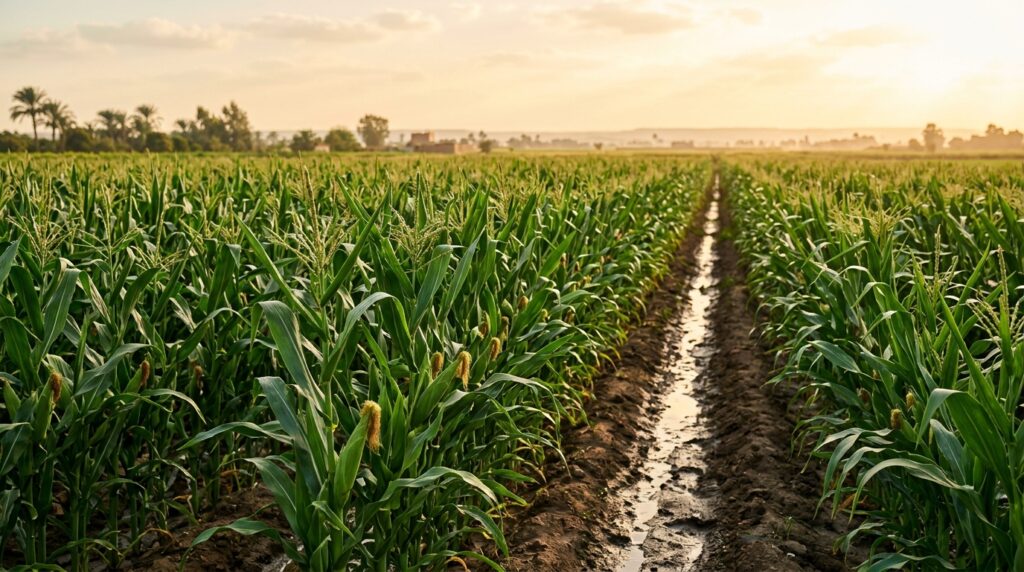
A two-year field investigation conducted in Egypt has demonstrated that integrating adequate crop irrigation with rigorous weed control substantially boosts maize grain yields while curtailing weed density and weed biomass. Field evaluations across contrasting water regimes revealed that maize growth, ear development, final grain yield, and grain nutrient contents of nitrogen, phosphorus, and potassium all improved significantly under higher irrigation levels. Simultaneously, higher moisture availability promoted weed proliferation, underscoring the necessity of coupling irrigation planning with effective weed management.
Agricultural production faces significant constraints from climate change, particularly through the growing frequency and severity of water deficits that threaten sustainable crop output worldwide. In maize, scientifically classified as Zea mays L. and cultivated as one of the most vital cereal crops globally, the detrimental consequences of water deficit are further magnified by aggressive weed competition, causing substantial harvest losses. Despite the recognized importance of both water availability and weed competition, their interactive dynamics across contrasting irrigation regimes have historically remained insufficiently characterized.
To address this research gap, agronomists established two comprehensive field experiments across the consecutive 2022 and 2023 growing seasons. The field trials were located at the Experimental Farm of the National Research Centre situated within the El-Nubaria district in Egypt. The experimental setup utilized a split-plot design structured with three replications to evaluate how graded water supplies interact with diverse weed suppression strategies in shaping crop performance, weed proliferation, and grain nutrient content.
The experimental treatments evaluated three distinct irrigation regimes assigned to main plots alongside five weed management approaches applied within subplots. Main plot irrigation levels corresponded to severe deficit irrigation at 60 percent crop evapotranspiration, moderate deficit irrigation at 80 percent crop evapotranspiration, and full irrigation at 100 percent crop evapotranspiration. Subplot weed control treatments encompassed applications of rice straw mulch, wheat straw mulch, the post-emergence chemical herbicide nicosulfuron applied at one liter per hectare containing sixty grams of active ingredient, manual hand hoeing, and an untreated weedy control.
Trial results revealed that water supply strongly influenced both crop development and weed competition. While increasing irrigation volumes markedly enhanced maize plant growth, ear development metrics, yield components, final grain yield, and grain nitrogen, phosphorus, and potassium accumulation, the elevated moisture simultaneously stimulated weed development. In contrast, under severe water deficit conditions set at 60 percent crop evapotranspiration, weed development was significantly suppressed alongside pronounced reductions in crop yield components and grain nutrient accumulation.
Water stress inflicted notable penalties on harvest productivity, as maize grain yields under severe deficit irrigation dropped markedly by approximately 17 to 21 percent in comparison to plots receiving full irrigation. The researchers recorded a pronounced interaction between irrigation regimes and weed management methods throughout both experimental seasons. Across all irrigation levels, effective weed intervention significantly improved overall crop performance, confirming that weed control remains critical even when water availability is restricted.
Both chemical herbicide application and organic mulching delivered exceptional weed suppression across the experimental plots. Nicosulfuron and straw mulching treatments reduced total weed biomass and weed density by approximately 85 to 95 percent relative to the untreated weedy control plots. Although the overall magnitude of crop responses varied across the different irrigation regimes, the relative performance ranking of the weed management treatments remained generally consistent across the evaluated watering levels.
The highest overall maize grain yields, reaching up to 6.62 tonnes per hectare in 2022 and 6.48 tonnes per hectare in 2023, were attained under full irrigation paired with effective weed suppression. Specifically, nicosulfuron herbicide applications and mulch-based methods yielded the highest or statistically comparable grain outputs among the evaluated weed management options. These documented yield peaks highlight that maximizing maize harvest potential requires mitigating both water stress and weed competition concurrently.
The research findings emphasize the vital importance of jointly managing water availability and weed growth when evaluating maize productivity and grain nutrient profiles under variable moisture regimes. Within this operational context, straw mulch-based techniques represent a promising and environmentally friendly alternative that can sustain maize performance while reducing dependence on synthetic chemical herbicides and minimizing broader environmental impacts in irrigated agricultural systems.
Subject of Research: Interactive effects of deficit irrigation regimes and weed management practices on maize productivity
Article Title: Interactive effects of deficit irrigation and weed management on weed growth, maize productivity and grain quality
Article References: El-Shahawy, T. A. E.-G., El-Metwally, I. M., & El Habbasha, E. S. F. (2026). Interactive effects of deficit irrigation and weed management on weed growth, maize productivity and grain quality. BMC Plant Biology, 26(1), Article 2017. https://doi.org/10.1186/s12870-026-10165-w
Image Credits: AI Generated
DOI: 10.1186/s12870-026-10165-w
Keywords: Zea mays, maize productivity, deficit irrigation, crop evapotranspiration, weed management, nicosulfuron, rice straw mulch, wheat straw mulch, hand hoeing, weed biomass, weed density, grain yield, grain nitrogen, grain phosphorus, grain potassium, El-Nubaria district, National Research Centre