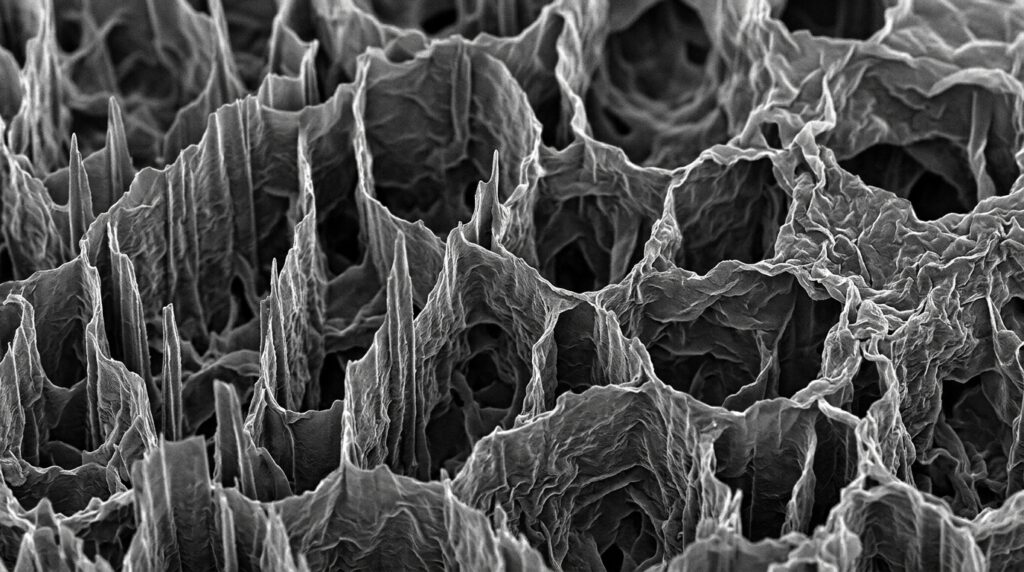
Wearable gas sensors are essential for real-time monitoring of personal environmental exposure, yet achieving high chemical sensitivity at room temperature while preserving mechanical compliance remains a fundamental engineering challenge. Addressing these limitations, researchers have developed a hierarchical three-dimensional graphene nanowall nanomesh that significantly improves room-temperature detection of toxic nitrogen dioxide gas. Rather than relying on conventional planar supports or chemical functionalization, the team directly integrated vertically oriented graphene nanowalls onto a flexible, breathable polymer nanofiber scaffold. This three-dimensional hierarchical architecture produced a nearly sixfold enhancement in gas sensitivity compared to conventional planar graphene nanowalls operating under identical room-temperature conditions. Experimental evaluations confirmed that the porous mesh architecture provides an open, deformable framework that maintains rapid, reversible chemiresistive response kinetics without needing external heating. By combining macroscopic structural flexibility with nanoscale confinement pathways, the findings establish an effective strategy for deploying sensitive gas sensors directly on soft wearable platforms.
The hierarchical sensing architecture relies on electrospinning and specialized polymer processing to produce a thermally stable, mechanically compliant scaffold. Fabrication began by synthesizing polyamic acid through the polymerization of pyromellitic dianhydride and 4,4′-oxydianiline in dimethylformamide at room temperature. Electrospinning this precursor solution at twenty kilovolts with a flow rate of three milliliters per hour yielded a fibrous mesh, which was converted to polyimide via vacuum imidization at 270 degrees Celsius under 0.1 millibar. However, pristine polyimide nanomeshes collapsed under high-energy plasma processing. To overcome this thermal and structural vulnerability, the researchers deposited a conformal 500-nanometer-thick parylene C protective coating across the polyimide nanofibers using chemical vapor deposition. Furthermore, to facilitate graphene nucleation across the electrically insulating polymer fibers, a thin silicon dioxide interlayer was sputtered onto the parylene-coated polyimide scaffold using radio-frequency sputtering under argon and oxygen gas flows.
Direct synthesis of vertically oriented graphene nanowalls onto the coated nanofiber scaffold was achieved via low-temperature plasma-enhanced chemical vapor deposition. The researchers systematically investigated growth parameters at a substrate temperature of 400 degrees Celsius and a chamber pressure of 0.5 Torr, utilizing an argon and methane gas mixture. Growth durations were varied between 6 and 14 minutes while microwave power was adjusted from 800 to 1400 watts. Deposition times of 14 minutes or longer led to excessive plasma etching and structural degradation of the nanofiber mesh, whereas durations below 6 minutes formed discontinuous networks. Microwave power exceeding 1400 watts caused scaffold collapse from energetic ion bombardment. Raman spectroscopy monitoring defect-induced D bands at 1350 inverse centimeters and graphitic G bands at 1580 inverse centimeters revealed that operating at 1200 watts for 10 minutes optimized graphitic ordering and yielded mechanically stable, conductive nanowalls.
Microscopic examinations verified the conformal growth and multiscale structure of the three-dimensional graphene nanomesh. Field-emission scanning electron microscopy confirmed that vertically oriented graphene nanowalls grew uniformly around individual nanofibers, establishing an interconnected, porous three-dimensional network. Field-emission transmission electron microscopy of the nanowalls revealed graphitic fringes with an interlayer spacing of approximately 3.45 angstroms, slightly wider than pristine graphite and consistent with edge-rich vertical graphene structures. Raman analysis demonstrated that the graphene nanowall nanomesh exhibited an intensity ratio of the D band to the G band of 0.78, noticeably lower than the 1.17 observed for planar graphene nanowalls. This reduction indicates improved graphitic ordering on the nanomesh, which the authors attributed to the three-dimensional fibrous geometry. The curved fibers redistribute local plasma exposure and carbon flux during deposition, suppressing excessive structural disorder across the macroscopic network.
Chemical surface analysis and electrical characterization demonstrated that the hierarchical nanomesh preserves essential graphitic bonding while maintaining conductive pathways. X-ray photoelectron spectroscopy survey spectra confirmed dominant carbon and oxygen peaks, while high-resolution carbon 1s spectra showed that both planar and nanomesh architectures were dominated by sp2-hybridized carbon. Both materials also exhibited a smaller sp3-hybridized carbon component corresponding to exposed edge and defect sites. Notably, the graphene nanowall nanomesh showed a higher sp2-to-sp3 ratio than planar nanowalls, indicating preserved in-plane crystalline bonding without excessive tetrahedral disruption. Four-point probe measurements tracking sheet resistance across deposition times revealed an initial resistance decline as continuous graphene pathways formed along the nanofibers, followed by resistance increases during prolonged growth due to plasma etching. These electrical measurements confirmed that intermediate deposition durations achieve the optimal balance between network densification and graphitic integrity.
Mechanical evaluations conducted in accordance with the ASTM D882 standard highlighted significant mechanical differences between planar graphene films and the hierarchical nanomesh. Rectangular specimens measuring two centimeters wide with a five-centimeter gauge length were stretched at ten millimeters per minute. Because the porous nanomesh lacks a continuous cross-sectional area, structural compliance was evaluated via device-level force-strain curves rather than conventional stress-strain analysis. Planar graphene nanowalls grown on flat polyimide substrates showed a relatively stiff mechanical response. In contrast, the graphene nanowall nanomesh required substantially lower force to achieve comparable strain levels. Under applied tensile deformation, the porous fibrous scaffold accommodates mechanical stress through nanofiber rearrangement, inter-fiber sliding, and distributed network deformation rather than concentrating localized fracture strain. This structural compliance prevents mechanical delamination or conductive path failure on curved, flexible substrates, rendering the nanomesh highly suitable for wearable applications.
To evaluate gas-sensing performance, devices with overall dimensions of two centimeters by two centimeters and an active sensing area of two millimeters by two millimeters were fabricated with 100-nanometer-thick silver electrodes. Room-temperature chemiresistive testing was performed in an environmental chamber at 20 to 21 degrees Celsius and 30 to 33 percent relative humidity, with nitrogen dioxide concentrations ranging from 10 to 50 parts per million in dry air. Both planar and nanomesh sensors exhibited clear, reversible resistance modulation upon gas exposure. However, the hierarchical nanomesh demonstrated substantially greater response amplitudes across all concentrations. Linear fitting revealed sensitivities of negative 0.044 percent per part per million for planar graphene nanowalls and negative 0.261 percent per part per million for the nanomesh sensor. This nearly sixfold sensitivity increase was accompanied by response kinetics more than twice as fast as planar devices, while preserving comparable recovery rates.
Device reliability, selectivity, and detection limits were thoroughly analyzed to confirm operational robustness. Over ten consecutive exposure cycles at ten parts per million of nitrogen dioxide, the graphene nanowall nanomesh exhibited reproducible response amplitudes and baseline stability. Selectivity testing against common interfering gases—toluene, acetone, carbon dioxide, hydrogen sulfide, and ammonia at ten parts per million—showed minimal response compared to nitrogen dioxide. This selectivity originates from strong electron-withdrawing charge transfer between nitrogen dioxide and graphene edge sites rather than molecular sieving. The sensor limit of detection was calculated at 2.4 parts per million using baseline noise and sensitivity metrics. Environmental testing demonstrated that sensor response increased almost linearly as temperature rose from 20 to 60 degrees Celsius and relative humidity expanded from 30 to 90 percent, indicating that environmental shifts can be corrected using integrated calibration algorithms.
To explain why the hierarchical architecture outperformed planar graphene, the authors performed particle-based Monte Carlo simulations of gas transport within the nanostructure. A three-dimensional simulation domain measuring two micrometers on each side was reconstructed from cross-sectional electron microscopy, incorporating vertical nanowalls with an extrusion height of 1.7 micrometers. Simulated nitrogen dioxide molecules at concentrations from 10 to 50 parts per million diffused across planar graphene and within the nanowall cavities. On planar surfaces, molecules underwent isolated surface collisions and desorbed, creating uniform molecular flux. Within the nanowall network, adjacent walls redirected gas trajectories, causing localized particle accumulation and repeated collisions within nanoscale wall-to-wall gaps. A conventional area-weighted model failed to capture the measured non-linear sensor reactivity, confirming that simple geometric surface enlargement cannot explain the observed sensitivity enhancement.
The transport behavior within the graphene nanowalls was further quantified through ergodic theoretical analysis. On planar graphene, the calculated ergodicity-breaking parameter remained near zero, indicating ergodic transport where molecules sample the available sensing area in a spatially uniform manner. Conversely, the graphene nanowalls exhibited persistently elevated ergodicity-breaking values, demonstrating strongly non-ergodic transport. Trajectory analysis showed that narrow wall-to-wall geometries trap gas molecules locally, prolonging their residence time and multiplying collision events at reactive edge sites. Spatial flux maps revealed heterogeneous, localized high-flux domains within specific wall motifs, intensifying at higher concentrations. A scaling model connecting simulated collision statistics to experimental initial reaction rates successfully reproduced the non-linear reactivity of the graphene nanowall sensor without additional fitting parameters, confirming that architecture-induced molecular trapping is the physical origin of the enhanced sensing response.
The practical utility of the hierarchical sensor was validated by integrating the device onto a commercial KF94 protective mask mounted on an experimental manikin. The smart mask was evaluated in ambient air at room temperature and 30 to 33 percent relative humidity over twelve continuous hours. Controlled 100-part-per-million nitrogen dioxide injections at three hours and six hours produced rapid, reproducible resistance changes, yielding an average response of 89.71 plus or minus 1.46 percent. Subsequent random gas pulses demonstrated that the device reliably resolved irregular exposure events while maintaining a stable baseline throughout the twelve-hour test. While current sensitivity and detection limits remain below specialized ionic hydrogels or functionalized metal oxides, the researchers noted that combining intrinsic material transport with hierarchical 3D-on-3D architectural engineering offers a robust design framework for wearable personal exposure monitoring.
Subject of Research: Hierarchical graphene nanowall nanomesh for room-temperature wearable gas sensing
Article Title: Hierarchical Graphene Nanowall Nanomesh Enables Confinement-Enhanced Gas Sensing for Wearable Applications
Article References: Choi, H., Kim, C., Kwon, S., Lee, S., Noh, J., Bae, J., Shin, J., Ahn, J.-H., Min, Y., Roh, J. W., Lee, J., Kang, H., & Lee, S. (2026). Hierarchical Graphene Nanowall Nanomesh Enables Confinement-Enhanced Gas Sensing for Wearable Applications. Advanced Fiber Materials. https://doi.org/10.1007/s42765-026-00752-9
Image Credits: AI Generated
DOI: 10.1007/s42765-026-00752-9
Keywords: graphene nanowalls, gas sensors, wearable electronics, nitrogen dioxide sensing, polymer nanomesh, polyimide nanofibers, plasma-enhanced chemical vapor deposition, parylene C coating, electrospinning, confinement transport, non-ergodic transport, chemiresistive sensors, smart masks, Monte Carlo simulation, room-temperature sensing, Raman spectroscopy, X-ray photoelectron spectroscopy